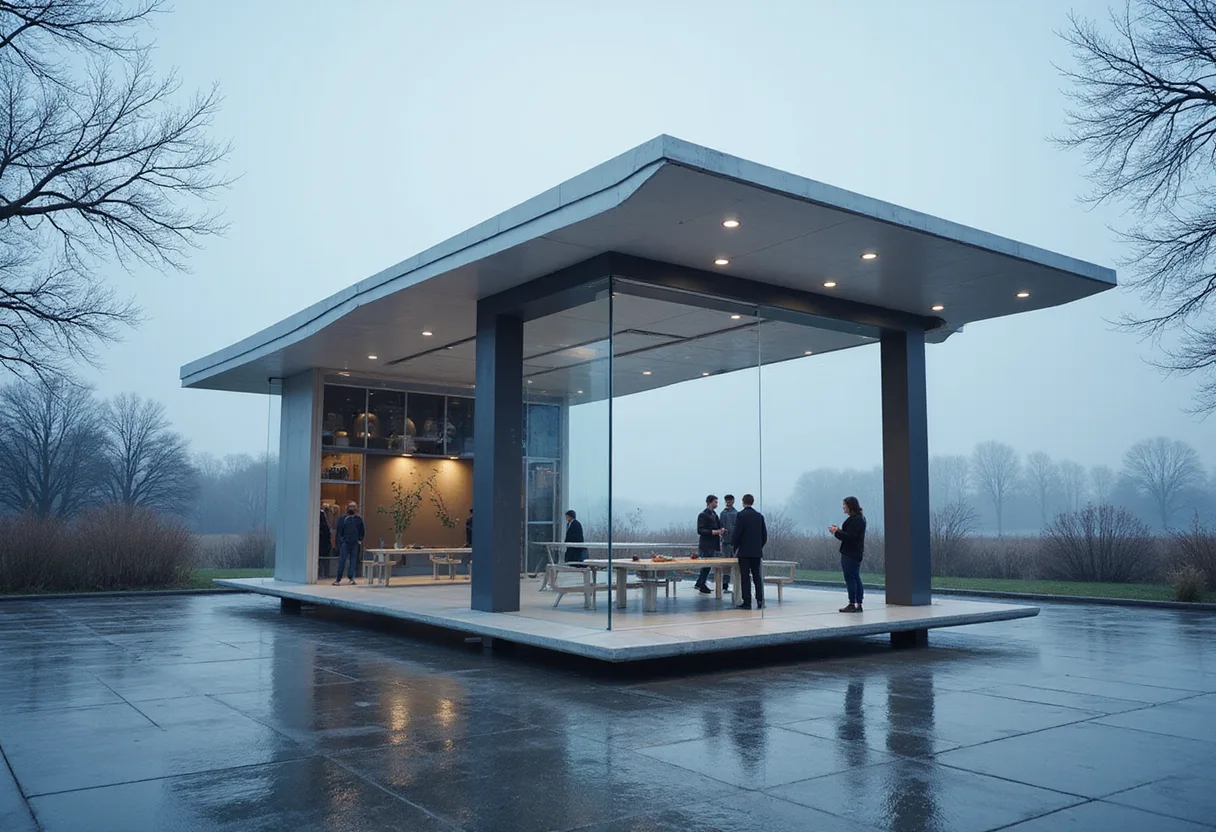
Mycelium Pavilion Hypha-Lume Turns Visitor Movement Into Light
Hypha-Lume, designed by a five-person team, uses curved mycelium modules and sensors to turn visitor movement into real-time light patterns projected back onto the pavilion's shell.
- Section
- Architecture
- Author
- By Elena Vasquez
- Filed
- Length
- 2 min read
Key takeaways
- Hypha-Lume is a modular pavilion built from three mycelium block types with curvatures of 20, 40 and 60 degrees.
- Sensors track visitor paths, pauses and gatherings, converting movement into real-time light patterns and audio.
- At night, projection displays layered traces of previous interactions on the building envelope.
- The design team comprises Darya Holub, Selin Ozasik, Pinak Bhapkar, Nikhil Narendiran and Baskar Bharathwaj Subramanian.
- The modules connect around vertical supports, allowing reassembly into varied site-specific configurations.
A pavilion built from mushroom mycelium records what its visitors do and replays it as light. The project, called Hypha-Lume, uses reconfigurable mycelium modules, sensors, projection and sound to translate human movement into spatial data — a building that doubles as an interactive record of the people inside it.
The team behind it lists five designers: Darya Holub, Selin Ozasik, Pinak Bhapkar, Nikhil Narendiran and Baskar Bharathwaj Subramanian. They conceived the pavilion as a responsive system rather than a fixed structure, and the geometry reflects that.
How the mycelium modules fit together?
Hypha-Lume is an adaptive, modular pavilion assembled from three block types, each with a different curvature: 20, 40 and 60 degrees. The tapered biomaterial modules connect around vertical supports, which keeps the shell stable while leaving it free to be reassembled into varied configurations depending on the site.
Varying module heights and openings let the pavilion respond to different paths and viewpoints. By day, the lightweight mycelium modules form an open enclosure that, as the designers describe it, balances shelter, visibility and circulation.
That flexibility is the structural point. A kit of three curvature types is enough to produce distinctly different shells, which means the same components can serve different sites without new fabrication.
What happens when people walk through?
The pavilion functions as what its creators call an interactive archive of site activity. Integrated sensors track three things:
- the paths visitors take
- where they pause
- where they gather
That data converts into real-time light patterns and audio. As visitors gather, changing colors register their presence across the modular surface, and colored light travels along the connections between modules, making the system legible at a human scale.
The two modes split cleanly between day and night. During the day, the structure reads as organic geometry with a modular rhythm. At night, illumination projects layered visual traces of previous interactions directly onto the building envelope.
Under lighting, the open shell also exposes the textured surface of the mycelium itself — the material becomes part of the display, not just the substrate.
Why an archive of light?
The traces accumulate. Layered records of interaction build up as a shifting field of color, and in the designers' framing this transforms the pavilion into "a living archive of collective activity." Warm nighttime illumination traces the curved geometry and turns the structure into an intimate space.
The mechanism is simple when you take it apart: sensors capture movement, software maps it, projection returns it to the envelope. The material choice does the rest. Mycelium is grown, not manufactured, and its textured surface catches projected light in ways a smooth industrial panel wouldn't.
The project arrived via designboom's DIY submissions feature, which invites readers to submit their own work for publication. For the five designers, the concept points at a broader question: whether temporary pavilions can do more than shelter an event — whether they can remember one.
Original: google.com
More from Elena Vasquez
Show full bio
Senior reporter covering money, funding and market shifts around construction industry, architecture, interior design at Built Current.
136 articles