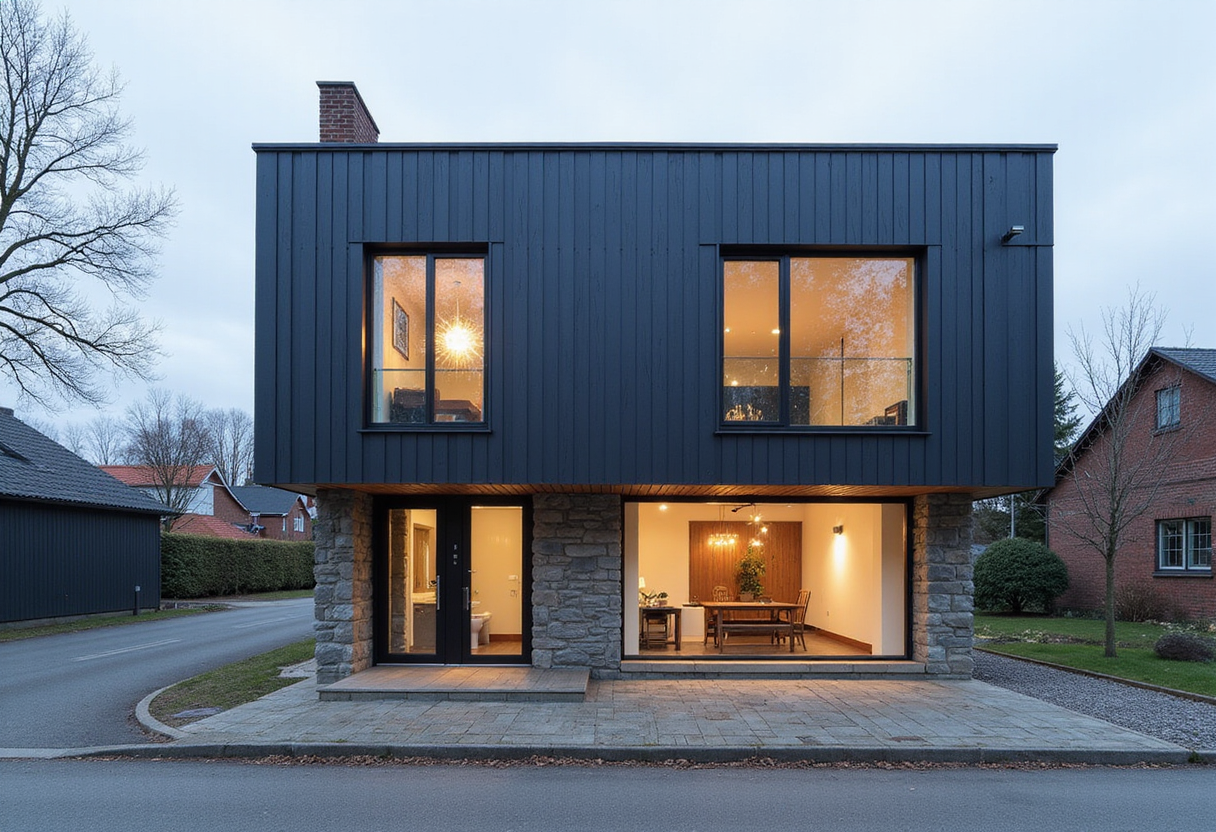
ER Atelier Unifies a Senec Peninsula With Two Cabin Composition
ER Atelier's two cabins at Sunny Lakes, Senec — 196 m², completed 2025 — treat the whole peninsula tip as one composition, seeking a unified architectural language.
- Section
- Architecture
- Author
- By Marcus Bennett
- Filed
- Length
- 2 min read
Key takeaways
- Two recreational buildings totalling 196 m² completed in 2025 at Sunny Lakes, Senec
- Lead architects: Ema Ruhigová and Roman Ruhig of ER Atelier
- The site is a waterfront peninsula with unregulated buildings from mixed periods and styles
- Kingspan, ISOVER Saint Gobain, HELUZ, Aluprof and Ceresit number among the manufacturers
- Photographs by Matúš Nedecký
Two recreational cabins totalling 196 square metres now redefine the tip of the Sunny Lakes peninsula in Senec, Slovakia, completed in 2025 by ER Atelier.
Lead architects Ema Ruhigová and Roman Ruhig approached the commission not as a pair of standalone buildings but as a single architectural and landscape composition. The site gave them a clear problem. The waterfront peninsula holds an unregulated mixture of recreational buildings from different periods and architectural styles — a fabric with no common rule and no shared language.
The firm's answer, described in text supplied by the architects, is explicit: "Rather than introducing another isolated expression, the proposal seeks to redefine the entire tip through a unified architectural language."
That sentence carries the project's argument. One more expressive object on a chaotic peninsula would add noise. A unified language, applied across both structures, gives the tip an identity that no single cabin could establish alone.
What does the approach change for practitioners?
The project models a strategy for a common condition in Central European lake districts: fragmented recreational settlements where each owner builds in the idiom of their own decade. ER Atelier treats the brief — two separate buildings — as an opportunity to work at the scale of the terrain rather than the parcel.
The architects state the second half of their ambition with equal weight. The composition aims at "preserving the memory of the site and strengthening its relationship with the lake and the public realm." Two moves, one sentence. Memory without imitation. Connection to water and to the public edge, not retreat from them.
For designers working on similar waterfront sites, the takeaway is procedural. The design question shifts from "what form should this building take?" to "what language could bind several buildings and a landscape into one composition?" The Senec project demonstrates that a 196-square-metre commission can carry a peninsula-scale argument.
Who built it, and with what?
The manufacturer list reads as a map of contemporary Central European building supply. Ceresit supplied finishes. Kingspan delivered insulated panels. ISOVER Saint Gobain and HELUZ appear in the envelope and masonry chain. Aluprof contributed aluminium systems. Fatrafol and Zaluman handled membranes and cladding products.
The list also documents the design and communication stack: Graphisoft Archicad for documentation, Twinmotion for visualisation, and Loxone for building automation. Smaller names — Flabra, Nesia, Lilla, Sklofix, Dispoline, Audom, Colab, Bigmilanstav, AVG Group — round out a supply chain that keeps the project regional.
Matúš Nedecký photographed the completed buildings.
Why the date matters
A 2025 completion places the project in the current wave of Slovak recreational architecture that treats lakefront sites as public-facing territory rather than privatised retreat. The architects' stated aim — strengthening the relationship with the public realm — positions these cabins as an argument other lakefront clients in Senec and beyond will have to answer, whether by matching the unified language or by explaining why they chose another isolated expression.
Source: ArchDaily
More from Marcus Bennett
Show full bio
Correspondent covering money, funding and market shifts around construction industry, architecture, interior design at Built Current.
116 articles