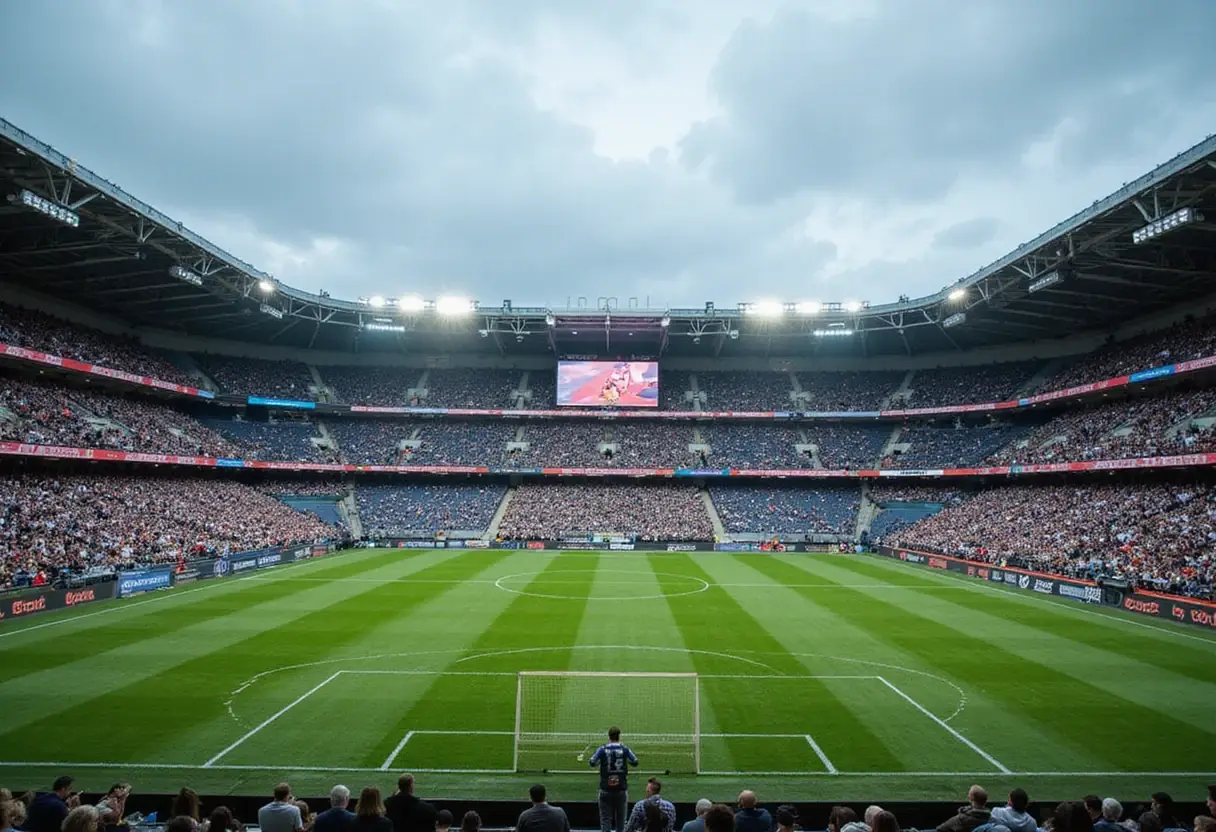
Another $10 Billion Bears Stadium Plan Lands on Chicago's Table
A retiring congressman backs a $10 billion Bears stadium in Bronzeville with no financing plan, as Medford resists $70 million and Houston polls against arena funding.
- Section
- Urbanism & Planning
- Author
- By Grace Kim
- Filed
- Length
- 4 min read
Key takeaways
- A $10 billion Bears stadium and entertainment district is proposed for the former Michael Reese Hospital site in Bronzeville.
- The plan could demolish up to 1,000 apartments at Prairie Shores; developers promise replacement units.
- Medford, Oregon's council is resisting $70 million in public money for an $80 million Eugene Emeralds ballpark.
- Missouri's supreme court rejected a challenge to the state's stadium subsidy law on standing grounds.
- Houston polls show enthusiasm for an NHL team but overwhelming opposition to public arena funding.
A retiring U.S. congressman wants Chicago to build a $10 billion stadium and entertainment district on the former Michael Reese Hospital site — and he hasn't said where the money would come from.
Representative Danny Davis, who leaves Congress in January after 30 years, made the case in an op-ed for Crain's Chicago Business. His target is a 100-acre proposal from a team of developers who want to bring the Chicago Bears to the Bronzeville neighborhood on the city's South Side lakefront. It's the latest in a string of competing plans for the team's future home, alongside the Arlington Heights proposal that Governor J.B. Pritzker has suggested could cost $1.5 billion in tax money.
Davis, according to Fox32, "did not identify a specific financing plan, say how much public money he would support or explain where additional funding would come from." That leaves a lot of blanks in a plan whose developers have sketched only the broadest funding outline.
What do we know about the Bronzeville plan?
The developers have committed to three things, and only vaguely:
- The stadium would be publicly owned, which would exempt it from property taxes.
- It would possibly use Illinois Sports Facilities Authority bonds.
- It would require public infrastructure funding.
Add those up and you're likely talking billions in tax dollars. That's the same scale as the Arlington Heights deal Pritzker has floated — a deal he says he hopes to complete "but not at taxpayer expense, somehow."
There's also a housing cost. The plan would require demolishing as many as 1,000 apartments at the existing Prairie Shores complex. The developers say they'll build replacement units. Whether that happens is another question: a report from Impact for Equity found the Chicago Housing Authority is still decades away from replacing previously demolished housing units unless the city and state take action.
Davis defended the public spending in philosophical terms, writing that "taxation is the price that you pay for a civilized society." Critics of stadium subsidies have long countered that taxation funneled to projects voters didn't ask for sits uneasily with that argument.
Medford council slams the brakes on $70 million ballpark ask
Two thousand miles west, the Medford, Oregon city council is pushing back on plans to spend $70 million of public money on an $80 million stadium for the Eugene Emeralds, a minor-league baseball team. The council's internal debate has produced some of the more colorful exchanges in stadium politics this year.
One councilmember said, "If this is the last off ramp, I am taking that exit." Another replied, "My turn signal is on."
Outside the council chamber, protestors objecting to the use of a public park for the stadium reportedly referenced economist J.C. Bradbury's new book, This One Will Be Different — a title that doubles as a tidy summary of every stadium subsidy pitch ever made.
Houston wants hockey, not the bill
Houston residents are mostly "enthusiastic" about landing an expansion NHL team, according to a Houston Chronicle report. But they are overwhelmingly opposed to paying for a new arena with public money.
A Rice University political science professor credited the split to voters "feeling very constrained economically" and being "in no mood whatsoever to spend public funds on sports stadiums." That sentiment isn't new — opposition to public financing for billionaire-owned franchises has been the polling norm for decades — but it continues to shape which deals can actually get done.
Missouri Supreme Court tosses stadium subsidy challenge
A lawsuit claiming Missouri's stadium funding law is unconstitutional is done, at least for now. The state supreme court rejected the challenge on technical grounds, ruling that the plaintiffs lack standing because the money hasn't been allocated yet.
The decision doesn't validate the law itself. It simply means no one currently has the legal standing to contest it — until the subsidies actually start flowing, at which point a new challenge could return to court.
Las Vegas debates another arena
In Las Vegas, a Clark County commissioner is pushing for a new NBA arena on the north end of the Strip, and Las Vegas Sports Biz is asking where it should be built. A fair counter-question: why does a metro area already dense with indoor arenas need another one?
For now, the question is rhetorical. But between Chicago, Medford, Houston and Missouri, this week made one thing clear: the pipeline of stadium subsidy proposals keeps growing, even as the public appetite for funding them keeps shrinking.
Source: fieldofschemes.com
More from Grace Kim
Show full bio
Staff writer covering money, funding and market shifts around construction industry, architecture, interior design at Built Current.
324 articles