A Chef-Turned-Designer Explains How to Build a Kitchen That Cooks
Harry Singh cooked in Mumbai, Dubai and San Francisco before founding Harry Singh Interiors. His rule: understand the work before shaping the space — from stockpots to spill-tested outlets.
- Section
- Kitchen & Bath
- Author
- By Grace Kim
- Filed
- Length
- 4 min read
Key takeaways
- Harry Singh worked as a chef in Mumbai, Dubai and San Francisco before founding Harry Singh Interiors in the San Francisco Bay Area.
- He praises AGA's 48-inch dual-fuel range with a multifunction oven, second convection oven and Glide-Out Broiler System.
- Legrand's Kitchen Countertop Outlet complies with the UL 498 half-gallon spill test.
- Fisher & Paykel's Double DishDrawer runs two independent wash cycles.
- Lutron's Caséta system and Wolf's convection steam oven platform appear among his specified products.
By Grace Kim
Harry Singh worked as a chef in Mumbai, Dubai and San Francisco before COVID disrupted the restaurant industry and pushed him into interior design. Today, through Harry Singh Interiors in the San Francisco Bay Area, he designs residential kitchens with a discipline borrowed from professional ones.
His test for any floor plan is a simple question: "Where does it go?" — asked the moment a hot tray leaves the oven while a roast rests and someone hunts for a wineglass. "Those are the moments I want a residential kitchen floor plan to handle gracefully," Singh writes.
He recalls the culinary saying, "Le chef a toujours raison" — the chef is always right — and treats it as a lesson in responsibility. A chef coordinates a brigade; a designer aligns the client, fabricator, trades and product specifications toward one shared goal.
How does mise en place translate into cabinetry?
Storage becomes a matter of proximity and visibility. Knives and boards belong near preparation. Utensils used at the range should be reachable from it. Baking equipment gets grouped where dough is actually made.
Open pantry shelving makes dry goods easy to find if shelves are shallow enough to stop ingredients disappearing behind one another. Closed pullouts offer similar visibility for quieter tastes. A niche beside the cooking area frees the counter of seasonings — but keep oils and spices away from direct heat and sunlight.
Before finalizing cabinetry, Singh says, measure the client's actual cookware. A stockpot needs storage, a cooking position and a sink big enough to wash it. Check roasting pans and sheet trays against oven cavities and rack openings.
Which appliances earn their price?
Appliances deserve an early conversation because they affect cabinetry, utilities and how meals come together. A dedicated fryer, sous-vide setup or second oven should answer a recurring need.
Singh names his favorites: AGA's 48-inch dual-fuel range, which combines a multifunction oven, a second convection oven and a Glide-Out Broiler System that "recalls the finishing work of a restaurant salamander right at home." Wolf's convection steam oven platform handles steam, convection, proof, sous vide and reheat — though an oven proofing dough cannot also roast dinner at that moment. KitchenAid's Slow Cook Warming Drawers add warming, proofing and slow cooking, but confirm the model's instructions rather than assuming all drawers perform the same tasks.
A showroom demonstration with the client's favorite pan, he argues, beats another feature comparison.
What keeps a host at the party?
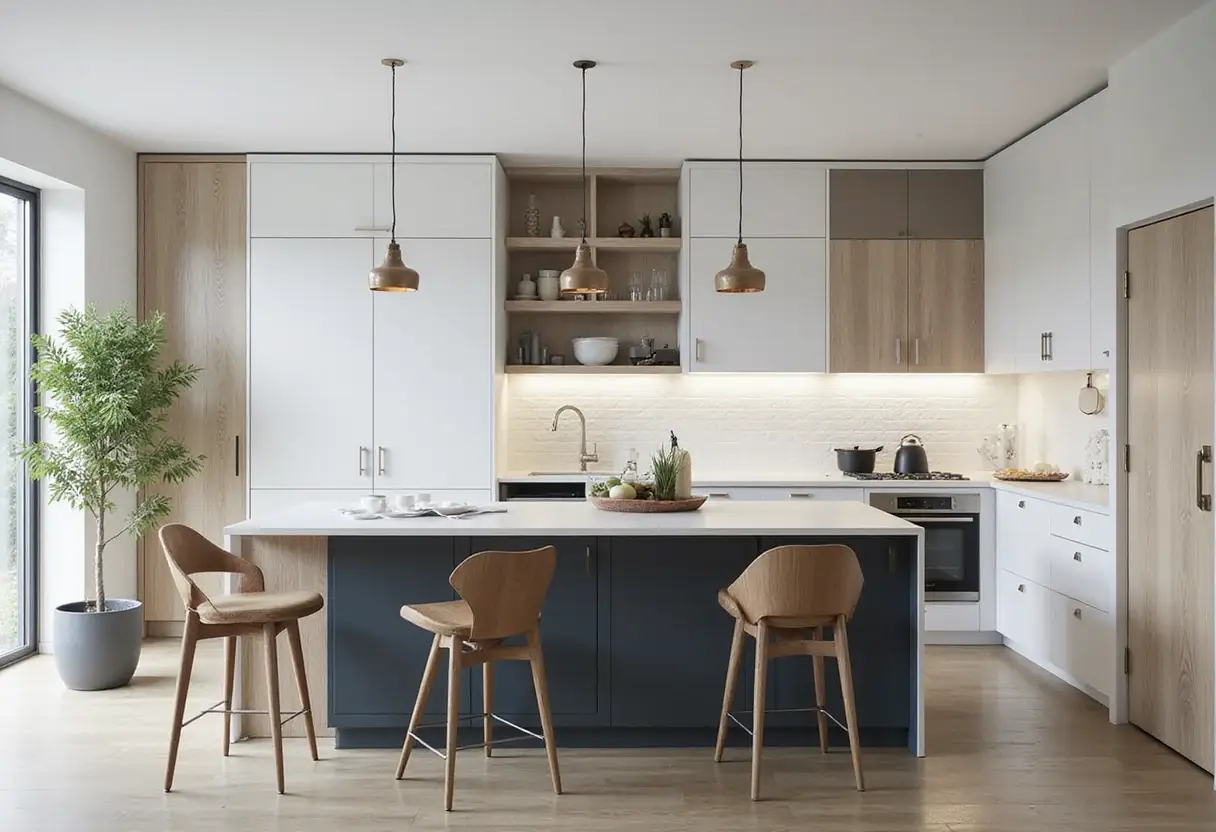
Position preparation so the cook can converse with guests, and give drinks, glasses and ice a home outside the cooking zone. Where full openness isn't possible, an operable pass-through with an engineered lift-up closure can serve and then separate.
Ventilation is part of hospitality. A hood should capture cooking effluent without making conversation difficult; a high CFM number cannot compensate for a poorly planned system. Coordinate makeup air with the HVAC contractor and local authority.
Which surfaces survive real cooking?
Stainless steel works for clients who accept scratches; a durable counter still isn't a knife-friendly surface. Sealing improves stain resistance but doesn't make marble immune to acid etching. Sintered stone suits where low porosity and resistance to stains and heat matter. Test expressive textures before they become the pastry-rolling spot.
Light, power and the journey back to clean
Task lighting belongs at actual prep surfaces — decorative pendants can't do every job. Lutron's Caséta system supports scenes that shift a room from cooking to entertaining. On power, Legrand's Kitchen Countertop Outlet is surface-mounted and passes the UL 498 half-gallon spill test; a furniture outlet or power strip should not be assumed suitable.
For cleanup, Fisher & Paykel's Double DishDrawer runs two cycles independently — useful for split loads, though not the same capacity as two full-size machines. Singh's revealing question: "What is still sitting on your counter the morning after you host?"
Before approving any kitchen floor plan, he says, imagine the last ten minutes before dinner — open the dishwasher, take out the roast, invite someone to help — then ask whether the kitchen still works. When it does, the cook has more attention for the food and the people around it. "That is the kind of luxury I want to design."
Source: kbbonline.com
More from Grace Kim
Show full bio
Staff writer covering money, funding and market shifts around construction industry, architecture, interior design at Built Current.
345 articles