The Fish That Changed Architecture: How Computation Took Over Design
Zaha Hadid Architects says advanced computing made the Heydar Aliyev Center possible. From Cedric Price's Fun Palace to Gehry's 1992 fish, the question is who really won: architecture or computation.
- Section
- Construction Tech
- Author
- By Elena Vasquez
- Filed
- Length
- 4 min read
Key takeaways
- Zaha Hadid Architects completed the Heydar Aliyev Center in Baku in 2013, crediting advanced computing for its construction.
- Frank Gehry's 1992 'Peix' sculpture in Barcelona required CATIA aeronautics software, the same package used for the Boeing 777.
- Nicholas Negroponte founded the Architecture Machine Group at MIT in 1967 and published The Architecture Machine in 1970.
- Bell and Fox's The Evolution of Computation in Architecture (2024) defines a seven-step technology adoption cycle; AI's cycle is incomplete.
- WikiHouse uses digital systems to target affordable net-zero homes; ETH Zurich's Block Research Group minimizes structural material digitally.
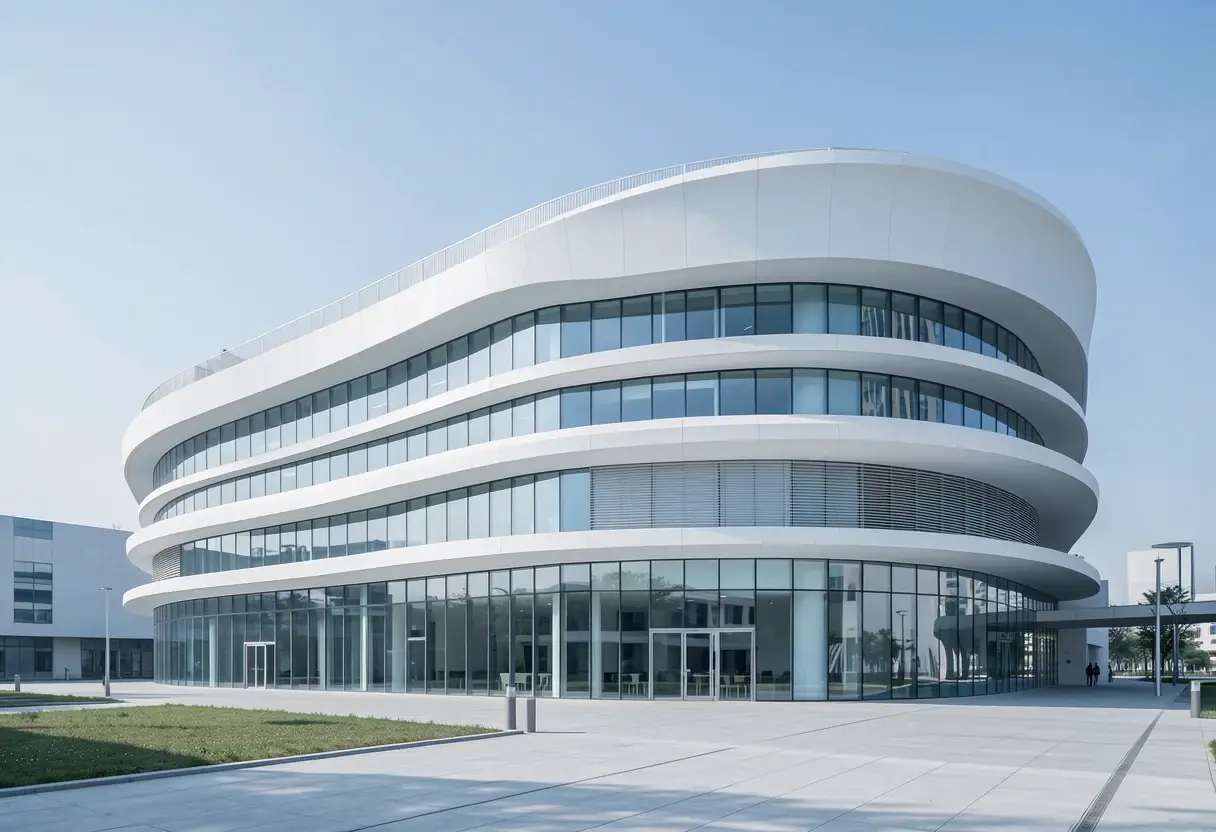
Zaha Hadid Architects credits advanced computing for making the Heydar Aliyev Center buildable at all. "Advanced computing allowed for the continuous control and communication of these complexities among the numerous project participants," the studio notes. Completed in 2013 in Baku, Azerbaijan, the building's fluid curves and folds rise from a clearing in the city's gridded urban fabric — a construction feat that raises a blunt question: is this architecture's triumph, or computation's takeover?
What came before the computer?
The discipline's entanglement with technology isn't new. When Imhotep pioneered stone construction at Saqqara in Egypt, builders carved pillars to resemble earlier reeded construction. The triglyphs on Doric entablatures in Greek architecture were a holdover from the timber buildings that preceded them. New technology arrived piecemeal, keeping the familiarity of the old.
Mathematics followed a similar slow path. Renaissance Europe turned proportion and mensuration studies into guiding principles of composition. The Islamic world adopted complex geometry and tessellating forms. The Industrial Revolution then brought engineering knowledge — the same knowledge behind steam engines and railways — to the great roofs of train stations. Computation would later reach architecture through that same engineering channel.
Where did architecture meet computing?
The relationship began in the 1960s, after transistors and post-war growth in computing power put mainframes inside large institutions. Visionary speculation often outran the hardware. Cedric Price and Joan Littlewood's Fun Palace was designed as a framework with continuously changing functions, where feedback and computation would let the building reorganize itself.
The most significant attempt came from MIT. Nicholas Negroponte's Architecture Machine Group, a lab and think-tank founded in 1967, built a program meant to replicate the architect's job by feeding the machine a vast collection of architectural rules. It failed — partly because of limited processing power, partly because of the rule-based approach. Negroponte documented those failures in his 1970 book, The Architecture Machine.
When did computers start designing?
The 1980s and 90s shifted the focus. Devices got smaller, cheaper, and more accessible, culminating in the home computer. CAD — a term coined in the 1950s for mechanical engineering — crept into architectural practice. Graphics too heavy for 1960s processors ran fine on personal computers inside architecture firms.
Then came Frank Gehry and the fish. The 'Peix' sculpture ('fish' in Catalan) was built on the Barcelona waterfront for the 1992 Olympic Games. Managing its structural behavior and construction method proved impossible without CATIA, the aeronautics software famously used to design the Boeing 777. Five years later, the Guggenheim Bilbao opened in 1997, firmly announcing computation's arrival in building design.
A second wave followed in the 1990s. Programs built for other disciplines, like Rhino, entered the field. Patrik Schumacher of Zaha Hadid Architects popularized the term 'parametricism' for computer-generated elements that adapt and integrate into CAD-CAM production. Software like GIS handled data mapping; Ecotect ran sophisticated environmental modeling.
Speculation returned too. Greg Lynn's Embryonic House manipulated spline blobs into endless permutations. Philippe Morel's Computational Chair generated thousands of potential forms from voxels — volumetric pixels — of which only 25 went into production. Michael Hansmeyer and Benjamin Dillenburger built Digital Grotesque I, a functional-less installation exploring digital potential. Philip Beesley combined 'synthetic biology, artificial intelligence, mechanics, sound, light, and filtering systems' in interactive environments. Hernan Diaz Alonso created surreal spaces that existed only in digital form — the digital for the sake of the digital.
What do the new books say?
Two recent books map this history. Bradley Bell and Michael Fox's The Evolution of Computation in Architecture (2024) profiles the pioneers of the computational paradigm shift. Mario Carpo's Beyond Digital: Design and Automation at the End of Modernity (2023) traces how computation reached its current role and identifies a move away from standardization toward bespoke manufacture and specificity.
Bell and Fox describe a seven-step cycle for how new technology enters a discipline: it starts with context — a coalescence of technological and socioeconomic forces — then passes through stages of pioneering and innovation before producing a new operational paradigm. CAD completed that cycle. Artificial intelligence hasn't yet.
So who won?
Will architects think like programmers? Will AI let buildings get vibe-coded into existence? Time will tell — and reactions always follow movements. MP3 and streaming didn't kill vinyl. Digital tools are already democratizing the field: the WikiHouse project aims to make well-designed net-zero homes widely available, and ETH Zurich's Block Research Group uses digital tools to refine structures down to the least material possible. The Heydar Aliyev Center may be a breathtaking digital feat, but it's one stepping stone on a much longer arc.
Original: en.wikipedia.org
More from Elena Vasquez
Show full bio
Senior reporter covering money, funding and market shifts around construction industry, architecture, interior design at Built Current.
363 articles