Seventeen Birdhouses Form a Folk-Art Village in Bunny Williams's Garden
Bunny Williams's Connecticut garden now holds 17 birdhouses, including one traced to a 1917 E.F. Hodgman catalog. A Penn historian calls 1890–1930 the form's golden age.
- Section
- Landscape & Public Space
- Author
- By Marcus Bennett
- Filed
- Length
- 4 min read
Key takeaways
- Bunny Williams's Falls Village, Connecticut, garden holds 17 birdhouses mounted on tall metal-banded posts.
- Historian Jacob Torkelson traces the form's golden age to 1890–1930, when government pattern books promoted birdhouses for pest control.
- One house in the collection matches the six-room Bungalow Martin House sold by the E.F. Hodgson Company from about 1917 until 1944.
- Williams commissioned a new signed piece from Jim Sidon of Sparrow 10:29 at the Trade Secrets fair in May.
- The houses come down every two years for a coat of wood preservative.
Seventeen birdhouses now stand on uniform posts among the apple trees of Bunny Williams's country garden in Falls Village, Connecticut — a village assembled without a master plan, one building at a time. Williams, an AD100 Hall of Famer, never set out to collect them.
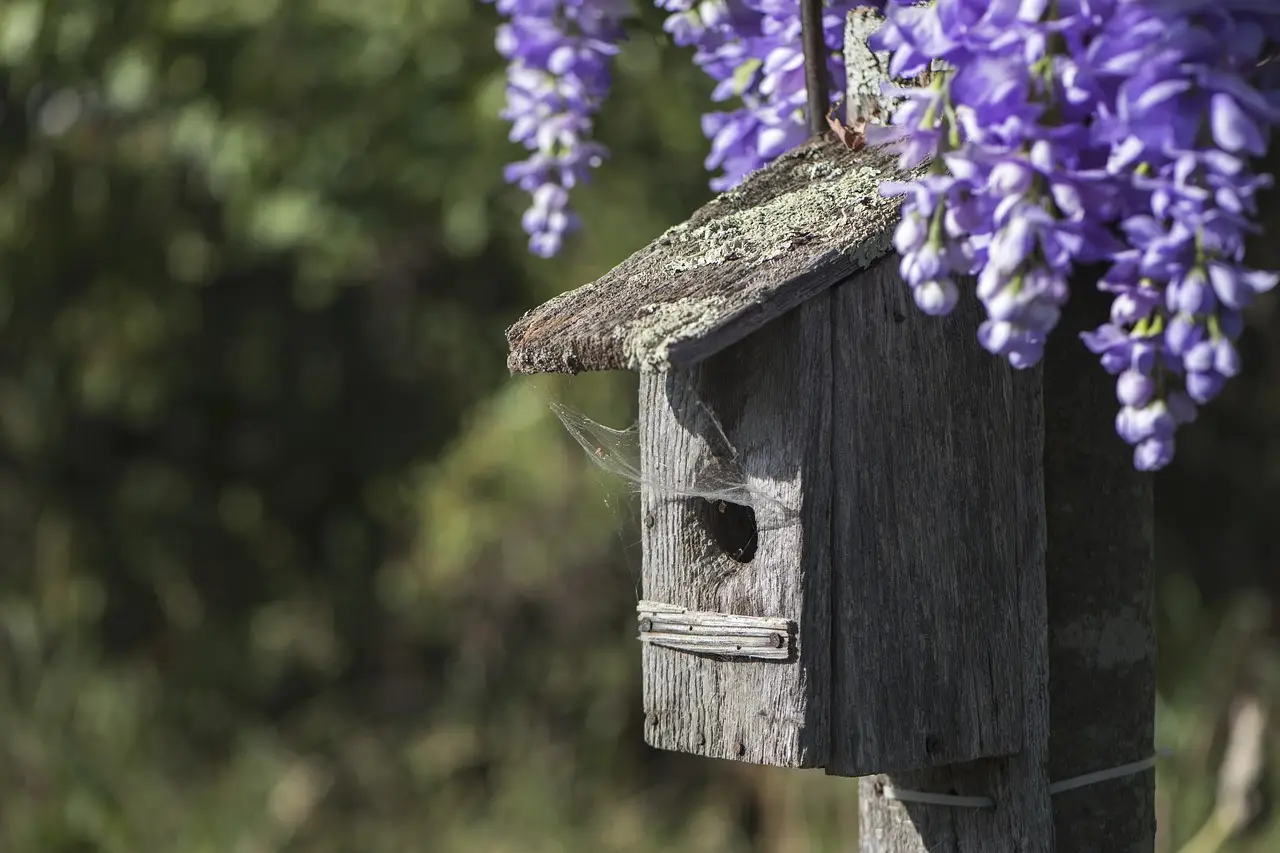
The houses include a church with a tin roof, a thatched cottage, a pagoda, a red house flying a tiny flag, and a shuttered structure that suggests a Russian dacha. Each sits high on its own post, finished on every side, painted and weathered like the buildings of a settled town. The height is deliberate: Williams wanted viewers to look up.
How did the collection start?
For years, Williams and her husband, the antiques dealer John Rosselli, combed fields and fairs for Treillage, the New York shop they ran until 2015. The birdhouses kept finding her. They gathered in the hayloft of her barn.
"When I had two, I didn't know what to do with them," she says. "Then all of a sudden there were 10." She decided they had been in storage long enough.
Williams and Robert Reimer, her head gardener, reclaimed an overlooked point of land for the display. They removed invasive species, freed a stand of apple trees, and planted oat grass, bird-friendly scrub, and fruit-bearing pawpaw trees. Each post carries a metal band to deter squirrels from climbing toward the intended tenants.
What do the houses tell us?
The attraction, Williams says, had nothing to do with value or pedigree. "Most of these birdhouses are sort of folk art," she says. "They were somebody having fun building an unusual structure." She prizes a thatched-roof cottage she has never seen duplicated, and points to gingerbread scallops on a many-holed high-rise — "somebody had a great time with their little saw."
The dealers who sold the houses rarely had history to pass along. Jacob Torkelson, an architectural historian at the University of Pennsylvania's Stuart Weitzman School of Design and one of the few scholars studying these objects, filled some gaps. "The period from 1890 to 1930 is really the birdhouse's golden age," he says, noting that government pattern books once encouraged farmers to install birdhouses so insect-eating birds would reduce pesticide use, while mail-order catalogs sold them as garden whimsy.
Shown photographs, Torkelson traced one house to the catalog page: the six-room Bungalow Martin House sold by the E.F. Hodgson Company, which listed the model from about 1917 until the firm closed in 1944. "Birdhouses are these wonderful mirrors to the human condition," he says. "They tell us the values that we have as a society or as individuals, in our houses, in our gardens."
Who is building the next one?
Williams is still collecting. Last May at Trade Secrets, the Litchfield Hills garden fair she cofounded in 2001 to raise funds for a local domestic violence support agency, she met Jim Sidon of Sparrow 10:29, based outside Atlanta. Sidon, retired from the printing industry, built his first architectural birdhouse in 2017 — a replica of the 1792 Federal-style mansion in Newburyport, Massachusetts, where he and his wife rented rooms as newlyweds. He recognized the hand of his late friend Larry Smith, a North Georgia builder known for metal roofs, in three of Williams's houses.
Williams has commissioned Sidon to build something new, though she has not decided what. Unlike her anonymous makers, Sidon numbers and signs every piece. "My hope is that years from now, someone's searching that out," he says. "And when they open it up, they'll see my signature."
Upkeep is minimal. Every couple of years the houses come down, receive wood preservative, and return to the weather. Torkelson, a preservationist by training, endorses the approach: "These houses were made to be ephemeral," he says. "They weren't made to last forever, and they should absolutely be used."
The intended residents remain unbothered. Williams thinks the birds prefer the trees, where they carry on like a symphony orchestra. "I've always felt that one of the reasons they don't live in these houses is the birds think it's suburbia," she says. "But they like the atmosphere." She has never once climbed up to check. "If they are nesting," she says, "I don't want to bother them."
Original: instagram.com
More from Marcus Bennett
Show full bio
Correspondent covering money, funding and market shifts around construction industry, architecture, interior design at Built Current.
328 articles