Lasagna-Tray Chandeliers and Fern Walls: A 1710 Farmhouse Reimagined
Artist Happy Menocal renovated her circa-1710 Bedford farmhouse with Cameron & Corrigan Architects, crafting chandeliers from aluminum lasagna trays and hand-painting ferns across the dining room.
- Section
- Interiors
- Author
- By Grace Kim
- Filed
- Length
- 3 min read
Key takeaways
- The oldest parts of the farmhouse near Bedford, New York date to circa 1710; the family moved in August 2020 and renovated with Mosolino Development and Cameron & Corrigan Architects.
- Happy Menocal designed dining room chandeliers made from disposable aluminum lasagna trays cut into leaves and draped over hanging lamps "like a hula skirt."
- The dining room occupies a 1960s greenhouse addition; Menocal hand-painted white ferns on lichen-green walls, and the butler's pantry uses Farrow & Ball Arsenic green.
Artist Happy Menocal built the dining room chandeliers in her 18th-century New York farmhouse from disposable aluminum lasagna trays—cut into leaves, flattened, bunched, and draped over utilitarian hanging lamps "like a hula skirt." The fixture is the defining gesture of a five-year renovation that modernized a 4,000-square-foot house without stripping its history.
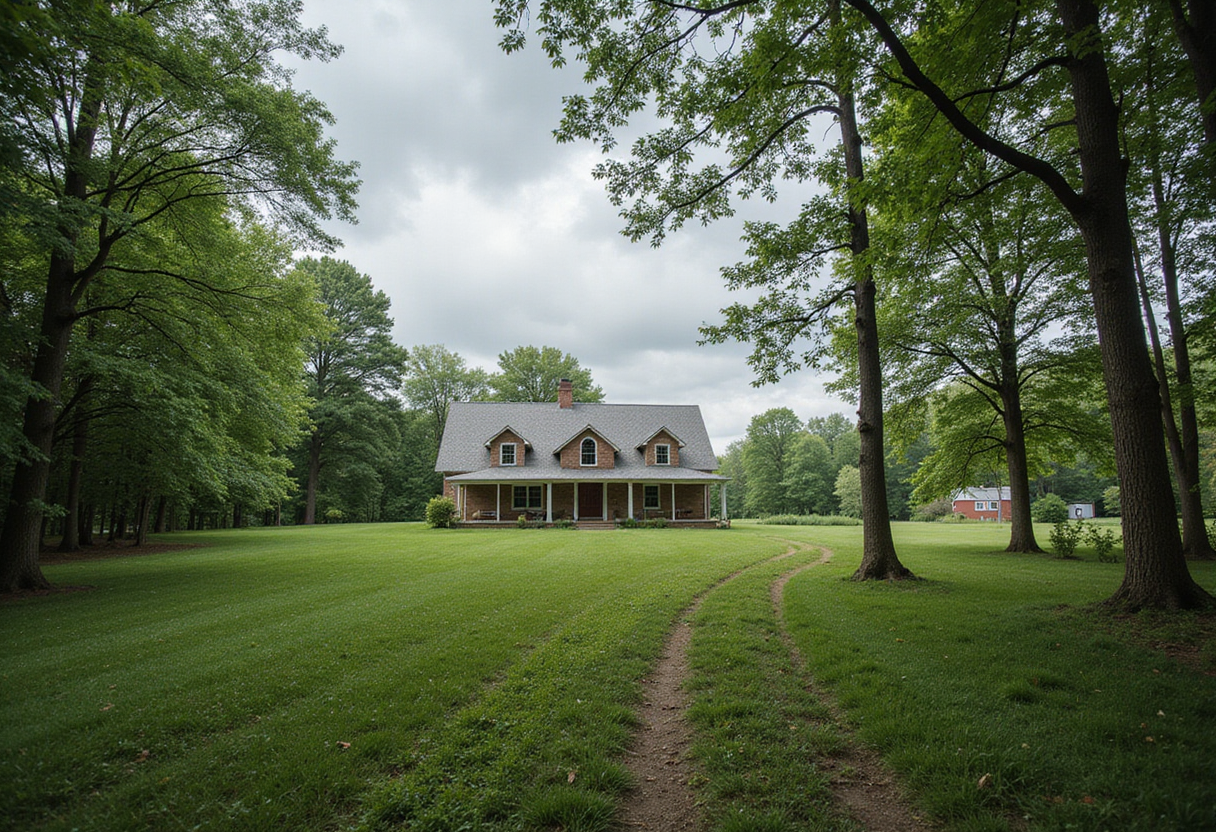
The farmhouse sits across the street from a protected reserve near Bedford, New York, harboring one of the last stands of old-growth forest in the northeast. A short walk through the woods leads past waterfalls, hundred-foot-tall eastern hemlocks, and an 1870s mineral quarry where feldspar and mica streaks glitter in the leaf litter. "My childhood was being in these woods," Menocal says. She found the listing late one night in June 2020 and set up a viewing the next day.
She, her husband, John, and their children, Rip and Daisy, now 9 and 11, moved in that August. They accepted the compromises of an old house—wearing coats in the drafty kitchen from October to April—while the property also served as headquarters for Menocal's eponymous art and design studio. The studio, which collaborates with brands like Paperless Post and Schumacher, is known for witty wedding invitations and stationery that nod to aristocratic traditions and medieval motifs.
After five years of dreaming up changes, the family assembled a team: Mosolino Development as contractors and Cameron & Corrigan Architects. Architect Kirtley Cameron recalls her first impression of the "quintessential New England" house, whose oldest parts date to circa 1710: three centuries of architecture Frankenstein'ed together into a "wonderful, rambling, homestead." The first walk-through was "both exciting and a little daunting," she says. She found the place "beautiful, charming, and unique—and also cold, inefficient, and structurally compromised in some places."
Cameron worked with the house's quirks—exposed beams, random stairs, erratic ceiling heights—while perfecting the flow. Menocal picked nearly every tile finish, paint color, and fabric herself. When she couldn't find what she wanted, she made it.
Menocal's mother, Katharine Barnwell, a classically trained decorative painter who lives with the family, helped on the chandeliers. The trays became leaves for the dining room, a space that was once a greenhouse added in the 1960s. Sunlight still streams in, carrying the forest's green glow. In a nod to the room's past life, Menocal hand-painted white ferns over lichen-green walls. The ferns climb from the floor and reach across the ceiling, bringing her dinner guests, she says, down to "insect scale."
At the far end of the dining room sits the butler's pantry, which might be Menocal's favorite room. Its walls wear a "cheerful but mischievous" Farrow & Ball Arsenic green—a "transition in energy" between the botanical dining room and the bright, clean kitchen.
Menocal's friend and frequent collaborator Rebecca Gardner, the event planner and interior designer behind Houses & Parties, describes Menocal's creative inspiration as lightning-bug-like and contagious. "Happy really understands a sense of place and abhors anything common…especially perfection," Gardner says. "And she makes no compromises for comfort…. It's feast or famine in the cushy sofa department." That tact shows room to room: personality without maximalism, and fun moments with space to breathe.
The house doubles as a showcase for work by people Menocal loves. "I really view the house like a gallery of things that people I love have made," she says. On view now: pottery by friends Lyn and Will Reardon of New York Stoneware, with whom she has a lamp collection, plus paintings by friends Cameron Goodyear and Elizabeth Jaeger.
Her own studio appears here too. Two chairs in the library wear her textile Gloriette for Schumacher in the red colorway. The family calls the space "the red room." "I've always wanted to have a red room," Menocal says. "I feel like that's like the sign that you've arrived." For a house that spent two centuries accreting rooms, quirks, and drafts, the arrival is now complete—and thelasagna-tray chandeliers ensure no guest mistakes it for anything common.
Original: schumacher.com