PriestmanGoode Unveils Day/Dream, a Train That Converts to Sleeper Service at Night
PriestmanGoode's Day/Dream concept converts daytime seating across all classes into lockable sleeper compartments at night, using materials from Kydex, Testori and Muirhead.
- Section
- Interiors
- Author
- By Marcus Bennett
- Filed
- Length
- 3 min read
Key takeaways
- PriestmanGoode unveiled the Day/Dream transformable train concept at InnoTrans 2026 in Berlin.
- Daytime seating across standard, business and first class converts into private lockable sleeping compartments at night.
- The interiors use Kydex thermoplastic, Testori plant-based recyclable fabric and Muirhead BioTan low-carbon leather, and fit within existing European rolling stock.
A Business Class day seat that carries four daytime travellers becomes a single or dual bunk at night. That conversion sits at the core of Day/Dream, the transformable train concept PriestmanGoode unveiled at InnoTrans 2026, Berlin's International Trade Fair for Transport Technology.
The London-based design bureau developed the concept with three material partners: Kydex, Testori and Muirhead. The interior uses image-infused thermoplastic from Kydex, plant-based recyclable fabric from Testori and Muirhead's BioTan low-carbon leather. PriestmanGoode describes the result as owing as much to hospitality design as to transportation.
Day/Dream envisages a triple-level, well-staffed trans-European service. An onboard hospitality crew supervises the transformation of the carriage layout from day to night configurations. Unusually, the conversion applies across all three classes — standard, business and first — turning the whole train into an overnight sleeping environment.
The concept marks what PriestmanGoode calls a "deliberate move away from the couchette model that defines most existing overnight rail provision." Instead, multifunctional spaces preserve capacity while increasing comfort. The interiors fit within existing European rolling stock and require no trackside infrastructural updates.
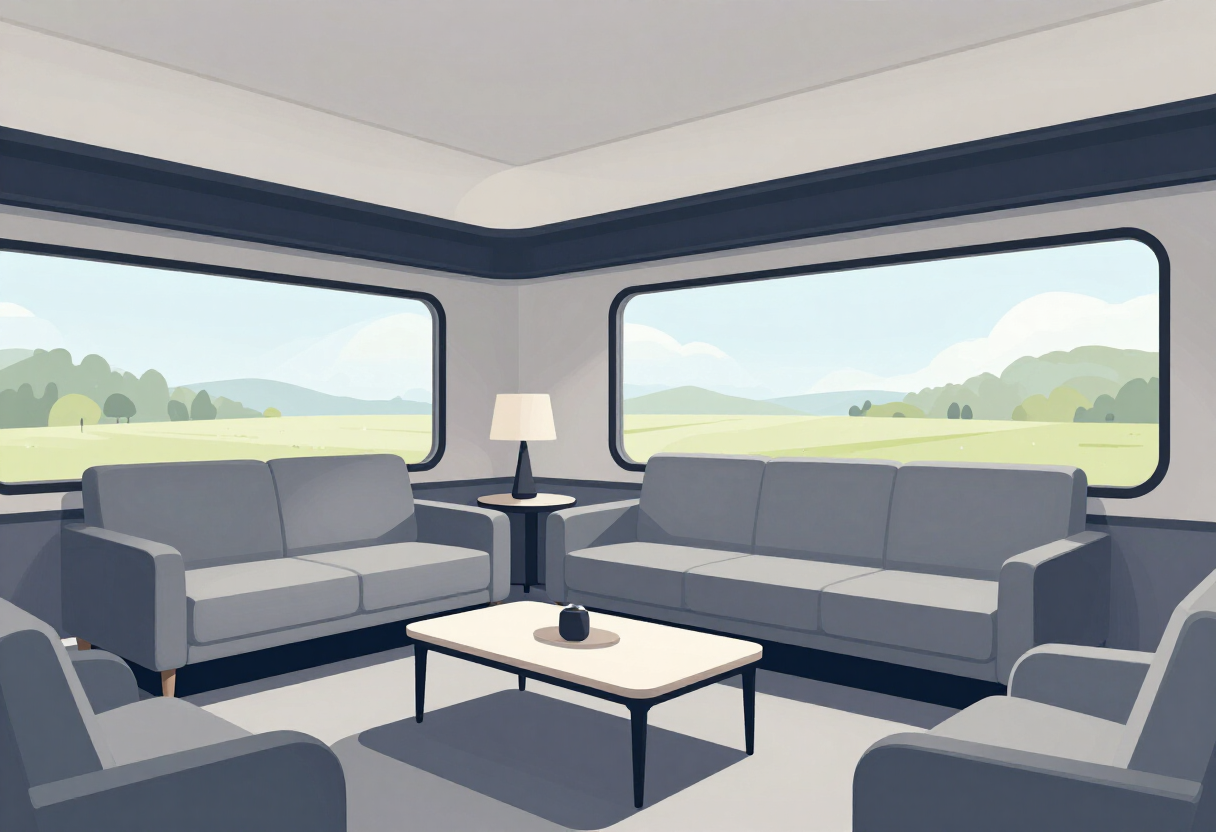
The lounge anchors the design. "Day/Dream is designed around the lounge as the primary social space, one that belongs equally to every passenger on board, regardless of how they have chosen to sleep," the designers say. Unlike aviation, they explain, "privacy is tiered; the experience is not. A passenger in a shared sleeping space and one in a private cabin share the same lounge, the same quality of environment, the same sense of occasion."
The concept also relies on a segmented passenger base. Commuters use First, Business and Economy in conventional configurations during the day. At night, a separate set of overnight travellers boards the transformed carriages. Open daytime seating converts into private, lockable compartments.
Kirsty Dias, managing director at PriestmanGoode, says passenger behaviour drove the layout logic. "Our understanding of how passengers move between different states, working, eating, socialising, resting, across a long journey has been central to how we have approached Day/Dream," she says. "Designing a space that performs equally well in two distinct operating modes, and transitions smoothly between them, draws on disciplines that are well established in aviation interior design: considered space planning, material performance under continuous operation, and a genuine understanding of passenger psychology at every phase of a journey."
That aviation experience runs deep. PriestmanGoode has worked on private jet concepts, Finnair's AirLounge business class seat, Lufthansa's First Class Suite configuration, and projects for United, Airbus and Korean Air. The rail portfolio is equally substantial: the firm counts London's Piccadilly and Elizabeth Lines, Austrian Federal Railways and VIA Rail in Canada among its clients, along with a clutch of industry awards.
Day/Dream remains a future vision rather than a commissioned build, but its constraint of working within existing rolling stock sets it apart from more infrastructure-hungry rail concepts. With rail continuing to lead the transport sector's decarbonisation race, a carriage that earns revenue in two operating modes per day offers operators a concrete argument for expanding overnight networks.
Original: google.com