NKBA 2027 Report: Walls Return, AI Stalls, Kitchens Keep Growing
NKBA's 2027 Kitchen Trends Report: 52% of designers expect bigger kitchens, 81% call intentional zoning 'here to stay,' and only 27% see AI ovens catching on.
- Section
- Kitchen & Bath
- Author
- By Amara Osei
- Filed
- Length
- 5 min read
Key takeaways
- Only 52% of designers expect kitchen footprints to grow over three years, down from 76% in the 2026 report.
- 81% of designers rate intentional zoning 'here to stay'; 46% call semi-enclosed layouts up-and-coming.
- Just 27% of designers expect ovens with integrated AI to be popular in 2027.
- Quartzite tops countertops at 78%, edging quartz at 74%.
- Leak detection and automatic shut-off valves lead climate-resilience features at 65%.
By Amara Osei
The National Kitchen & Bath Association's 2027 Kitchen Trends Report opens with a number that quietly ends an era: just 52% of designers expect kitchen footprints to grow over the next three years, down from 76% in 2026. Walls, it turns out, are back. So is skepticism about AI ovens.
The report, drawn from a survey of industry designers, manufacturers, remodelers and architects across the association's nearly 55,000 North American professionals, describes a kitchen in transition — zoned, wellness-minded and far less dazzled by technology than the broader market's AI chatter would suggest.
The sharpest reversal concerns layout. Defined zones, partial walls and operable partitions are replacing the fully open floor plan, and NKBA's own 2026 report had identified open layouts as a trend still in its growth phase. One year later, intentional zoning is rated "here to stay" by 81% of designers, with semi-enclosed layouts (46%) and partially concealed kitchens (41%) named up-and-coming.
"For the past several years, we've seen the kitchen expand in size," said Bill Darcy, global president & CEO of NKBA. "The 2027 Kitchen Trend Report reveals that this evolution is continuing, with the kitchen extending into more areas of the home. From mudrooms and laundry rooms to back pantries and personalized work zones, the report shows that we've entered a new era of what the kitchen can do for homeowners – solving real problems, adding home value and elevating the way we live."
What replaces the open plan?
Quite a lot, actually. The kitchen isn't shrinking; it's compartmentalizing. Some 86% of designers agree the layout itself is simplifying, with square footage reallocated into defined zones, back kitchens and enclosed storage.
- Dedicated prep spaces and back kitchens are cited as up-and-coming by 47% of designers.
- Layout reconfiguration ranks as the second-highest-ROI kitchen investment (49%), just behind cabinet upgrades (54%).
- Attached mudrooms will be popular over the next three years, according to 94% of designers; mudroom (45%) and laundry (43%) spaces are both expected to grow.
That's a lot of walls for a decade that spent itself knocking them down.
Which materials and colors win?
Neutrals hold the line at 96%, with greens (83%) and blues (75%) following — both down slightly from 2026's 86% and 78%. Warmer hues are making a case: yellows landed at 43% (down from 47%), while reds, including burgundies, held steady at 47%.
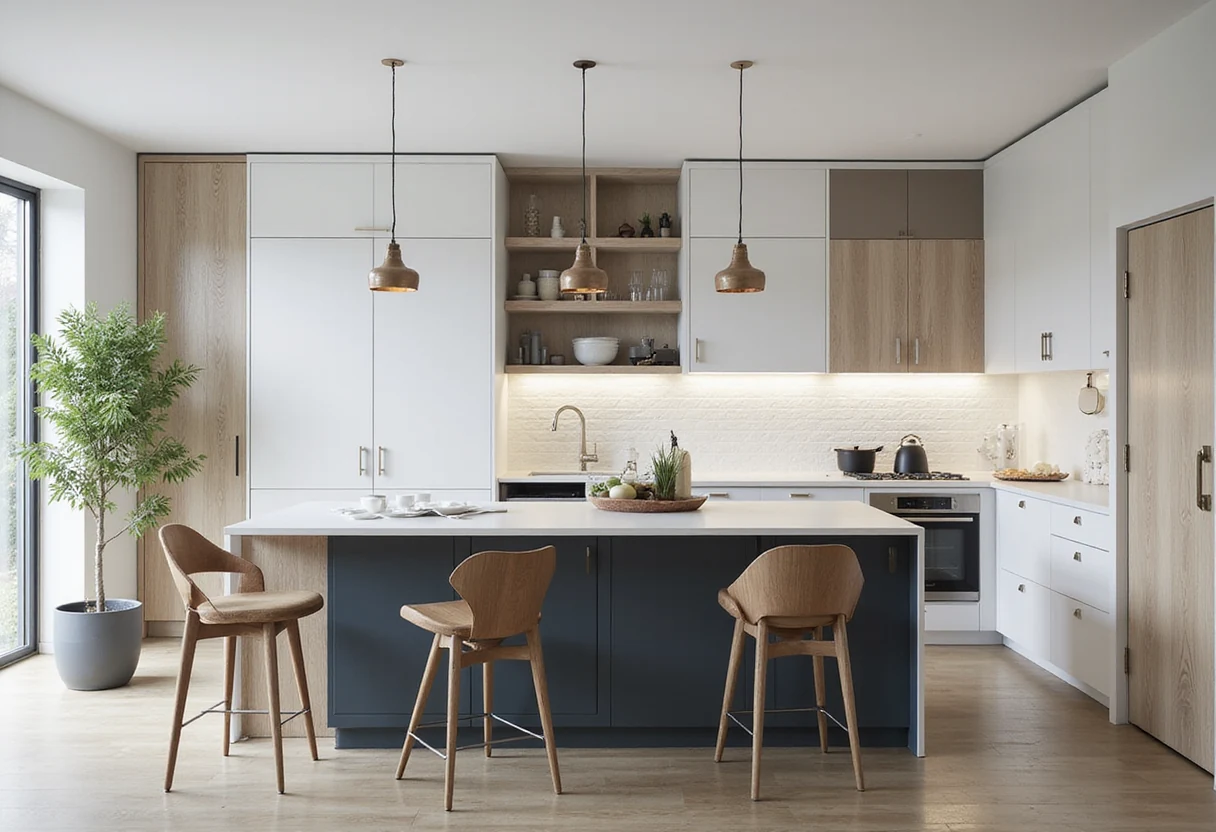
On countertops, quartzite edges out quartz, 78% to 74%. Concealment is the governing principle: 85% of designers agree cabinetry is being designed to hide appliances and functional elements, and 64% agree open shelving is on its way out in favor of enclosed storage.
Wood is the story in cabinetry. Some 34% of designers expect natural, unfinished material cabinets to be popular; white oak is the wood of choice for 49%. And 54% agree the kitchen island will wear a distinct color from the rest of the cabinetry.
How do wellness and climate resilience figure in?
Ventilation is being repositioned as a health feature rather than a code requirement, alongside water filtration, touchless faucets and sound-absorbing materials aimed at calmer kitchen environments. Climate resilience has moved from afterthought to priority:
- 65% of designers agree on leak detection systems and automatic shut-off valves.
- 62% cite backup power solutions.
- 53% point to ventilation and air filtration systems.
Is AI actually arriving in the kitchen?
Barely. Just 27% of designers expect ovens with food-recognition AI to be desired in 2027, and only 24% expect AI that learns and adjusts to cooking preferences. The air fryer, meanwhile, outpaces the convection oven in anticipated demand, 57% to 46. The contrast with the headlines is hard to miss.
What is connecting: mobile alerts for power failure or gas leaks (57%), app-controlled appliances (40%), and WiFi-connected refrigerators (37%) and dishwashers (36%).
What about function, lighting and the pantry?
Dedicated beverage areas keep rising, named by 90% of designers as a popular feature over the next three years, up from 85% in 2026. Pet feeding stations (64%) and eat-in kitchens (63%) round out the lifestyle features.
The island is becoming the kitchen's ultimate custom element: 82% of designers say size and configuration are growing more tailored, with technology leading all expected areas of island change at 74%, ahead of storage (60%) and functional zones (58%). Pantries are shifting too — 88% agree they're evolving from storage into multi-functional extensions of the kitchen, 73% predict dedicated small-appliance stations, and 67% expect walk-in pantries to dominate.
Lighting is trending from function toward design. Some 84% of designers agree kitchens will layer multiple lighting types for a more dynamic environment, and 78% agree lighting is now a key design feature rather than a purely functional necessity. Half expect lighting controls to be mobile-device connected. Leading fixtures over the next three years:
- Under-cabinet lights: 87%
- Interior-cabinet lighting: 76%
- Recessed lights: 57%
- Floor and path lighting for nighttime: 52%
- Sconces and wall lights: 48%; pendant lights: 46%
- Art lights (30%), soffit lighting (28%), chandeliers (23%) and hydroponic lights for herbs (18%) trail the field.
The full report is available at NKBA.org, with free access for NKBA members. If the 2027 numbers hold, the next kitchen you spec may have more partitions, fewer visible appliances and a smarter pantry — and an oven that recognizes dinner about as often as your commute recognizes shortcuts.
Original: nkba.org
More from Amara Osei
Show full bio
Market editor covering companies, deals and strategy in construction industry, architecture, interior design at Built Current.
132 articles