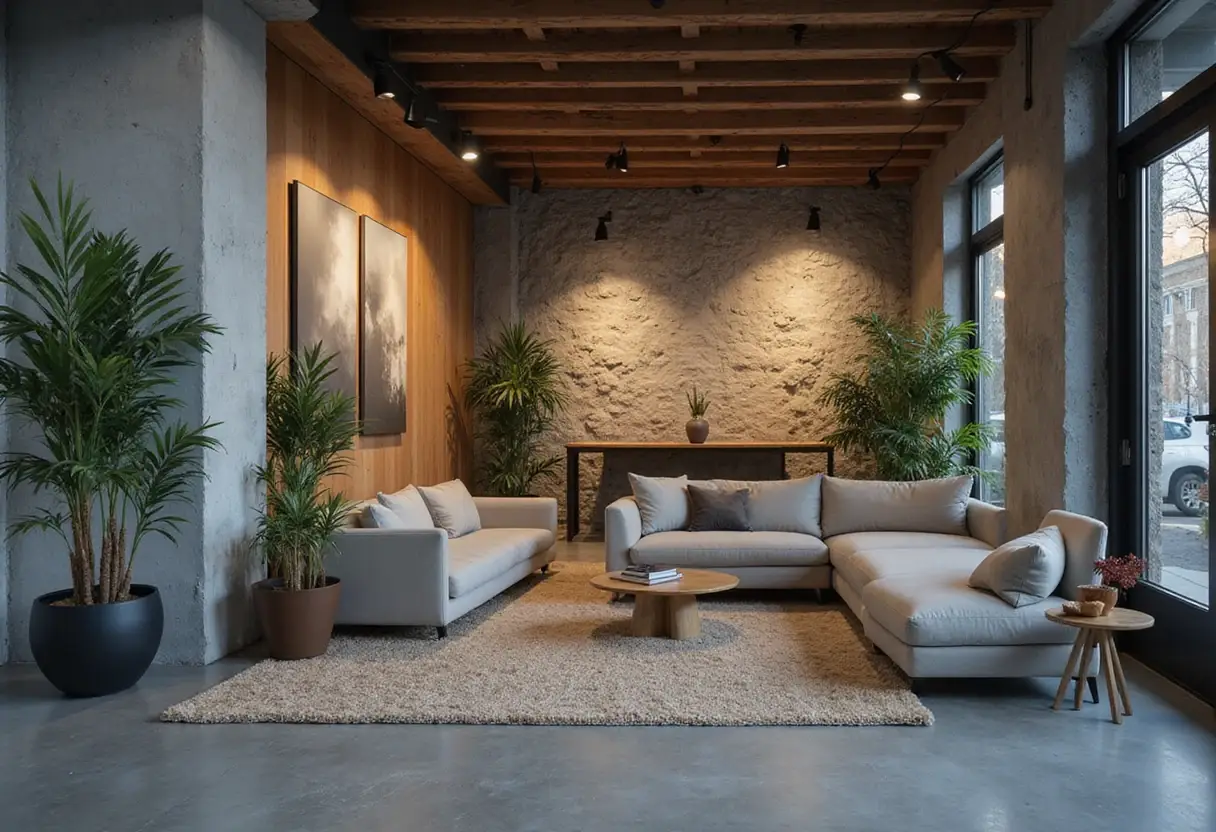
Nicola Peltz and Brooklyn Beckham's Wood Panels Solve Minimalism's Cold Problem
Nicola Peltz and Brooklyn Beckham's Beverly Hills living room relies on wide wood paneling matched to the flooring to warm up a minimalist space — a 500-year-old technique designers say hinges entirely on proportion.
- Section
- Interiors
- Author
- By Elena Vasquez
- Filed
- Length
- 3 min read
Key takeaways
- Nicola Peltz and Brooklyn Beckham's Beverly Hills living room matches wood walls and floors to soften a minimalist space.
- Wood paneling as a decorative technique dates back to the 16th century — about 500 years of use.
- Designer Amber Kamat warns narrow, tightly spaced paneling produces a dated 1970s feel.
- The couple chose wide, clean-lined panels echoing their flooring's warm tones to avoid that effect.
By Elena Vasquez
Nicola Peltz and Brooklyn Beckham's Beverly Hills living room uses matching wood paneling on both walls and floors to keep a minimalist space from feeling cold or sterile — and designers say the technique has worked for roughly five centuries.
The couple's Los Angeles home, which Homes & Gardens has covered repeatedly, runs on restraint. Almost no color, few furnishings, no bold accessories. The single material decision — continuous warm-toned timber wrapping the floor and the walls — does the work an art collection or a gallery wall would normally do.
Why does wood paneling work in a minimalist room?
Interior designer Amber Kamat, founder of the studio It's Not Complicated, frames the choice as a scale question. A large wall needs a focal point, and wood offers one without visual clutter.
'Wood paneling is a great way to incorporate on a large-scale wall when you don't want a maximalist approach with artwork or a gallery wall, which can look cluttered when you incorporate lots of color, furniture, décor, and accent pieces,' Kamat said.
In other words, one material replaces a dozen decorative decisions. The paneling becomes both the texture and the centerpiece, which matters most in rooms where everything else has been edited out.
Kamat calls timber cladding a refined way to build a three-dimensional accent wall that reads as timeless and clean. 'It's also a great way when you want to incorporate a minimalist approach in a living room because it can become the focal point or centerpiece in the space,' she said.
Where can the look go wrong?
The technique has one visible failure mode: proportions. Kamat is blunt about what happens when the panel dimensions are off.
'It may look outdated if you use the wrong paneling dimensions,' she warned. 'Narrow, tightly spaced paneling with no visible gaps can give a living room a distinctive 1970s feel, which can be dated and closed-in rather than stylish or contemporary.'
That's the mechanism worth understanding. Narrow boards set close together compress the wall visually — the room feels sealed rather than serene. Peltz and Beckham sidestepped the problem by choosing wide, clean-lined panels whose warm tones echo the flooring. Same material idea, different gauge, opposite result.
The distinction is the difference between a room that photographs as current and one that reads as a period set. Wide boards with clean lines keep the wall open; tight 1970s-style spacing closes it in.
What does the room prove about restraint?
The broader takeaway from the space is a simple trade: character through material rather than through accumulation. No bold colors, no heavy accessories, no layered décor — just one finish applied with the right proportions.
The pedigree helps explain why designers keep returning to it. Wood paneling as a decorative device has persisted since the 16th century, according to Homes & Gardens — roughly 500 years of continuous use, surviving every intervening style cycle.
The couple's living room suggests the run continues. When the dimensions are right, a pared-back space doesn't need ornament to feel welcoming; the timber alone carries it. As the coverage puts it, the look has already proved itself for 500 years — with, the piece adds, 500 more to come.
Source: homesandgardens.com
More from Elena Vasquez
Show full bio
Senior reporter covering money, funding and market shifts around construction industry, architecture, interior design at Built Current.
400 articles