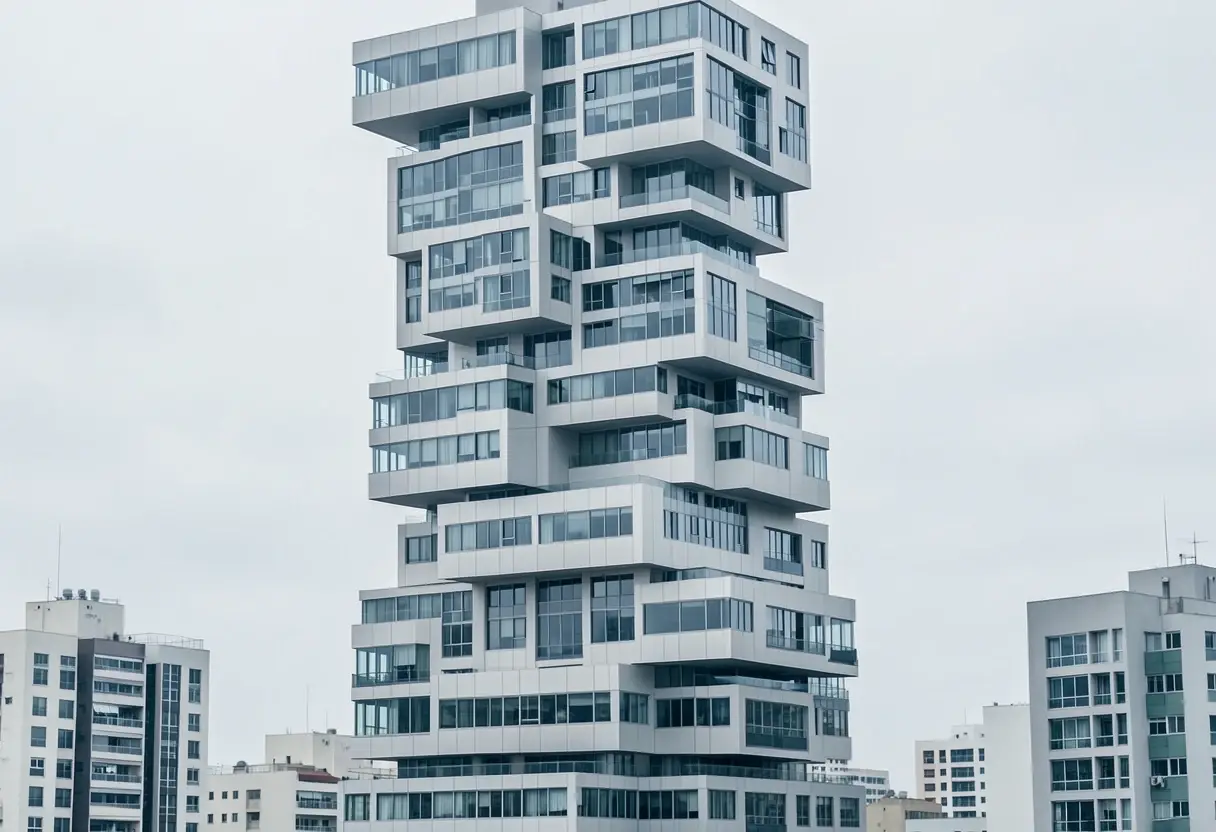
From Walnut Furniture to a São Paulo Tower: Pixel Design Goes Physical
Pixelated design has jumped from screens to objects and buildings: walnut furniture, a 69-panel kinetic clock, and a 21-storey São Paulo tower show how the 8-bit grid works in physical form.
- Section
- Architecture
- Author
- By Elena Vasquez
- Filed
- Length
- 3 min read
Key takeaways
- FGMF Arquitetos' Valente Building rises 21 storeys in São Paulo's Pinheiros district with a pixel-like stacked façade.
- The Klapklok kinetic clock uses 69 individually moving panels instead of clock hands, with a bio-polyurethane frame.
- Carlo Andreini's Pixless Camera captures 16-bit-style low-resolution images in a 3D-printed body with USB-C and micro-SD.
- Alberto Essesi's Ghost Collection combines mirror-polished aluminum and solid walnut into pixel-inspired furniture.
A 21-storey tower in São Paulo's Pinheiros district now wears a façade of stacked rectangular volumes that read like enlarged digital pixels — the clearest sign yet that pixelated design has outgrown the computer screen. That project, the Valente Building by FGMF Arquitetos, is one of five designs Yanko Design rounds up in a new survey of how blocky, low-resolution aesthetics are moving into furniture, gadgets, and buildings.
The through-line is simple. A wooden furniture base, a mechanical clock, and a camera can all look pixelated while working nothing alike. Some of these designs lean on nostalgia. Others use the grid to solve real problems — shading, ventilation, flexible layouts. Here's how each one works.
How do you turn pixels into furniture?
Alberto Essesi's Ghost Collection pairs mirror-polished aluminum with solid walnut. Console tables, ottomans, and sculptural accessories recreate enlarged digital pixels through carefully stacked wooden modules, so each piece transitions from smooth, reflective surfaces to deliberately blocky forms. The result sits somewhere between a virtual rendering and a handcrafted object.
Yanko Design notes the collection can read as gallery-worthy art, statement furnishing, or a conversation piece depending on the room. The mechanism matters more than the look: the pixel isn't printed or painted on, it's built from stacked modules.
What does retro computing look like on a desk?
The MiniToo Retro PC-Style Pixel Bluetooth Speaker & Alarm Clock reimagines the 1980s desktop computer as a compact multifunctional device. It has a miniature CRT-style display, oversized keyboard-like buttons, and a signature beige finish. The customizable pixel screen shows animated clock faces, digital artwork, text, and photos.
The spec sheet is longer than the object: Bluetooth speaker, alarm clock, white noise machine, focus timer, reminders, and interactive pixel features in one unit. Tactile buttons and a rotary volume knob handle control, with wireless connectivity for the rest.
Why would anyone shoot in 16-bit resolution?
Carlo Andreini's Pixless Camera runs the megapixel race in reverse. The compact camera deliberately captures images in a low-resolution, 16-bit-inspired format reminiscent of classic video games, inside a lightweight 3D-printed body with USB-C connectivity and micro-SD storage.
The software produces bold, blocky visuals that push users toward composition over sharpness. Customizable colour palettes inspired by classic gaming consoles let each image take on a distinct retro aesthetic, and a browser-based interface handles previews, settings, and style switching — no dedicated mobile app required.
Can a clock be made of moving pixels?
The Klapklok replaces clock hands with 69 individually moving panels arranged in a rounded pixel grid. The handcrafted clock draws on vintage split-flap displays and retro pixel graphics. Every few minutes the panels shift to show the time; each hour the entire grid transforms into a numerical display, with soft rhythmic sounds accompanying the motion.
The materials list is specific: a bio-polyurethane frame and durable composite flaps. A companion smartphone app lets users push their own pixel art, icons, and text onto the mechanical display. It's kinetic design — pixels that physically move rather than glow.
What does pixelation do for a building?
The Valente Building by FGMF Arquitetos rises 21 storeys in Pinheiros, one of São Paulo's most beloved neighborhoods, and its stacked rectangular volumes do more than make a skyline statement. Yanko Design reports the tower was designed from the inside out: each projecting volume corresponds to functional interior space, producing flexible duplex and triplex layouts that maximize natural light, ventilation, and city views.
The pixelated geometry creates depth and shifting shadows while breaking down the visual scale of the mixed-use program. It's the clearest example in the set of the survey's core argument — that modular grids and block-like volumes can serve shading, ventilation, and mixed-use planning, not just looks.
The larger takeaway: pixelated design has stopped being a nostalgic wink at early computing and become a versatile creative language connecting digital culture with physical craftsmanship. As the five projects show, that language now spans a walnut ottoman, a desk gadget, a camera, a mechanical clock, and an urban tower.
Source: Yanko Design
More from Elena Vasquez
Show full bio
Senior reporter covering money, funding and market shifts around construction industry, architecture, interior design at Built Current.
363 articles