Nearly 250 Students Built 13 Wood Installations at BuildFest 2026
Nearly 250 participants from 15 institutions built 13 wood installations at Bethel Woods, launching "Acts of Construction," Stephanie Sang Delgado's three-year curatorial arc on the historic Woodstock site.
- Section
- Architecture
- Author
- By Marcus Bennett
- Filed
- Length
- 5 min read
Key takeaways
- BuildFest 2026 ran September 9–13 on Max Yasgur's farmlands in Bethel, New York, site of the 1969 Woodstock festival.
- Nearly 250 participants from 15 institutions built 13 primary installations—up from four schools at the first event in 2022.
- The festival launched a three-year curatorial vision, Acts of Construction, led by Kean University assistant professor Stephanie Sang Delgado.
- Installations remain open to the public through November; open calls for Act Two: Choreography go out in early 2027.
Nearly 250 participants from 15 institutions converged on Max Yasgur's historic farmlands in Bethel, New York, from September 9 to 13 to build thirteen experimental wood-framed installations at BuildFest 2026, the fifth edition of the Bethel Woods Art & Architecture Festival.
The event marked the first chapter of a three-year curatorial vision led by guest curator Stephanie Sang Delgado, an assistant professor at Kean University. Her theme, Acts of Construction, centers the performative aspects of designing, building, and occupancy, and challenges "designers and artists to collaborate on an interdisciplinary series of 'acts," according to the curators Sang Delgado and Neal Lucas Hitch.
This year's Act One framed "Staging" as a directive with a double meaning: installations designed either as reimagined stages for performance or as proofs of concept in circular construction through disassembly and re-use. "Act Two: Choreography" follows next year, and 2028 culminates with "Act Three: Performance."
"Staging" became a double entendre, Sang Delgado explained: many installations take the shape of a reimagined performance stage while "literally setting the stage for next year—pun intended."
How did the festival grow?
The gathering began in 2022 with four schools—Kean, Rochester Institute of Technology, Cornell University, and the Illinois Institute of Technology. This year's edition was the largest and most geographically expansive yet, drawing teams from UCLA, University of Colorado Denver, and the University of Idaho, among others.
Thirteen primary installation projects were joined by workshops, digital light and projection activations, musical guests, DJ sets, soccer games, and camp-like activities.
Why does design-build still matter?
Sang Delgado, who works extensively in digital practice, defended hands-on pedagogy: "As somebody who does a lot of digital practice, I [still] think it's important to have hands-on experiences, understanding materials and the reality of construction, the problem-solving of what it means to design ahead of time and [then] bring it together."
Hitch connected this year's theme to last year's focus. "Last year, the explicit theme of the festival was about 'convivial technology,' or giving people back agency over the means of production," he said. "In art and architecture, that's pretty straightforward: giving people the agency to make their own environments and to build their own world."
He framed the festival's broader ambition in cooperative terms: "So much research is focused on technology or devices that would make buildings more sustainable, but one of the things that also needs to happen is that the way we live needs to be more sustainable. Part of the possibility of BuildFest is working together to rethink how to live together."
What did the teams build?
Proscenium — Robert Wightman (University of Idaho). Two sets of inverted, interlocking trusses form an L in plan, framing a forest clearing with a three-dimensional proscenium. Roundwood web members retain their bark—lumber the industry rejects for its small size.
Contact Hi-Fi — Emma Silverblatt and Ryan Whitby (Cornell University). Four wedge-shaped components built from leftover pallet wood reference the slope of the hill fronting the Grand Stage. X-braced trusses allow reconfiguration; the installation hosted a Saturday night performance by musician Always For Only.
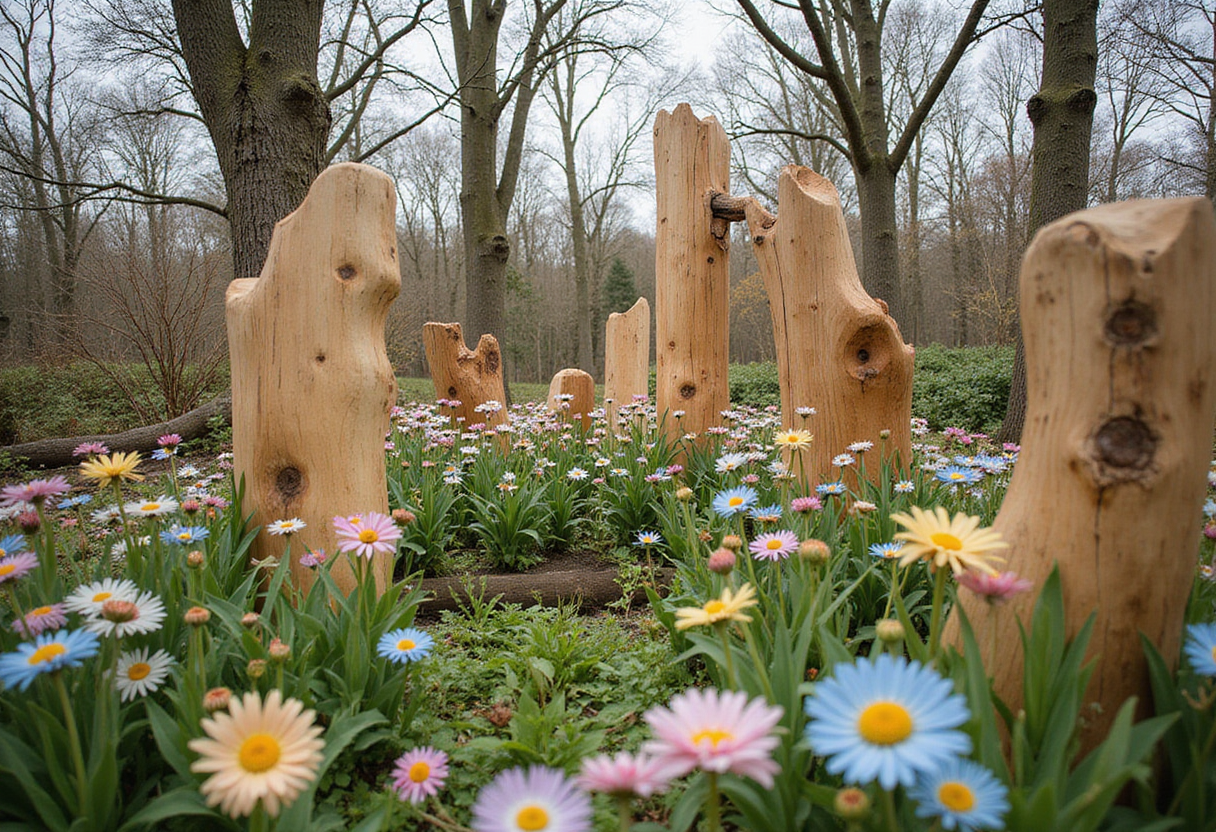
Wildflowers — Christina Chi Zhang and Lauren Scott (Lehigh University); Hannibal Newsom (Syracuse University). A cruciform framework of plus-shaped timber columns joined by colorful 3D-printed, biodegradable connections.
Baleworks — Regenerative Architecture Lab/Marta H. Wisniewska (Cornell University). Four modules form a biomaterial Maison Dom-ino: wood-and-straw-bale columns support cantilevering roof platforms above floating floors. The most obvious prototype of the group.
Pour Stop — Praveen Menon (Boston Architectural College). A full sheet of plywood tilted inward forms an introverted monument painted Rothko red inside. Entry occurs via a single flipping panel.
Switch! — Stephanie Sang Delgado, Fabio Castellanos, Henry Stankiewicz (Kean University); Galo Canizares (University of Kentucky). A revolving door set on a circular stage and framed by an angular plywood arch continues office ca's investigation of "architecture as interface."
FRAME(D) — Austin Lightle (University of Oklahoma). A Sol LeWitt–inspired cubic gridwork of thin furring strips creates traverse, end-on, and thrust stage types for an unknown future.
Flotilla — Kutan Ayata, Hunter Blackwell (UCLA); Cameron Kursel (University of Tennessee, Knoxville). A "site-responsive, amphibious installation that functions simultaneously as dock, platform, and performance infrastructure," with habitation modules aggregating into a barge.
In the Wings — Danny Wills, Morgane Copp (University of Colorado Denver). A reflective metallic proscenium curtain conceals a backstage toolshed with "Dada-esque" details: orange hardware store buckets as formwork, shovels as bracing stakes, bungee cords as fasteners.
St∆cks — Kelly Wilton, Andrew Moore (Rochester Institute of Technology). Lumber reused from Flux, RIT's 2025 installation, forms playful triangular follies that "encourage visitors to connect with their inner child and play through our space," per the designers.
Skylights — Neal Lucas Hitch, Kristina Fisher (Carnegie Mellon University). Modular timber lampposts over ten feet tall support battery-powered LEDs for the weekend music acts. A pivot joint allows one person to lower the arm and replace lights; an inverted prefabricated deck footing block locks each post in place.
Two interventions joined the eleven installations: Flying Buttruss by Benjamin Vanmuysen (Rensselaer Polytechnic Institute/Syracuse University), an inverted-truss hammock between two trees reusing materials from last year's Stacked & Strapped, lit by a squiggly LED strip; and Common Grounds by Mero Studios/Megan Dang and Rose Zhang (Pratt Institute), re-used stair stringers arrayed around an illuminated cylindrical core of wood slats.
The installations remain open to the public through November. Open calls for Act Two: Choreography go out in early 2027, with the festival tentatively slated again for early September.
Original: buildingfestival.com
More from Marcus Bennett
Show full bio
Correspondent covering money, funding and market shifts around construction industry, architecture, interior design at Built Current.
116 articles