Students Build Recyclable Timber Pavilions at BuildFest 2026
Lehigh and Syracuse students built Wildflowers, a disassemblable 3D-printed-joint timber pavilion, among reusable prototypes at BuildFest 2026 on the Woodstock site.
- Section
- Architecture
- Author
- By Priya Raman
- Filed
- Length
- 3 min read
Key takeaways
- Wildflowers, by Lehigh University and Syracuse University, uses custom 3D-printed joints and hex bolts so timber columns can be disassembled and reused without damage.
- BuildFest 2026 ran 9–13 September on the 1969 Woodstock festival grounds in Bethel, New York, with installations open to the public through November.
- The 2026 edition, Act One: Staging, opens a three-year curatorial initiative called Acts of Construction; future editions will reuse and transform this year's structures.
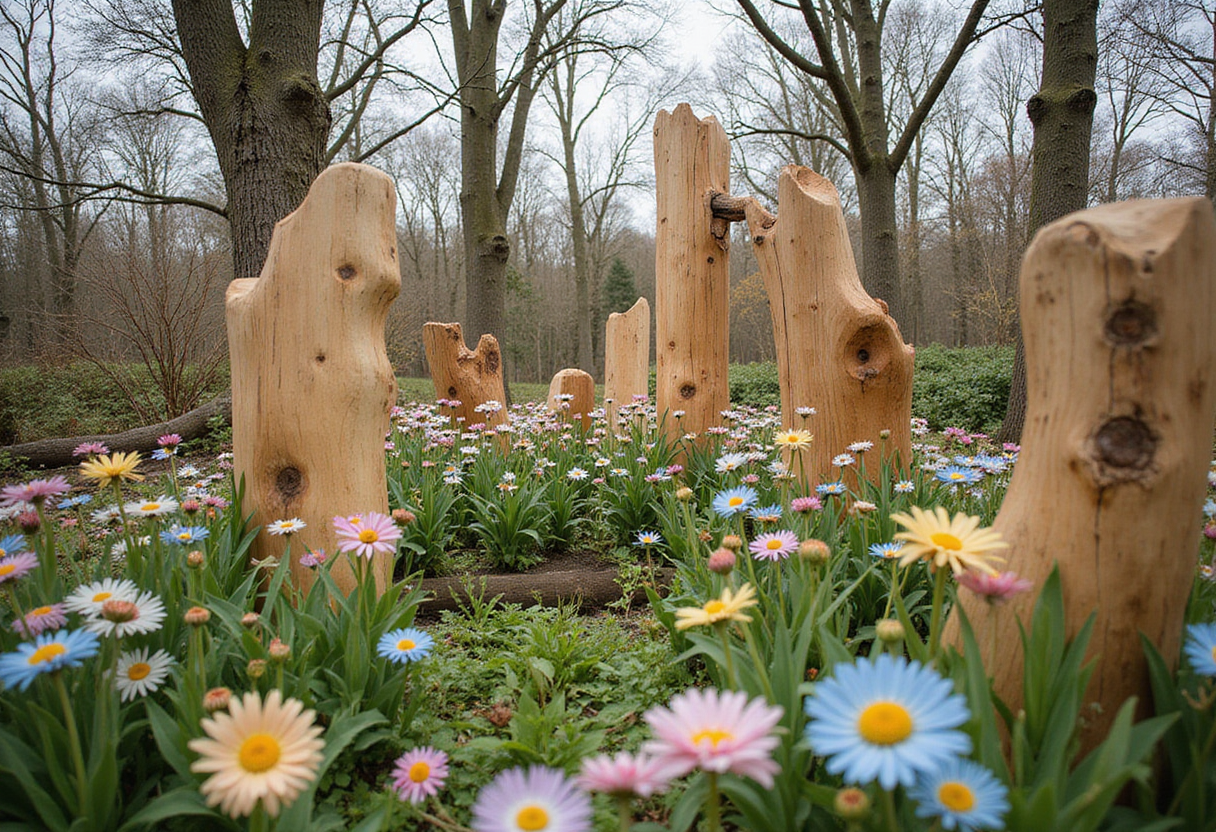
Students from Lehigh University and Syracuse University have built Wildflowers, a fully disassemblable timber pavilion joined with custom 3D-printed connectors, as part of BuildFest 2026 on the historic grounds of the 1969 Woodstock festival in Bethel, New York.
The installation arranges timber columns in an X shape that resembles flowers. Its joints are fixed with simple hex bolts that leave three small holes in each piece, so components can be removed and reused without damaging the timber.
BuildFest 2026, which ran from 9 to 13 September, was the fifth edition of the event and forms part of the Bethel Woods Art and Architecture Festival. It brings together students and faculty to design and build timber pavilions and multimedia installations. This year's programme focused on large-scale structures designed to be adapted, dismantled and reused.
The festival also marks the first instalment of a three-year curatorial initiative titled Acts of Construction. Called Act One: Staging, the 2026 edition explored how structures can accommodate different uses, performances and configurations, with future editions set to reuse and transform them.
At the edge of the forest, the University of Idaho presented Proscenium, a raised stage and suspended curtain framed by a timber truss. Led by Robert Wightman, the structure used stump and roundwood rejected by commercial timber milling alongside dimensional lumber, creating a performance space among the trees that recalled the Grand Stage at Woodstock.
Cornell University contributed two projects. Contact Hi-Fi, led by Emma Silverblatt and Ryan Whitby, drew on prefabricated roof trusses and was constructed from pallet wood diverted from waste streams. Its modular trusses can be rearranged into 12 configurations, with interchangeable panels featuring sonic transducers and sound-responsive lighting to create a backdrop for performances.
The second Cornell installation, BaleWorks, led by Marta H. Wisniewska and the Regenerative Architecture Lab, is an infrastructural prototype made from straw bales held within modular timber frames. The structure doubles as a composting porta-john, combining agricultural waste, construction and public infrastructure in a single build.
At the festival's pond, a team from the University of California, Los Angeles constructed Flotilla, a floating modular ramp developed with the University of Tennessee, Knoxville. The raft could be assembled into a single structure, separated into individual rafts or rearranged to create spaces for performances.
Suspended among the trees, Flying Buttruss by Syracuse University and Rensselaer Polytechnic Institute, led by Benjamin Vanmuysen, was constructed using lumber, hardware and LED lights reused from last year's BuildFest. The illuminated timber truss was relocated from the festival's camping ground to the forest, where it was raised between the trees and accompanied by a small bench made from leftover timber.
At night, several pavilions and installations hosted live performances and light shows.
BuildFest Acts of Construction took place over five days, with all installations remaining open to the public through November in Bethel, New York. The Wildflowers project was led by Hannibal Newson, Christina Chi Zhang and Lauren Scott.
As the first act of a three-year initiative, the 2026 builds are set to be reused and transformed by future festival editions — a working test of circular construction at full scale.
Original: buildingfestival.com
More from Priya Raman
Show full bio
News editor covering industry trends and analytics at Built Current.
63 articles