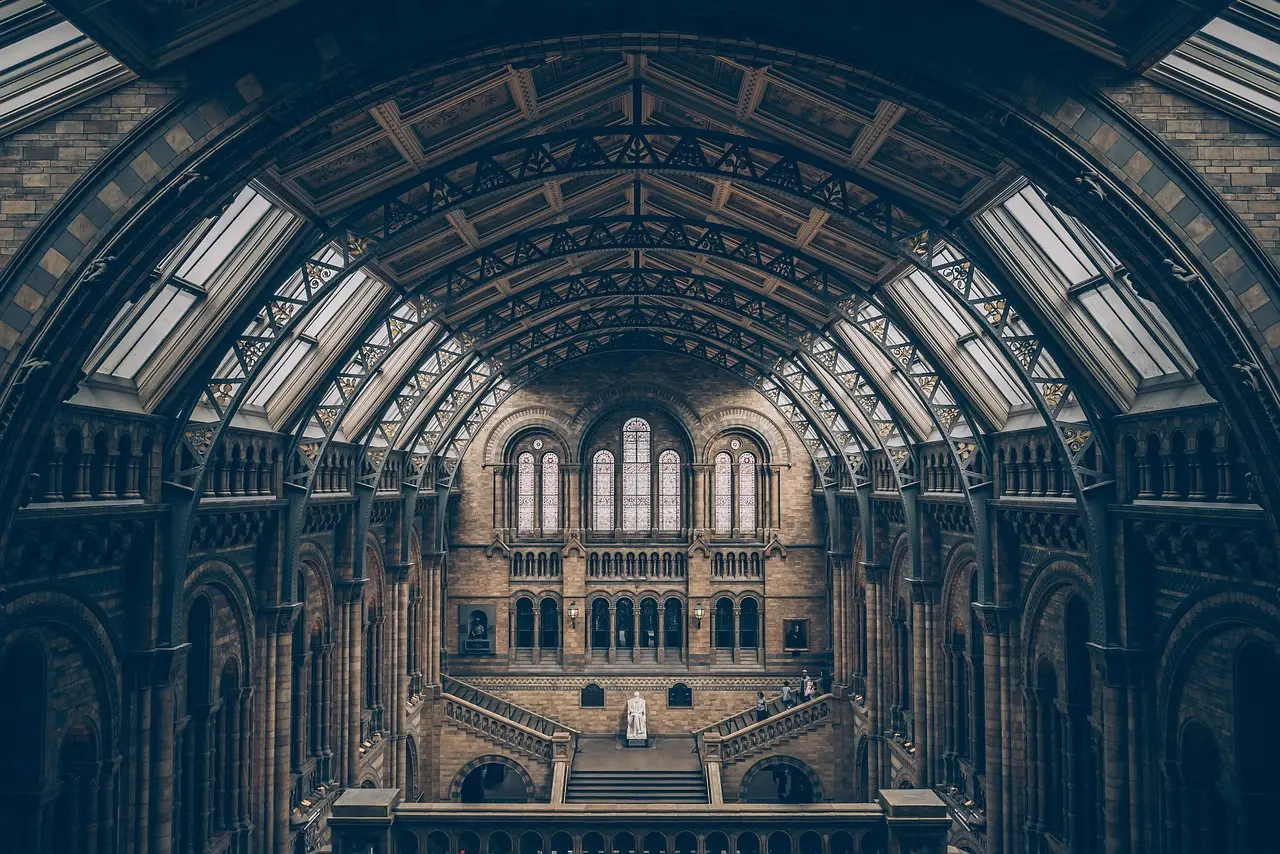
London Museum opens its new Smithfield home
The London Museum opens 28/29 November 2026 inside redesigned Smithfield Market — 33,000 sq m of Victorian and 1960s buildings turned into what its architects call 'soft power' for the city.
- Section
- Renovation & Retrofit
- Author
- By Grace Kim
- Filed
- Length
- 4 min read
Key takeaways
- The London Museum opens to the public on 28/29 November 2026 at Smithfield Market.
- The project spans several existing buildings across some 33,000 sq m.
- Stanton Williams led the design, with Asif Khan and Julian Harrap Architects.
- 48 historic shop units have been converted into 12 curated 'houses'.
- Over 400 pieces of Elizabethan and Jacobean jewellery, found in 1912, are on display.
The London Museum opens to the public this weekend, 28/29 November 2026, in its new home at the redesigned Smithfield Market. The move marks the first-phase reveal of the institution formerly known as the Museum of London, relocated from London Wall to the site of the famous meat market. It spans several existing buildings across some 33,000 sq m.
Architecture studio Stanton Williams led the project, working with Asif Khan and conservation specialist Julian Harrap Architects. Each firm tackled different parts of the plot, but all agree the project was conceived to reflect both its specific site and the capital whose story it tells.
'It was a rare chance to help one of the world's great city museums reinvent itself,' says Paul Williams, principal director and co-founder of Stanton Williams. 'Cities are changing quickly, and people increasingly look to public institutions to help them make sense of that change.'
What does the museum's 'soft power' actually mean?
Williams frames the institution's civic role in direct terms. 'A museum that engages with social and environmental issues and offers a shared civic space to a wide range of communities can do that in a way few other places can,' he says. 'There is a soft power in that too: an open, confident cultural institution doesn't just sit in its city; it helps to shape it.'
Smithfield sits at the western end of the City's cultural axis, alongside the Barbican and the Guildhall School of Music & Drama. The site comprises two existing market buildings — one Victorian, one from the 1960s — with a 'captured street' between them: a former market lane now turned into the embrace of the main museum entrance.
'It feels like the natural home for a museum that wants to be part of the city's life rather than observe it from a distance,' Williams adds.
The division of labour was clear. Stanton Williams focused on the poultry market, basement galleries and the covered street linking the two markets. Khan took charge primarily of the general market's above-ground interiors and exterior, including ground-floor public spaces, upper storeys and entrances, working closely with Julian Harrap Architects.
This weekend's launch is the first stage in a staggered opening that will eventually also take over the poultry market next door.
How do you turn a market into a museum?
Alec Shaw, the London Museum's director of new museum project and estate, described the scale of the adaptation in an interview in September. 'We were constantly doing open-heart surgery into different parts of the building to try and adapt them to make them more welcoming,' he said. 'Without being too grand, I'm hoping this is a complete game changer for city museums across the world.'
The buildings themselves are part of the show, creating a journey through time through architecture. Beneath the General Market, cavernous underground railway chambers showcase row upon row of old, 7m-high vaulted brick jack arches.
Those vaults came as a surprise. They were partly buried, closed off, and absent from the plans when the museum began the project. They were originally open-air goods yards, where cargo arriving by rail and river was stored before Horace Jones built the General Market on top.
At Khan's suggestion, the complex transforms 48 historic shop units into 12 'houses'. Six are reserved for the institution's use and six go to external ventures in a mix the museum will curate. The idea, Khan says, was to create an incubator — 'a coral reef of multiple institutes'.
What's on display?
The exhibits cover the London of the present and the past. In places, the building fabric itself holds part of the collection — some objects were baked into the flooring, forming part of the ground level and visible to all.
The main exhibitions include over 400 pieces of Elizabethan and Jacobean jewellery, found buried in a cellar in 1912.
Can a museum stay unfinished on purpose?
The first stage was designed to absorb change and feel interactive, inviting visitors in as actors rather than passive viewers. 'It can always be an unfinished project,' Khan told us in September. 'This is what has been missing, in a way, from the museum of the 20th century. Here, it's baked into the architecture, the capacity and the need to change.'
Williams recalls his first encounter with the site. '[My first reaction to the site was] visceral,' he says. 'I first walked into the General Market in 2016 and was blown away by the power and physicality of its contrasting spaces. That feeling hasn't left me. The site was raw, far more derelict than anyone had realised, and a time capsule. That complexity is its richness.'
He closes with the museum's larger ambition: 'This isn't a museum built merely to hold London's past. It is designed to keep imagining London's future, a place where history, ideas and people meet, and new stories emerge. Like the city, it is built layer upon layer, reinventing itself without erasing what came before.'
With the poultry market handover still to come, the Smithfield campus will keep growing into that promise.
Original: google.com
More from Grace Kim
Show full bio
Staff writer covering money, funding and market shifts around construction industry, architecture, interior design at Built Current.
409 articles