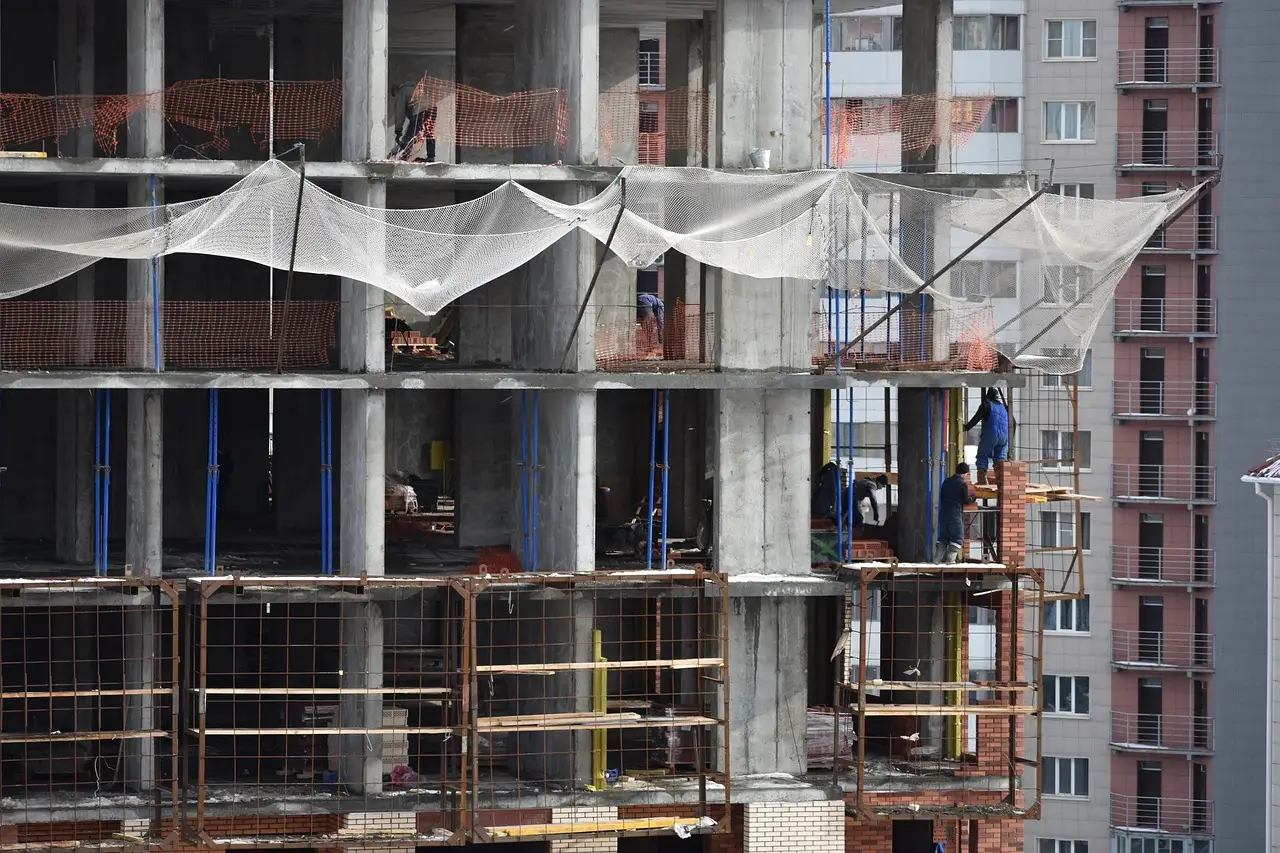
Interior Finishes Lead Single-Family Construction Time
NAHB builders report 25.3 weeks to complete an average detached home. Interior finishes consume 6.4 weeks and more than 24% of construction costs, survey data show.
- Section
- Construction
- Author
- By Elena Vasquez
- Filed
- Length
- 3 min read
Key takeaways
- Interior finishes average 6.4 weeks, the longest of seven major construction stages in NAHB’s October 2026 HMI survey.
- NAHB estimates 25.3 weeks, or about 5.8 months, to build an average single-family detached home.
- Framing and major systems rough-ins each average 3.7 weeks; final steps take 3.6 weeks and exterior finishes 3.4 weeks.
- Interior finishes account for more than 24% of construction costs, according to NAHB’s latest construction-cost survey.
- The Census Bureau reported an average completion time of 6.1 months for a single-family home built for sale in 2025.
By Elena Vasquez
Interior finishes take 6.4 weeks on average, longer than any other major stage of single-family construction, according to the latest NAHB/Well Fargo Housing Market Index (HMI) survey.
The October 2026 HMI survey asked builders how long they take to complete seven stages traditionally used in NAHB’s construction-cost surveys. It covers the work a builder typically undertakes after purchasing a finished lot, using a single-family detached home built for sale as the reference case.
What takes the most time?
The NAHB survey reports these averages for the seven stages:
- Interior finishes: 6.4 weeks. The work includes drywall, interior doors, painting, cabinets, countertops, plumbing fixtures and flooring.
- Framing: 3.7 weeks.
- Major systems rough-ins: 3.7 weeks. These include HVAC and plumbing and electrical work other than fixtures.
- Final steps: 3.6 weeks. Builders perform landscaping, erect outdoor structures and complete clean-up.
- Exterior finishes: 3.4 weeks. This stage covers siding, roofing, windows and doors.
- Site work: a little over two weeks.
- Foundations: a little over two weeks.
At 25.3 weeks for the full build, the 6.4-week finish phase takes roughly one week in every four. NAHB describes that concentration as broadly proportional to interior finishes’ share of the overall construction schedule.
Why do time and cost move together?
NAHB’s latest construction-cost survey puts interior finishes at more than 24% of a builder’s construction costs. That means more than 24 cents of every construction dollar, and the share is significantly higher than for any other stage. NAHB says it remains roughly proportional to the time interior finishes consume.
Final steps break that pattern. NAHB identifies them as the least expensive construction stage, even though they require 3.6 weeks and therefore absorb a disproportionately large amount of time.
The complete stage-by-stage cost breakdown and a detailed description of each stage appear in NAHB’s Cost of Constructing a Home-2024.
How long does the average home take?
NAHB’s October 2026 survey puts the total construction period at 25.3 weeks, or about 5.8 months. The Census Bureau reports 6.1 months from start to completion for a single-family home built for sale in 2025. NAHB characterizes its 5.8-month estimate as close to that Census figure.
The Census data also show that custom homes take significantly more time. Its examples include contractor-built homes constructed one at a time on the homeowner’s lot and owner-built homes where the owner acts as general contractor.
NAHB cautions that both estimates are averages. Completion time varies with geography, the characteristics of the home and the builder handling the project.
Which estimate should a builder use?
The Census Bureau’s completion estimate relies on a considerably larger and more intricately stratified sample than NAHB’s. For a straightforward measure of total construction time for a single-family home, NAHB points to the Census estimate.
NAHB’s 25.3-week figure offers a different advantage: it breaks the schedule into stages. NAHB says that detail can help builders educate customers, decide when to purchase building materials, schedule inspections and manage subcontractors.
For builders, the practical result is a schedule that reserves 6.4 weeks for interior finishes and anchors material, inspection and subcontractor planning. The stage data gives them a working timetable, while the Census figure remains the stronger benchmark for total construction time.
Source: eyeonhousing.org
More from Elena Vasquez
Show full bio
Senior reporter covering money, funding and market shifts around construction industry, architecture, interior design at Built Current.
363 articles