Giant Glowing Eggs Give a Tallinn Shipyard Mast a Second Life
Inimruum and un-like have installed two glowing polyethylene eggs, hand-woven angle-iron nest and all, atop a 65-foot shipyard lighting mast in Tallinn's Noblessner district.
- Section
- Landscape & Public Space
- Author
- By Grace Kim
- Filed
- Length
- 3 min read
Key takeaways
- Nest 2 places two glowing eggs nearly 65 feet above ground on a decommissioned lighting mast in Tallinn, Estonia.
- Metal artist Heigo Jelle hand-wove the nest from structural angle iron, measuring more than eight feet across.
- The eggs are rotomolded polyethylene with internal LEDs that can change colors and illuminate separately.
- The first Nest, installed in 2024, originated from a five-year-old's drawing and was developed by un-like with design agency Velvet.
- Nest 2's eggs reuse the same mold as the original installation; developer Merko commissioned the work.
Two giant eggs now glow nearly 65 feet above a decommissioned shipyard lighting mast in Tallinn, Estonia. The installation, called Nest 2, gives a leftover piece of industrial infrastructure a second job as public art in the Noblessner waterfront district.
Spatial design studio Inimruum created the work together with lighting studio un-like. It sits on a disused lighting mast on Lennusadama Street, in a former submarine shipyard that has become a mixed-use neighborhood. The project tackles a familiar redevelopment problem: how to give obsolete industrial structures a purpose while keeping their history legible.
A mast does that work differently than a plaque. It takes up space, interrupts the skyline, and makes the neighborhood's earlier life harder to treat as background information.
How is the nest built?
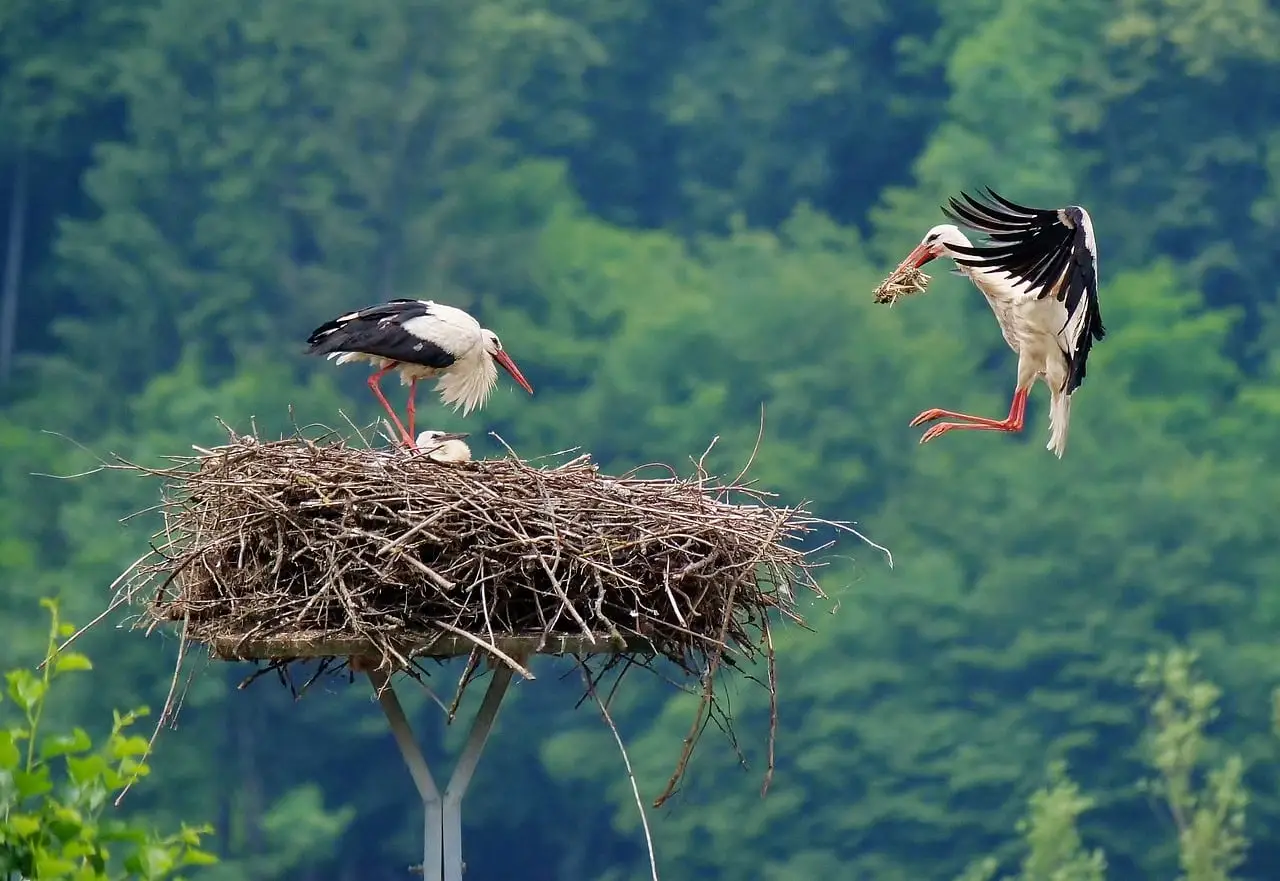
The structure follows that preservation-minded thinking. Its branches are structural angle iron, hand-woven by metal artist Heigo Jelle into a nest more than eight feet across. The material echoes the mast's own legs, tying the sculpture to its support.
That's a deliberate choice. A smoother, more polished nest might have looked like an accessory dropped onto the tower. Using an industrial profile to imitate gathered twigs gives the playful subject visual weight, and the bird reference stays easy to read without requiring the structure underneath to disappear.
What do the eggs add?
The two eggs bring a different material and a gentler shape. Both are rotomolded polyethylene, with internal LEDs that can illuminate them separately and shift their colors. Smaller lights among the metal branches pick out the nest after dark.
One egg sits almost on its side. That tilt carries as much personality as the lighting technology: a perfectly balanced pair might feel like a formal display, while a tilted egg suggests a nest assembled by an animal with priorities other than symmetry.
Where did the idea come from?
The premise has a charming origin. The first Nest, installed in 2024, grew from a five-year-old's drawing of eggs on a rusty mast. That earlier work held three eggs, and un-like developed it with design agency Velvet. A child saw a tall, unused structure and imagined somewhere for a bird to live — and the adults let the simplicity of that thought survive the engineering.
There's practical continuity between the two projects, too. Nest 2's eggs were produced using the same mold as the original installation's, while the heavier-looking angle-iron branches give the sequel a different character closer to the sea. Reusing the tooling gives the series a recognizable family resemblance without demanding that every component be redesigned — a sensible production choice alongside the reuse of the mast itself.
What does this change for Noblessner?
Developer Merko commissioned the installation, so the work belongs to the broader business of making a residential neighborhood appealing. That context keeps the assessment grounded: a glowing nest can't tell us whether the surrounding development is accessible, affordable, or pleasant to navigate.
What it can offer is a specific image attached to a specific place. "Meet near the giant eggs" has a clarity that a tasteful abstract sculpture might struggle to match.
The strongest decision here is leaving the old mast recognizable beneath its unlikely new occupants. The nest needs that height and industrial framework to make the joke work; remove them, and you'd still have a large illuminated sculpture, but a less particular one. The takeaway is refreshingly small: before treating an obsolete object as clutter, it's worth asking what its existing shape might already be suggesting.
Source: Yanko Design
More from Grace Kim
Show full bio
Staff writer covering money, funding and market shifts around construction industry, architecture, interior design at Built Current.
345 articles