ETH Zurich Turns Bacteria Into Builders With 3D Biocement Printing
ETH Zurich's Karen Antorveza Paez grows solid building elements from bacteria, sand and robotic fabrication, curing at room temperature in two to five days.
- Section
- Materials & Products
- Author
- By Priya Raman
- Filed
- Length
- 3 min read
Key takeaways
- 3D biocement printing solidifies printed sand-bacteria objects in 2–5 days at room temperature.
- The robotic method ran continuously for six months at the 2025 Venice Architecture Biennale.
- The process uses Sporosarcina pasteurii bacteria to produce calcium carbonate, the mineral in limestone.
- The reaction generates ammonium as a by-product, an environmental risk under investigation.
- The material is closer to mortar than concrete; load-bearing use remains long-term.
By Priya Raman
ETH Zurich researcher Karen Antorveza Paez has produced solid building elements using bacteria, sand and robotic fabrication — no cement kiln, no external heat. The facade element her team grew functions as a sunshade or partition wall, and it hardened at room temperature in two to five days.
The work sits in ETH Zurich's Department of Architecture, within the Digital Building Technologies and Complex Materials research groups. It challenges a basic assumption of the field: that construction is an exclusively human activity.
How does bacteria actually build?
The process is microbiologically induced calcite precipitation (MICP), or biocementation. Bacteria called Sporosarcina pasteurii produce an enzyme that breaks down urea, triggering a reaction that generates calcium carbonate — the mineral in limestone, mussel shells and chalk. Those microscopic crystals form between grains of sand and bind them into a solid structure.
Biocementation isn't new. Researchers have studied it for stabilizing loose soil and for self-healing concrete (concrete that repairs its own cracks). Antorveza Paez's contribution is treating it as a standalone construction material, wired directly into digital manufacturing. The architect sets the conditions, builds the fabrication system and defines the geometry. The microorganisms do the mineralization.
What are the two fabrication methods?
The first is 3D biocement printing. It starts with a bio-ink mixing sand, live bacteria and a water-based gel made from alginate and xanthan. Like conventional 3D printing, the mixture deposits into predetermined geometries. The printed object then sits in a mineralization bath of urea and calcium chloride, with fresh solution supplied daily. Over two to five days — depending on target strength — bacterial activity converts the print into solid mineral.
Antorveza Paez compares the process to baking a cake, with microorganisms replacing the oven by setting the material. The team has already used the technique for the facade element mentioned above, whose structure emerges from the interplay between printed geometry and biological activity inside it.
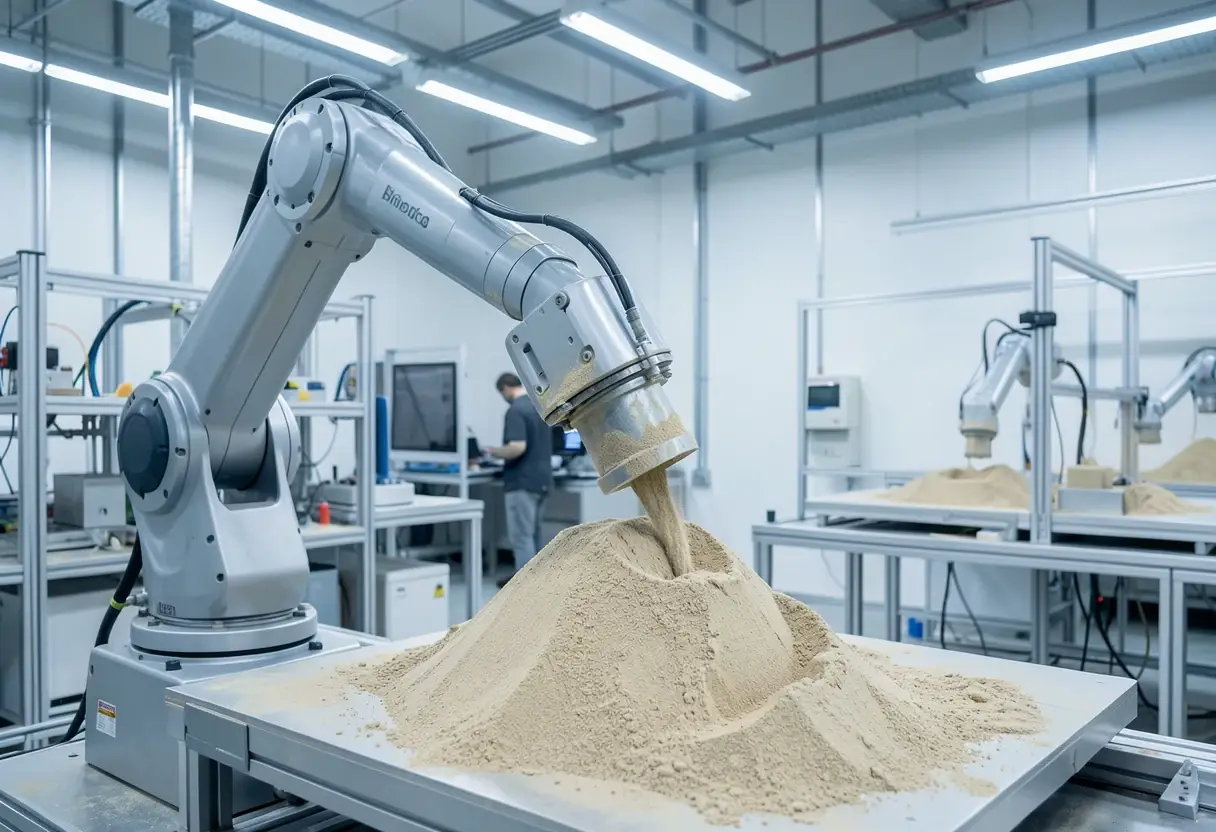
The second method is robotic biocementation spraying. A robotic arm deposits sand, bacteria and mineralization substances onto a surface, one after another, building height layer by layer. The model is geological: stromatolites, sedimentary rock formations created by mineral-depositing microorganisms. The project Geological Microbial Formations demonstrated the technique at the 2025 Venice Architecture Biennale in the Arsenale's Material Bank, where the robotic process ran continuously for six months as visitors watched the material form.
Is it actually greener than cement?
Partially. Cement manufacturing is a major contributor to construction-related carbon emissions, and biocementation avoids the high-temperature processes of conventional cement production. But the biological reaction generates ammonium as a by-product, which can damage the environment if not properly managed. Antorveza Paez is currently investigating that impact and solutions for handling the chemical waste.
Material limits remain, too. She describes biocementation as closer to mortar than concrete. Further research is needed on how grain sizes, mineral bonds and internal structures affect strength and durability. Load-bearing applications remain a longer-term possibility.
What does this change for architecture?
Beyond materials, the research reframes authorship. Buildings have traditionally been products of human design, engineering and industrial manufacturing. Biocementation adds the microorganism as a participant, with architectural production emerging from orchestrated interactions between human intelligence, digital technologies, biological activity and mineral matter.
It also changes how architects relate to their materials. Antorveza Paez notes that architects rarely know much about how the materials they specify are produced. Working with microorganisms brings those processes into focus — and shows how sophisticated material structures can emerge through biological activity alone.
Original: google.com
More from Priya Raman
Show full bio
News editor covering people, launches and day-to-day practice in construction industry, architecture, interior design at Built Current.
306 articles