ecoLogicStudio Grows Architecture From Algae, Fungi and Carbon
ecoLogicStudio's DeepForest³ at Milan's Triennale grows a forest from algae biopolymers, living mycelium and 50 liters of CO₂-capturing cyanobacteria, extending a 20-year practice of biotic architecture.
- Section
- Green Building
- Author
- By Priya Raman
- Filed
- Length
- 3 min read
Key takeaways
- DeepForest³ opened in 2025 at the Triennale Design Museum in Milan as part of We the Bacteria, curated by Beatriz Colomina and Mark Wigley.
- The installation holds 50 liters of living cyanobacteria that actively capture CO₂ from the gallery environment.
- The AirBubble in Nyon, Switzerland (2024), uses 36 borosilicate glass bioreactors with 350 litres of Chlorella algae filtering 150 litres of polluted air per minute.
- The Urban Algae Folly debuted at EXPO Milano 2015 with Spirulina microalgae growing in its canopy membrane.
- CryoflorE, shown at MUDAC's 2025 Solar Biennial, channels photosynthesis-generated electrons into copper-wired electrical currents.
By Priya Raman
In 2025, a forest grew inside the Triennale Design Museum in Milan. It was DeepForest³, an installation by London-based ecoLogicStudio, presented within the exhibition We the Bacteria: Notes Toward Biotic Architecture, curated by Beatriz Colomina and Mark Wigley.
The studio, founded in 2005 by Claudia Pasquero and Marco Poletto, has spent two decades proposing a built world that uses nature's own machinery: algae that purify air, mushrooms that digest waste, insulation that grows itself. Poletto describes DeepForest³ as a system built with a 'fully functional and tangible biotechnological living system, grounded in the metabolic cycles of algae and fungi.'
What does the installation actually contain?
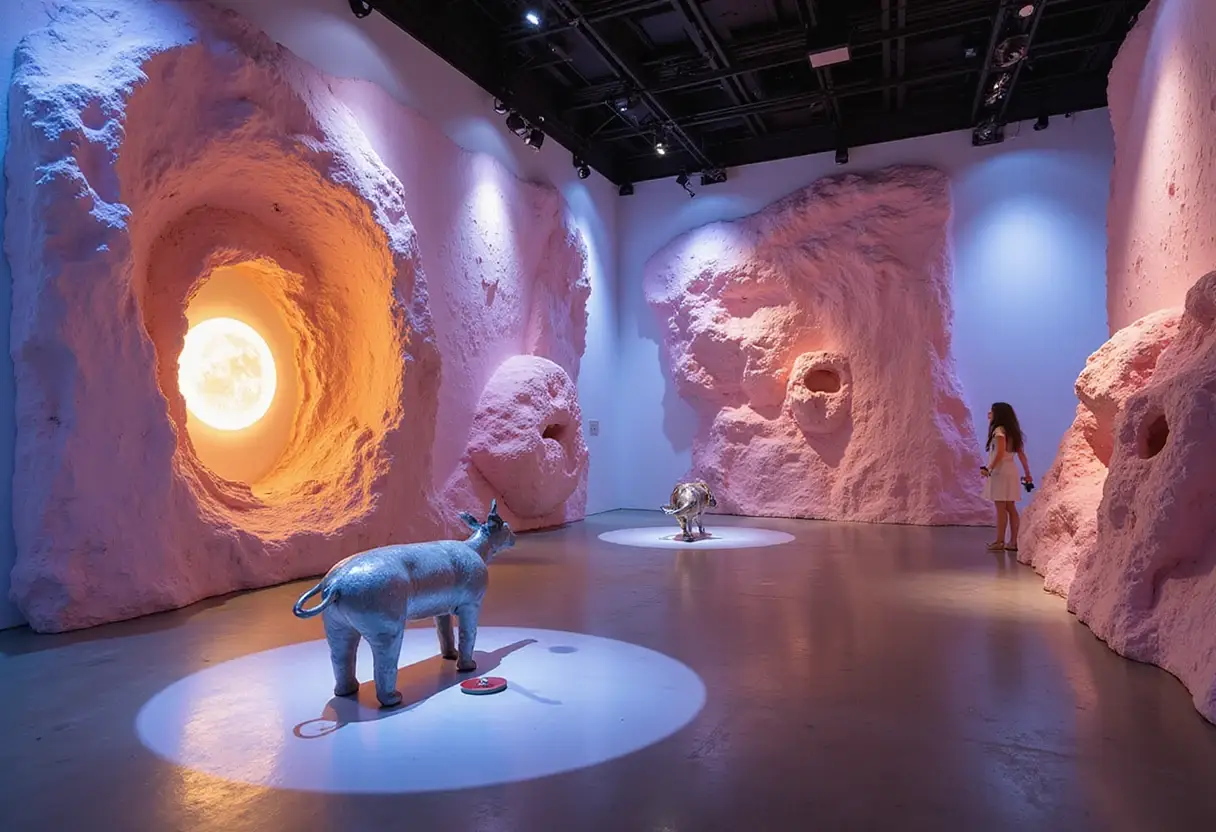
DeepForest³ sits on the museum's sun-filled upper floor. It looks like an abstracted forest — no leaves, no dirt, no moss. Stripped, birch-like trunks stand upright on a textured floor. ecoLogicStudio calls these 'biodegraders, built from 3D-printed bark-like shells made of algae biopolymers, [which] host living mycelium networks.' They feed on coffee grounds and develop a sinewy layer that functions as insulation.
Three components make up the system:
- Biodegraders — the algae-biopolymer trunks hosting living mycelium.
- Photosynthesizers — glass containers holding '50 liters of living cyanobacteria, actively capture CO₂ from the gallery environment.'
- Carbon storers — elements that digest waste material and give life to living lichen.
Tubes, seams and cords connect the parts. The result is not a space for living, the studio argues, but a space that lives, grows, digests and filters.
A decade of building with microbes
The Milan forest extends a project lineage that reaches back to EXPO Milano 2015. There, in the Future Food District's central square, ecoLogicStudio built The Urban Algae Folly: a canopy of triangular panels filled with Spirulina, a nutritious microalgae and effective CO₂-capturing organism. The system created a symbiosis between sun, algae and humans — more sun means more algae growth, and the CO₂ exhaled by people seeking shade fed the canopy. Architecture, the studio argued, should work with microbial life rather than exclude it.
In Nyon, Switzerland, in 2024, the studio delivered what it calls 'the world's first biotechnological healthcare garden that combines air-purifying algae cultures with medicinal plants.' The AirBubble is a circular, tent-like structure of semi-transparent fabric. Its circumference holds '36 large bioreactors in borosilicate glass which contain 350 litres of living green Chlorella algae cultures that can filter a flow of polluted air of 150 litres/minute.'
And in 2025, with the Synthetic Landscape Lab at the University of Innsbruck, the studio produced CryoflorE for MUDAC's Solar Biennial, Soleil·s — a near-hexagonal model resembling a miniature cityscape of cyanobacteria-filled high-rises. The designers 'capture and channel electrons generated through photosynthesis into electrical currents flowing along the copper wires embedded in the streetscape.' It is a first simulation of a city powered by bio-solar energy networks.
The book behind the show
DeepForest³ serves as a case study for Colomina and Wigley's book We the Bacteria (Lars Müller Publishers), a sequel to Are We Human? The authors critique contemporary architecture's obsession with sterility and reposition that hostility as a threat to human and planetary health. 'This book is covered in microbes,' they write — preliminary evidence of how pervasive single-celled organisms are. They advocate design that lets bacteria thrive.
Pasquero frames the stakes in bodily terms: 'We are microbial ecosystems, we are algorithmic networks. It is a necessary consequence that our home becomes an extension of these ecosystems and networks. Our home is our microbiome.'
Across these projects, bacteria, fungi and algae are not contaminants but participants in the environments we inhabit. ecoLogicStudio's wager is that buildings designed as living systems can deliver net-positive outcomes for human health too — a claim Milan's museumgoers could now breathe in directly.
Original: google.com
More from Priya Raman
Show full bio
News editor covering people, launches and day-to-day practice in construction industry, architecture, interior design at Built Current.
205 articles