The Loneliest Plant on Earth Lives Under Glass at Kew
A 130-year-old cycad at Kew, coral biobanks in Australia and a frozen zoo in San Diego show how buildings now house what the wild can no longer hold.
- Section
- Architecture
- Author
- By Grace Kim
- Filed
- Length
- 5 min read
Key takeaways
- Kew Gardens has kept a male cycad, Encephalartos woodii, alive since 1899; the species is Extinct in the Wild and no female has ever been found.
- Grimshaw, Arup and Haley Sharpe Design are building a 420-hectare Oman Botanic Garden with two glass biomes recreating native mountain environments.
- The Forever Reef Project in Port Douglas maintains over 225 coral species; a proposed Living Coral Biobank by Contreras Earl Architecture remains unbuilt.
- Australia's PlantBank vault (BVN, 2013) stores more than 100 million seeds; Svalbard's seed vault, open since 2008, holds collections at minus 18 degrees Celsius.
- Cells from a Przewalski's horse frozen in 1980 produced cloned foals Kurt and Ollie (2023) at the San Diego Frozen Zoo.
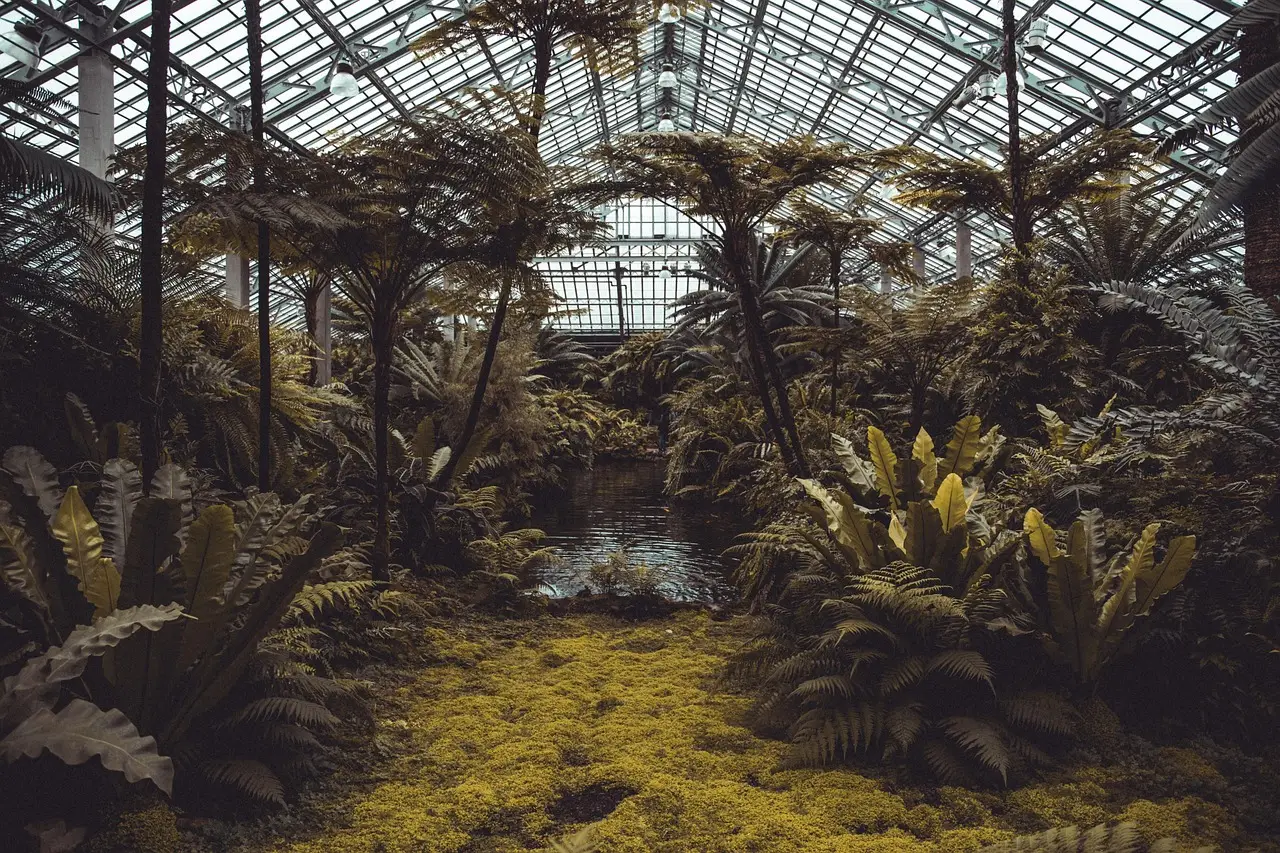
A cycad called Encephalartos woodii has spent more than a century beneath the glass roof of Kew Gardens' Victorian Temperate House — and it may be the loneliest plant on Earth. Discovered in South Africa in 1895, the species is known from a single wild individual, and it was male. Every surviving specimen is a clone of that original plant. A female has never been found, and the species is now classified as Extinct in the Wild.
Kew has kept its cycad alive since 1899. Yet the glasshouse cannot provide a mate or restore the forest it once inhabited. So what, exactly, has been saved?
The question points to a growing architectural responsibility. As habitats disappear, buildings are increasingly being designed to shelter parts of the natural world from the environmental changes taking place outside.
In his 2014 book Flight Ways, environmental philosopher Thom van Dooren describes extinction as the 'slow unravelling of intimately entangled ways of life.' A species exists through its relationships with other organisms and the places they inhabit. Preserving an individual is one thing. Sustaining the complex ecological world that supports it is another.
How do you rebuild a mountain inside a building?
At the foot of Oman's Al Hajar Mountains, a botanical garden is taking shape across 420 hectares of desert terrain. Designed by Grimshaw with Arup and Haley Sharpe Design, the Oman Botanic Garden will bring the country's varied landscapes together, including the misty forests of Dhofar and the cooler mountain environments of the north.
Two sweeping glass biomes will recreate the conditions required by some of Oman's most sensitive native plants. Cooling systems regulate the interior climates, while integrated shading controls the intense desert sunlight. Entire mountain environments are being reconstructed indoors, with the needs of endangered species informing the architectural design.
At Jersey Zoo, run by the Durrell Wildlife Conservation Trust, an ordinary room lined with glass terrariums holds miniature tropical habitats for poison dart frogs. Sprinklers and fogging machines simulate the rainfall that encourages the animals to breed. Strawberry poison dart frog mothers transport their tadpoles into small pools of water held within bromeliad plants, returning periodically to feed them unfertilized eggs.
Even the frogs themselves change under artificial conditions. In their native forests, poison dart frogs acquire their toxicity from the insects they consume. In captivity, a different diet leaves them largely harmless — a sign of how deeply their biology depends on the world beyond the glass.
Can an ocean species survive in a building?
The ocean is becoming another subject of architectural preservation. In Port Douglas, Australia, Great Barrier Reef Legacy's Forever Reef Project maintains more than 225 coral species within controlled aquarium systems. A proposed Living Coral Biobank, designed by Contreras Earl Architecture with Arup, imagines a permanent home for the collection inside a sculptural concrete building inspired by mushroom coral.
The proposal remains unrealized, while the existing facility keeps operating. Its living colonies hint at a future in which fragments of a reef survive through artificial systems, even as their marine habitats grow increasingly hostile.
Other facilities preserve life in a dormant state. At the Australian PlantBank in Mount Annan, designed by BVN and completed in 2013, mirrored facades reflect the surrounding vegetation. Visitors can look into research laboratories, while deeper inside a temperature-controlled vault holds more than 100 million individual seeds. Seeds collected from threatened habitats can remain viable for decades, awaiting conditions that allow them to grow again.
What does a frozen zoo actually bring back?
At the San Diego Zoo Wildlife Alliance's Frozen Zoo, established in 1975, living cells from endangered animals sit in cryogenic storage, sometimes long after the animals themselves have died. In 1980, scientists froze cells belonging to a Przewalski's horse named Kuporovitch. The horse died in 1998, but his genetic material survived. Forty years after the cells entered storage, they produced a cloned foal named Kurt. A second foal, Ollie, followed in 2023.
Both horses carry genetic material that had become underrepresented in the surviving population. Their births offer a possible means of restoring genetic diversity to the endangered species. The architecture behind it is surprisingly ordinary: laboratories and liquid-nitrogen storage vessels holding the biological futures of animals in forms almost impossible to recognize as life.
On the Norwegian archipelago of Svalbard, a narrow concrete entrance emerges from a snow-covered mountainside, its angular form lit by an artwork from Norwegian artist Dyveke Sanne. The Svalbard Global Seed Vault extends more than 100 meters into the rock, where agricultural seed collections from around the world sit at minus 18 degrees Celsius. Since opening in 2008, it has safeguarded crop diversity against the loss of seed collections elsewhere.
In 2015, its purpose was tested when conflict in Syria disrupted a major agricultural seed bank. Researchers retrieved seeds previously deposited at Svalbard and rebuilt collections in Lebanon and Morocco. The seeds were planted and multiplied, with some eventually returned to the vault — a rare example of an architectural archive whose contents have already helped regenerate what was lost.
Who decides which species survive?
In their 2020 paper From Ark to Bank, researchers Esther Breithoff and Rodney Harrison describe biological archives becoming 'investment banks,' where 'genetic materials can be actively reworked and revived to build new futures.' That reframing complicates the familiar image of a modern Noah's Ark. Preserved material may eventually shape future animal populations, raising questions about who determines which species receive protection and how their biological material is used.
Those decisions also depend on resources. Cryogenic storage requires reliable energy, and maintaining artificial habitats demands sustained funding. Some forms of life, in other words, are much easier to preserve than others — and as habitats keep shrinking, that inequality is set to decide what the wild of the future looks like.
Original: google.com
More from Grace Kim
Show full bio
Staff writer covering money, funding and market shifts around construction industry, architecture, interior design at Built Current.
144 articles