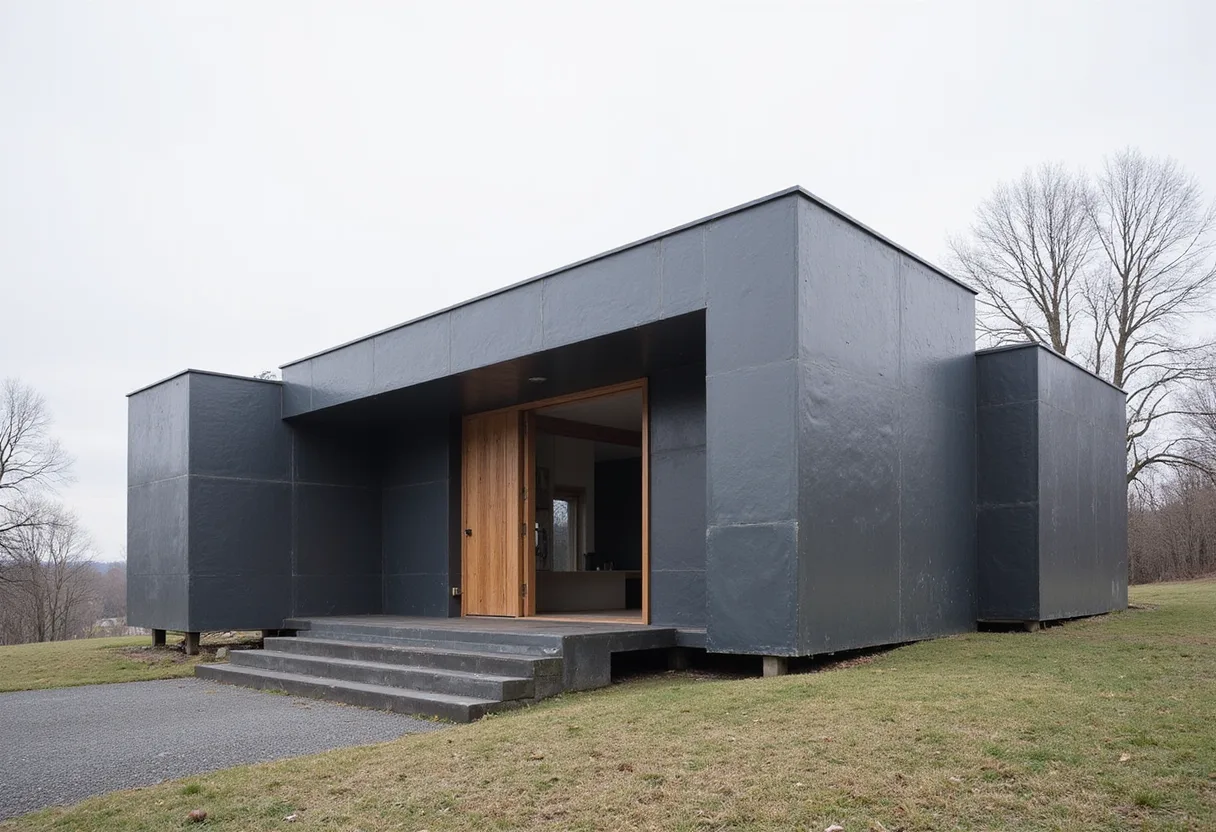
David Chipperfield Builds a Pavilion for One 11-Metre Kiefer Painting
An 11-metre Anselm Kiefer canvas has never been exhibited — until now. David Chipperfield Architects built a monolithic concrete pavilion around it in Künzelsau, Germany.
- Section
- Architecture
- Author
- By Priya Raman
- Filed
- Length
- 2 min read
Key takeaways
- The pavilion houses a single painting, Anselm Kiefer's Schwarze Flocken (2007), measuring 11m high by 7.10m wide.
- The work is the largest Kiefer in the Würth Collection and had never previously been exhibited due to its size.
- The building sits in the sculpture garden of Museum Würth 2 at the Carmen Würth Forum in Künzelsau, Germany.
- Its three-layer wall construction — concrete, brickwork and clay plaster — provides natural climate control without mechanical systems.
- The pavilion was designed in close collaboration with Kiefer, who shaped the room's proportions, openings and wall colours.
By Priya Raman
Anselm Kiefer's painting Schwarze Flocken measures 11 metres in height and 7.10 metres in width. Until now, no museum could show it. A new pavilion by David Chipperfield Architects in Künzelsau, Germany, changes that.
The building opened in the small town north-east of Stuttgart. It stands in the sculpture garden of Museum Würth 2, part of the Carmen Würth Forum cultural centre — also designed and realised by David Chipperfield Architects.
What does one painting need from a building?
A lot, it turns out. The pavilion is a single monolithic volume with bush-hammered concrete walls (a hammered finish that leaves a coarse, stone-like texture). It reads as a sculpture in itself, and it matches the architectural language of the existing forum buildings.
Inside, the proportions, openings and colouring of the wall surfaces were determined in collaboration with Kiefer himself. The room has no strict artificial climate control or lighting systems. Instead, the architects optimised a three-layer wall construction — concrete, brickwork and clay plaster — to achieve natural climate control.
The result, per the design team, is a tranquil atmosphere centred fully on the artwork. That's the point. One work, one room, no competition.
Why has the painting never been shown?
Schwarze Flocken (2007) is the largest work by Kiefer in the Würth Collection. Its dimensions kept it out of galleries. The new pavilion was tailored specifically to the painting, and its scale finally gives the piece a permanent display context.
The title translates as "Black Flakes" and comes from a poem by Romanian poet Paul Celan, written around July 1944 in Czernowitz (now Chernivtsi, Ukraine) after his return from a forced labour camp. The poem responds to news of his parents' fate during the Holocaust — his mother was shot, his father died of typhus in a camp in Transnistria, in Moldova. Kiefer's painting, through abstraction, captures the poem's harsh winter landscape and grief.
Kiefer is best known for confronting paintings of post-war Germany, sitting at the intersection of contemporary art and neo-expressionism (a movement reviving expressive, raw painterly gesture).
What does this change for museum design?
It's a working model for art-driven architecture. Rather than adapting a canvas to a room, Chipperfield's team built the room around the canvas — from wall depth to plaster colour, with the artist in the loop. The passive climate strategy, using layered masonry instead of mechanical systems, also points to a lower-energy path for galleries holding single, monumental works. Expect the Künzelsau pavilion to become a reference case for collector museums commissioning purpose-built spaces around oversized pieces.
Original: google.com
More from Priya Raman
Show full bio
News editor covering people, launches and day-to-day practice in construction industry, architecture, interior design at Built Current.
135 articles