A Living Garden That Changes Color to Show How Moths See Flowers
At Ars Electronica 2026, Adrien Lucca's Parallel World uses programmable LEDs to show how flowers might look to elephant hawkmoths — and what streetlights do to pollinators.
- Section
- Landscape & Public Space
- Author
- By Elena Vasquez
- Filed
- Length
- 4 min read
Key takeaways
- Parallel World by Adrien Lucca debuted at Ars Electronica 2026 in Linz after an earlier showing at Łaźnia in Gdańsk.
- A 2017 Nature study found nocturnal flower visits fell 62 percent under artificial light compared with dark areas.
- Research published in Nature in 2002 showed elephant hawkmoths distinguish color under dim starlight.
- The installation was developed with color scientist Ali Aiman Raza, researcher Colas Schretter and biologist Marko Ilić.
At the 2026 Ars Electronica Festival in Linz, a living garden changes color on a cycle while every plant stays exactly where it was planted. The installation, Parallel World by Brussels-based artist Adrien Lucca, uses computer-controlled LEDs to suggest how flowers might appear to a moth.
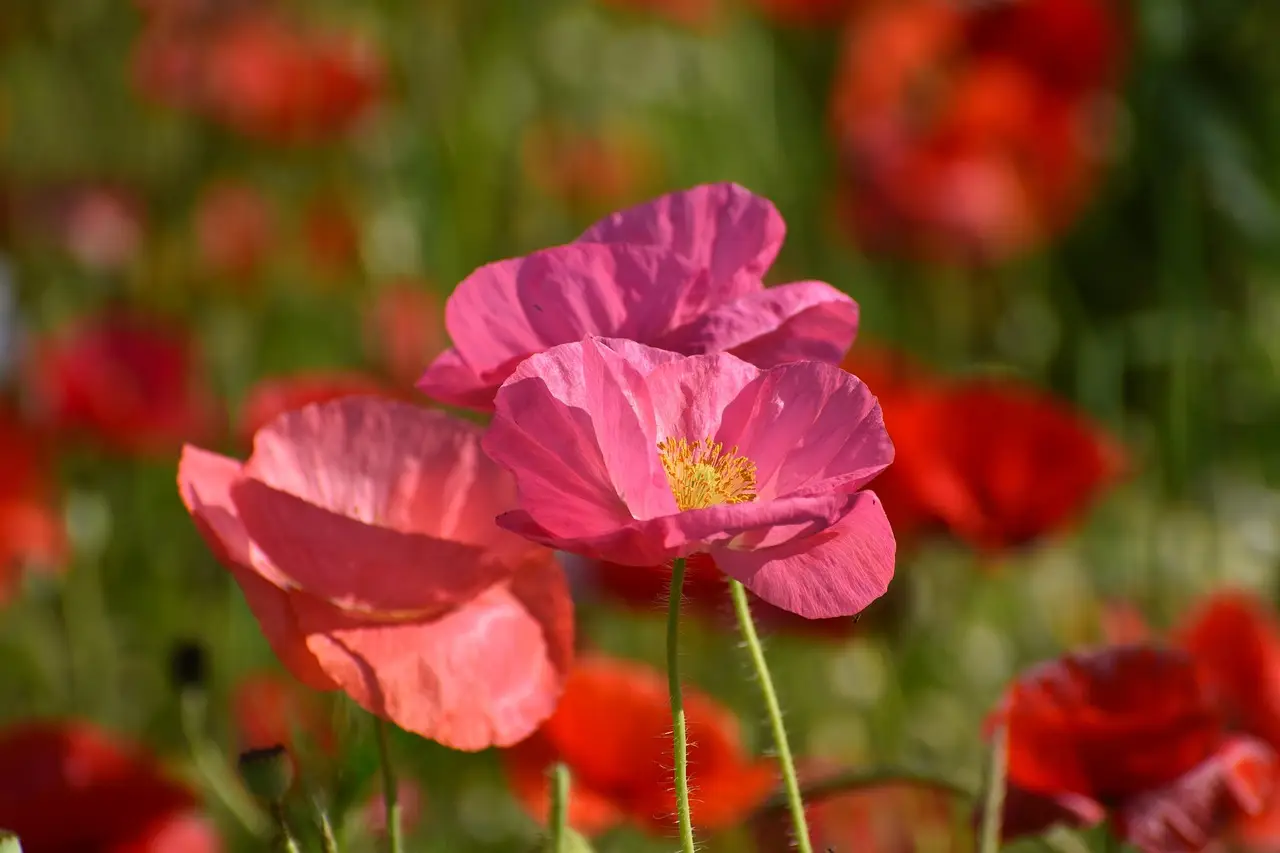
The setup is simple. Real plants sit beneath a programmable lighting system, forming a small indoor meadow of delicate stems, dense foliage and scattered pink blossoms. When the light shifts, the whole composition changes. Under bluish light, green leaves turn brown or nearly black, and the flowers become unusually bright against their surroundings. The mechanism is wavelength reflection: the colors we associate with a garden are only one interpretation of what exists there.
How does a moth see at night?
The installation draws on the visual system of the elephant hawkmoth (Deilephila elpenor), a nocturnal pollinator that distinguishes colors under exceptionally dim light. Humans gradually lose color perception after sunset. These insects keep identifying flowers beneath the faint illumination of the night sky.
Their eyes respond to ultraviolet wavelengths alongside the blue-to-green regions of the spectrum — visual information beyond human perception. Research published in Nature in 2002 established that the species can distinguish colors under conditions comparable to dim starlight.
Lucca developed the 2026 installation with color scientist Ali Aiman Raza, researcher Colas Schretter and biologist Marko Ilić, whose work focuses on insect vision. Together they use programmable lighting to translate aspects of the moth's visual environment into colors human visitors can experience. The approximation has limits: human eyes can't directly perceive ultraviolet light, and the moth's compound eyes process visual information differently from ours. Even so, the changing garden gives tangible form to a sensory experience that would otherwise be inaccessible.
Where did the project come from?
The project grew out of Lucca's earlier experiments with plant pigmentation and artificial light. In 2022, he worked with Brussels-based LMNO Gallery and Belgian seed producer Ecosem on Mondes parallèles, an installation of wildflowers under programmable lamps. By adjusting the spectrum, he could change the relationships between colors within the planting — bringing certain flowers forward while others receded into the vegetation. That experiment explored how flowering plants developed visual characteristics through long evolutionary relationships with pollinating insects.
During a 2024 residency with Gluon in Brussels, Lucca turned to the elephant hawkmoth and the colors of the night. His 2025 exhibition À l'aube du crépuscule at LMNO brought together paintings and luminous sculptures tracing twilight's changing light. A drawing titled Rosetta compared human and hawkmoth visual sensitivities, using visible red as a substitute for ultraviolet.
Parallel World was presented at Łaźnia in Gdańsk, Poland, before Ars Electronica 2026, where it appeared in the festival program Negotiating Beyond Humanity. Development credits include Studio Adrien Lucca, Gluon, STUDIOTOPIA 2.0, S+T+ARTS and LMNO.
Why does this matter beyond the gallery?
The research points at a real ecological problem: artificial lighting shapes contemporary nocturnal landscapes. Flowers have evolved colors and patterns that communicate with pollinators, including markings visible only in ultraviolet light. Streetlights can alter those visual signals after dark.
A 2017 study in Nature found that nocturnal flower visits dropped by 62 percent in artificially illuminated plant communities compared with dark areas — a decline with consequences for plant reproduction. To put that in perspective, roughly three in five night visits simply don't happen under artificial light.
The type of illumination matters too. A 2021 study in Nature, using the elephant hawkmoth's visual system as a model, examined how different artificial light sources affect the visibility of flowers against foliage. Some spectra preserved or enhanced color contrast. Narrow-band orange lighting made floral colors harder for the moth to distinguish. The wavelength and intensity of artificial light can change how insects navigate, even when the environment looks perfectly legible to human eyes.
Lucca's earlier work applied custom-built lighting to painted surfaces and architectural spaces. Here, the same methods meet living plants and the animals that encounter them. The installation leaves open the possibility of environments designed around other species' sensory needs — streetlights and illuminated gardens are generally built around what people need to see, even though their light extends into habitats occupied by countless other organisms. In Parallel World, a change in illumination is enough to reveal how much of a familiar landscape depends on the observer.
Original: google.com
More from Elena Vasquez
Show full bio
Senior reporter covering money, funding and market shifts around construction industry, architecture, interior design at Built Current.
242 articles