14,858 Reclaimed Tiles and 16,800 Recycled Plates Redefine Material-Led Design
Koshish House reuses 14,858 reclaimed Mangalore tiles; RAD+ar turns 4,800 kg of plastic waste into 16,800 shading plates; BaleBio links Flores bamboo cooperatives with Bali manufacturing.
- Section
- Materials & Products
- Author
- By Marcus Bennett
- Filed
- Length
- 4 min read
Key takeaways
- Koshish House in Kochi incorporates 14,858 reclaimed Mangalore tiles collected from four locations.
- Lattice Creative Garden in Jakarta used 4,800 kg of recycled plastic to produce 16,800 lattice plates for solar shading.
- BaleBio's laminated bamboo roof rises approximately 8.5 meters; Eco-Mantra's LCA reports a 110 percent reduction in Stage A emissions against its stated baseline.
- UNEP's Global Status Report for Buildings and Construction 2025–2026 identifies the sector as a major contributor to global emissions and material extraction.
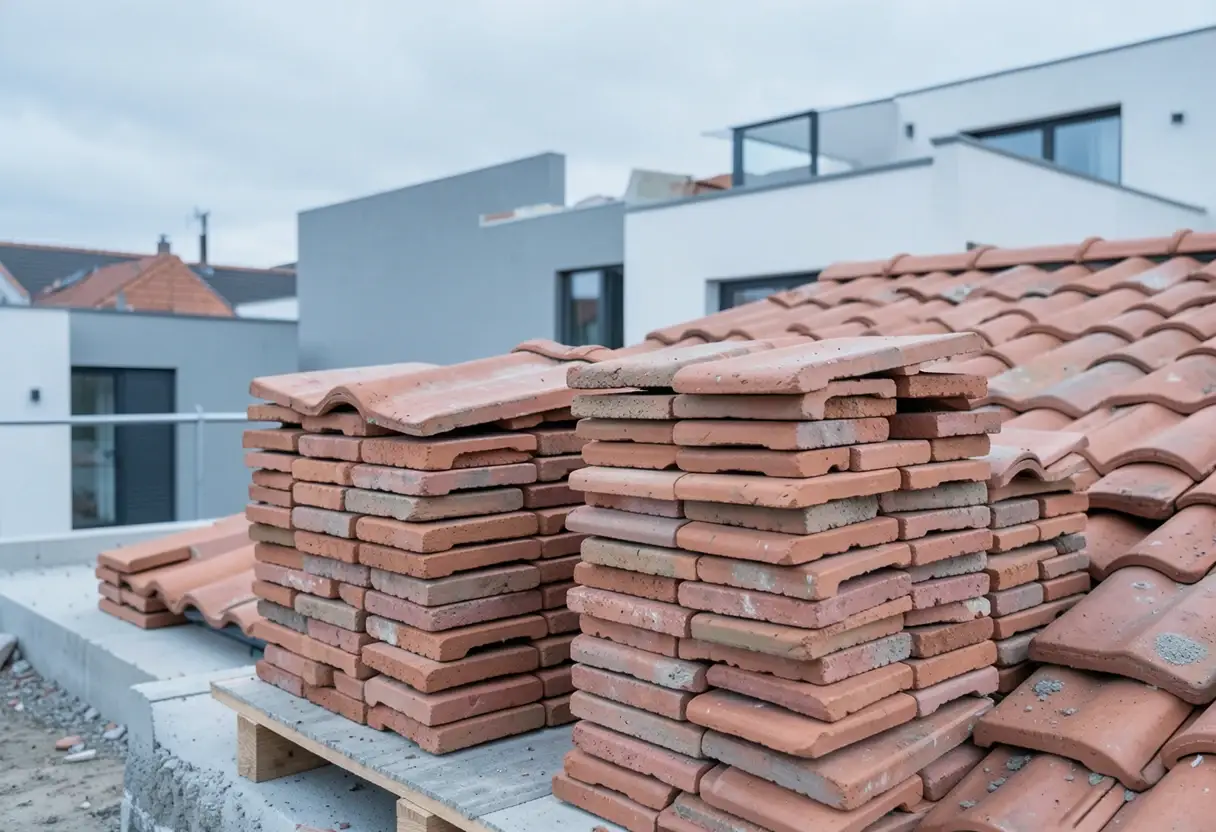
A house in Kochi built by Koshish incorporates 14,858 reclaimed Mangalore tiles, and the number was not a specification choice — it was the available stock. The tiles, collected from four locations, now cover the building's pathways, walls and roof. Steel and windows came from a textile factory eight kilometers from the site. What changes for practitioners is the sequence of decisions: the quantity and condition of recovered components determine the building's dimensions, the distribution of materials and the sequence of construction, inverting the usual process of specification and procurement.
Koshish House sits at one end of a spectrum of material-led design. Two further projects — RAD+ar's Lattice Creative Garden in Jakarta and Cave Urban's BaleBio pavilion in Bali — extend the approach through recycling and engineered bamboo. Together they show how material sourcing and processing can shape architectural decisions before any product reaches the building site.
How does a recovered stock drive design?
Recovered components rarely arrive in standardized dimensions or predictable quantities. Architects must establish how many usable components exist, what condition they are in and whether their dimensions suit the proposed application. At Koshish House, tiles conventionally used for roofing also appear in pathways and walls. Each component required checking for damage and assessment against the demands of its proposed use. The design, in effect, was informed by what the recovered stock could support.
What does recycling demand beyond collection?
Recycling introduces a different material process. Plastic recycling involves collecting and processing discarded material into a form that can be manufactured into new components — components that must achieve consistent dimensions and properties for their intended use.
RAD+ar's Lattice Creative Garden demonstrates the step. According to the project description, 4,800 kilograms of plastic collected from the SCBD business district's waste stream were manufactured into 16,800 lattice plates. The plates hang from a tensioned cable system, forming an undulating external screen that provides solar shading. The architects relate the screen to traditional Indonesian latticework, adapting patterned openings and filtered light through recycled-plastic plates and tensioned cables. The plates are part of the building's shading system and visual composition, not a material used only for its recycled content.
Environmental performance depends on more than recycled content. Service life hinges on how the plastic responds to prolonged exposure, how often the plates need maintenance or replacement, and whether they can be recovered at the end of use. A sound assessment accounts for material diverted from disposal, the component's service life and its end-of-life options.
What does engineered bamboo change?
At Mertasari Beach in Bali, Cave Urban's 84-square-meter BaleBio pavilion reinterprets the Bale Banjar, a traditional Balinese community meeting space. Its laminated bamboo structure comes through Indobamboo, which links smallholder forestry cooperatives in Flores with manufacturing in Bali. The curved laminated bamboo roof rises to approximately 8.5 meters, spanning an open communal pavilion beneath it. The project also incorporates reclaimed roof tiles and Ulin wood.
BaleBio extends the material focus from recovery and recycling to provenance and engineering. Lamination allows the bamboo to become structural members; the supply chain links forestry cooperatives in Flores with production in Bali and construction on site. For bamboo, practitioners must consider the source of the culms, the expertise involved in lamination and the organizations responsible for processing and transport.
Eco-Mantra's life-cycle assessment of BaleBio reports a 110 percent reduction in Stage A emissions against its stated conventional baseline. The result is attributed primarily to the bamboo system, including the carbon stored in the material and the impacts of its production and transport. The finding applies only to BaleBio's stated assessment boundary and baseline; it cannot be generalized to other bamboo products, reclaimed materials or locally sourced components. Wider comparison would need to account for service life, maintenance, transport and end-of-life treatment.
What stands in the way of reuse at scale?
The United Nations Environment Programme's Global Status Report for Buildings and Construction 2025–2026 identifies buildings and construction as a major contributor to global emissions and material extraction. In a 2020 systematic review published in Waste Management & Research, Kambiz Rakhshan and colleagues classify barriers to building-component reuse as economic, technical, social, regulatory and organisational. Concerns about component quality, regulatory compliance, liability and cost make architects and contractors reluctant to specify recovered materials.
Each approach also depends on a supply chain capable of delivering material in a construction-ready form:
- Reuse requires systems for locating components, assessing their condition and storing them until use.
- Plastic recycling requires collection and processing facilities, plus manufacturers able to produce consistent components.
- Engineered natural materials require management of the source, suitable processing and coordination between producers, manufacturers and construction teams.
Wider adoption will depend on reliable systems for assessing components, documenting their condition, establishing liability and coordinating procurement. Until those systems mature, the Koshish, RAD+ar and Cave Urban projects show what becomes possible when design begins with an inventory of available resources rather than a specification sheet.
Original: caveurban.com
More from Marcus Bennett
Show full bio
Correspondent covering money, funding and market shifts around construction industry, architecture, interior design at Built Current.
343 articles