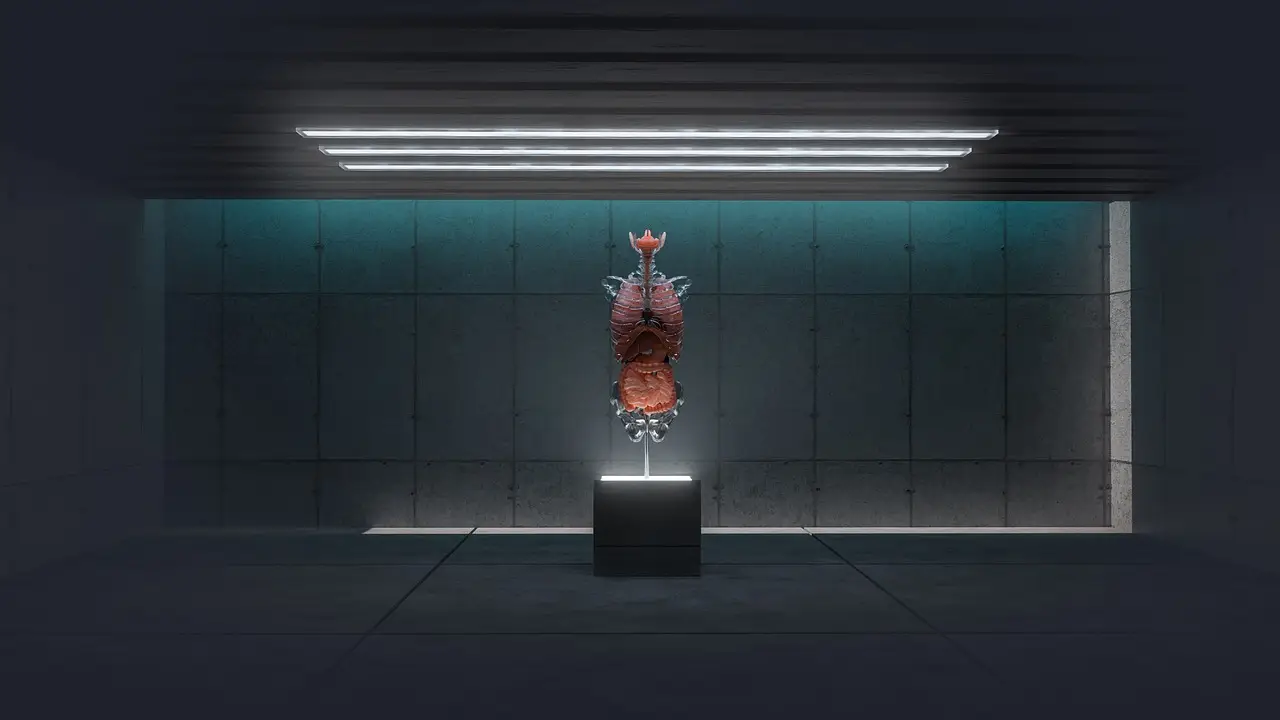
Walker Art Center Launches Design Triennial Flesh-like Speakers
Beyond Materialism, the first Walker Design Triennial, opens with Lucas Muñoz Muñoz's flesh-like latex speakers and runs at the Walker Art Center until 14 February 2027.
- Section
- Materials & Products
- Author
- By Marcus Bennett
- Filed
- Length
- 3 min read
Key takeaways
- The inaugural Walker Design Triennial, Beyond Materialism, runs 17 October 2026 to 14 February 2027 at the Walker Art Center in Minneapolis.
- Curator Joseph Grima said the show questions "the association between design and optimisation".
- Lucas Muñoz Muñoz's All Ears comprises latex-covered speakers playing Minneapolis field recordings.
- Historical works include Alessandro Mendini's 1970s Lassù, shown with depictions of the chair burning.
- Espace Aygo's post-apocalyptic appliances derive from the studio's 2022 conversion of a derelict apartment building.
Latex speakers that look like flesh, wired to play field recordings of Minneapolis, anchor the first Walker Design Triennial, which opened at the Walker Art Center on 17 October 2026 and runs to 14 February 2027.
The exhibition, titled Beyond Materialism, fills a series of galleries in Minneapolis, Minnesota, with conceptual design at every scale, from historical pieces to newly commissioned installations. Curator Joseph Grima framed the show as an argument against the discipline's current defaults.
"We live in an age that is conditioned to think that anything and everything can be designed, and often what is that everything can be optimised," said Grima. "And it's precisely this association between design and optimisation that this exhibition intends to question."
What does the show contain?
The checklist spans five decades. Historical work includes Italian radical designer Alessandro Mendini's 1970s Lassù, displayed alongside depictions of the chair's performance on fire. Contemporary participants include US designers Germane Barnes and Theaster Gates, plus dozens of international studios. Terracotta plinths support objects large and small across the exhibition design.
Several large-scale works were commissioned directly for the event:
- Spanish designer Lucas Muñoz Muñoz's All Ears, a set of latex-covered speakers programmed to play sounds recorded in Minneapolis in the preceding months; a sleek soundboard lets visitors play tracks routed through the amorphous speakers simultaneously, to cacophonic effect.
- A fabric-covered kiosk by Vessel, spooled with two massive rolls of fabric based on cofounder Navine G Dossos's paintings of her and her partner James Bridle's self-built home.
- Post-apocalyptic appliances built from found objects by Brussels-based Espace Aygo, derived from the studio's 2022 transformation of a derelict apartment building into a home and art space.
Muñoz told Dezeen the installation was designed to be a "microphone" for the city itself and "make visible the act of listening". The broadcast was also projected out of the gallery as a radio sequence.
Which designers appear in the smaller rooms?
The themes of fleshy objects, post-apocalypticism and reuse carry into the smaller-object galleries. London-based Superflux showed pieces from its Relics of Abundance series, imagining objects a future civilisation might build from our own in a time of scarcity, including a chair made from straw and rebar.
Other contributions:
- Austro-Canadian designer Christoph Wimmer Ruelland: furniture assembled from found objects, extraordinarily colour-matched.
- Korean designer Jonghoo Jeong: a fountain made from jerrycans, referencing his past practice of dumping the objects during his process.
- Athens-based Astronauts: inflated metal works informed by autobody shops — love seats, chairs and a seesaw, iridescent yet familiar.
- Italian-German Maximilian Marchesani: a structural piece of smartphone glass refracting metal-coated leaves, and a chandelier combining LEDs with branches.
- South Korean Wknd Lab: stools made from discarded shells.
Moon Seop Seo, Studio Ker, Objects of Common Interest, Stef Fusani, Kevin Quale and Kostas Lambridis also took part, a roster of avant-garde design refracted through the lens of Grima and artistic director Asli Altay.
Why launch a triennial now?
Grima, who has curated and taught at institutions including Design Academy Eindhoven and the international exhibition series Alcova, positioned the inaugural edition as a pause rather than a product cycle. It was an "opportunity to stop, take stock for a moment, and reflect on what design is today," he said.
For practitioners, the signal is clear: a major US institution has staked its new recurring platform on conceptual, reuse-driven work that refuses optimisation as the discipline's measure — a counterweight to the trade-fair circuit that other recent showcases, from Armadillo's reused-shingle furniture to Rafael Prieto's fragments of New York buildings, have begun to test.
Original: walkerart.org
More from Marcus Bennett
Show full bio
Correspondent covering money, funding and market shifts around construction industry, architecture, interior design at Built Current.
230 articles