Mirrored Walls Turn One Tree into an Endless Forest in Shanghai
Chang Hao Studio's Infinite Grove uses two curved mirrored-steel walls to multiply a single tree into an endless forest. The prefabricated pavilion travels Shanghai with a new tree each season.
- Section
- Architecture
- Author
- By Priya Raman
- Filed
- Length
- 3 min read
Key takeaways
- Infinite Grove by Chang Hao Studio debuted at the 2026 Shanghai International Flower Festival (April 18 – May 10, 2026), which drew approximately 29.5 million visits.
- Two curved mirrored-steel walls and frosted panels multiply a single tree into a forest with no visible edge inside a pavilion only a few steps across.
- The prefabricated, foundation-free structure fits on a single truck and changes its central tree each season — a flowering azalea in spring, an olive tree in summer.
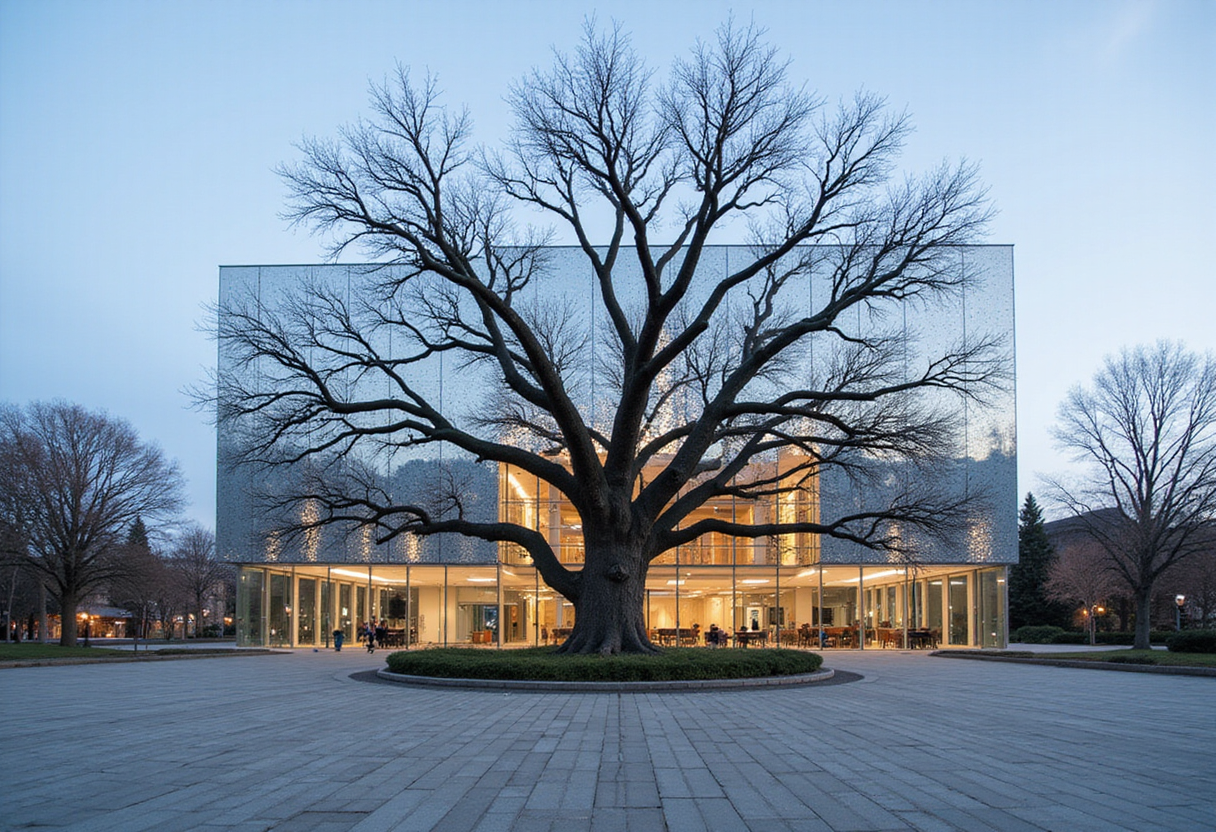
Two curved mirrored-steel walls multiply a single tree into a forest with no visible edge. That is the entire premise of Infinite Grove, a traveling pavilion by Chang Hao Studio in Shanghai, first presented in spring at the 2026 Shanghai International Flower Festival.
The pavilion has since moved across the city, pairing the same structure with different trees for each season. Its compact material palette consists of curved mirrored steel, frosted panels, and one living tree. Frosted panels diffuse daylight into a soft haze, making it difficult to distinguish the real tree from its reflections.
A staged reveal, borrowed from the classical garden
A circular entrance reveals only part of the interior. The experience unfolds through three stages according to the studio: a partial view through the circular opening, the first glimpse of the reflected forest, and the realization that the entire scene originates from a single tree. Inside, the tree appears above while its repeated reflections surround the visitor, incorporating their own figure into the mirrored landscape.
The design draws on two principles of the classical Chinese garden: framed views (kuangjing) and borrowed scenery (jiejing). Chang Hao Studio uses them as spatial strategies rather than historical references. Traditional gardens often use a small doorway or window to frame a landscape beyond its apparent scale; Infinite Grove applies the same approach through its circular entrance, withholding the full view until the visitor enters. Here, the borrowed scenery is the tree itself. Reflections extend it beyond the limits of the site, turning a pavilion only a few steps across into a forest-like interior.
Festival debut among forty gardens
Xiaohongshu (RED) Design Week selected Infinite Grove for the 2026 Shanghai International Flower Festival, held from April 18th to May 10th, 2026. The expanded festival brought gardens beyond traditional exhibition grounds and into shopping districts, parks, and streets across two main venues and ten sub-venues throughout Shanghai. The festival received approximately 29.5 million visits.
The pavilion was installed at the Huangpu main venue in Xintiandi among more than forty themed gardens. Within the dense urban setting, it uses a compact footprint to create an interior that appears much larger than its physical dimensions.
Prefabricated, foundation-free, truck-portable
The structure is prefabricated in a factory and requires no foundations. On site, it is simply positioned in place, limiting its impact on the ground. The completed pavilion can be transported on a single truck, allowing the entire structure to move between locations.
The central tree changes according to the season and setting. At the flower festival in spring, a flowering azalea stood at the center, its blossoms multiplying across the mirrored walls to create a forest of color. For its second site in summer, the azalea was replaced by an olive tree. Its silver-green foliage and twisting trunk gave the reflected landscape a lighter character. The structure remained unchanged, while the different tree produced a new spatial and visual environment.
The pavilion continues to travel through Shanghai as a mobile installation, with each new tree reshaping the forest created inside the two mirrored walls.
Project information
- Name: Infinite Grove
- Architect: Chang Hao Studio
- Design team: Hao Chang, Fan Liu, Chao Li
- Location: Shanghai, China
Original: changhaostudio.com
More from Priya Raman
Show full bio
News editor covering industry trends and analytics at Built Current.
63 articles