Kengo Kuma's 'Losing Architecture': How a 1964 Encounter Built a Career
A 1964 encounter with Kenzo Tange's Yoyogi Gymnasium set Kengo Kuma on a path to 'losing architecture' — buildings that yield to place rather than dominate it.
- Section
- Architecture
- Author
- By Marcus Bennett
- Filed
- Length
- 4 min read
Key takeaways
- Kengo Kuma decided to become an architect in 1964 after seeing Kenzo Tange's Yoyogi National Gymnasium at age ten.
- Kengo Kuma & Associates, founded in Tokyo around 1986, now operates from Tokyo, Paris, Shanghai, Beijing and Seoul.
- KKAA's first major overseas project, Great (Bamboo) Wall in China, completed in 2002.
- V&A Dundee, Kuma's Scottish waterfront museum, opened in 2018.
- 2026 saw two new Kuma books: Substance (Images Publishing) and Kengo Kuma: New Works (Thames & Hudson, September).
A ten-year-old boy stood before Kenzo Tange's Yoyogi National Gymnasium in 1964, abandoned his plan to become a vet, and vowed to become an architect. That boy was Kengo Kuma, now among Japan's most globally celebrated practitioners and founder of the Tokyo-based Kengo Kuma & Associates (KKAA).
More than six decades later, Kuma's portfolio spans restaurants, residences, theatres and public spaces across the world, unified by an architectural language that draws on traditional Japanese aesthetics: minimalist, modern and crafted.
What defines the Kuma approach?
KKAA's buildings share a recognizable DNA. A sensitivity to emptiness. A play of light and shadows. Soft boundaries between inside and out, rhythmic joinery, and a natural material palette running from wood and bamboo to paper and stone.
Human-scale buildings that harmonise with their setting — culturally, environmentally, materially — remain key, with nature typically the most important component in the studio's projects.
Landmark works make the argument concrete:
- Japan National Stadium (2019) — layered eaves, timber joinery and plant-filled spaces, used for the Tokyo Olympics.
- Nezu Museum, Tokyo (2009) — temple-like serenity, clean lines, angled shadows and bamboo walkways.
- Lotus House (2005) — a private residence in the mountains of Kanagawa Prefecture with a chequered façade of travertine and air, layered and light-filtering.
- V&A Dundee (2018) — a structural dialogue between nature, architecture and place inspired by Scottish cliffs, opened on the city's waterfront as KKAA's layered-horizontalist breakthrough abroad.
How did a traditional childhood shape him?
Kuma grew up in a traditional wooden house built by his grandfather in a small town between Tokyo and Yokohama, surrounded by rice paddies, woods and farmland in an area still untouched by post-war urbanisation. He was initially embarrassed by his tatami, paper and earthen-walled home as schoolfriends moved into shiny new housing developments along the train line.
Retrospectively, he credited that nature-rooted childhood with the sensitivity to craftsmanship, light and natural materiality that now underpins his design philosophy.
After the Yoyogi encounter, he studied architecture at the University of Tokyo under architects Hiroshi Hara and Yoshichika Uchida, then moved to New York in 1985 as a visiting scholar at Columbia University. The distance proved decisive. It compelled him to buy tatami mats, study tea and read The Book of Tea, Okakura Kakuzo's seminal 1906 work on traditional Japanese aesthetics.
What is 'anti-object' architecture?
Kuma set up his practice in Tokyo around 1986, first experimenting with monumental work such as M2, a structure for Mazda built in the final throes of the bubble years. After the bubble collapse, he shifted to smaller rural projects, working with artisans and carpenters using traditional construction techniques.
From this period emerged 'anti-object', set out in a 2000 book of the same title: architecture should not be isolated from its setting but dissolve the boundaries between structure and environment, engaging regional materials, topography, communities and cultural identity.
KKAA's first major overseas project tested the idea. Great (Bamboo) Wall in China, a 2002 private residence, uses a minimalist linear bamboo form flowing along an undulating ridgeline — conceived, in Kuma's words, as 'a criticism toward the conventional form of architecture that tends to seek to be an isolated object among the environment'.
He extended the thesis in 2004 with makeru kenchiku, or 'losing architecture': buildings should yield to their environment rather than dominate the landscape. The idea runs from Water/Glass in Atami (1995), a guesthouse dissolving into coast through water, glass and sky, to the Hiroshige Museum (2000), whose vertical louvres echo rain in the artist's woodblock prints and were restored earlier this year.
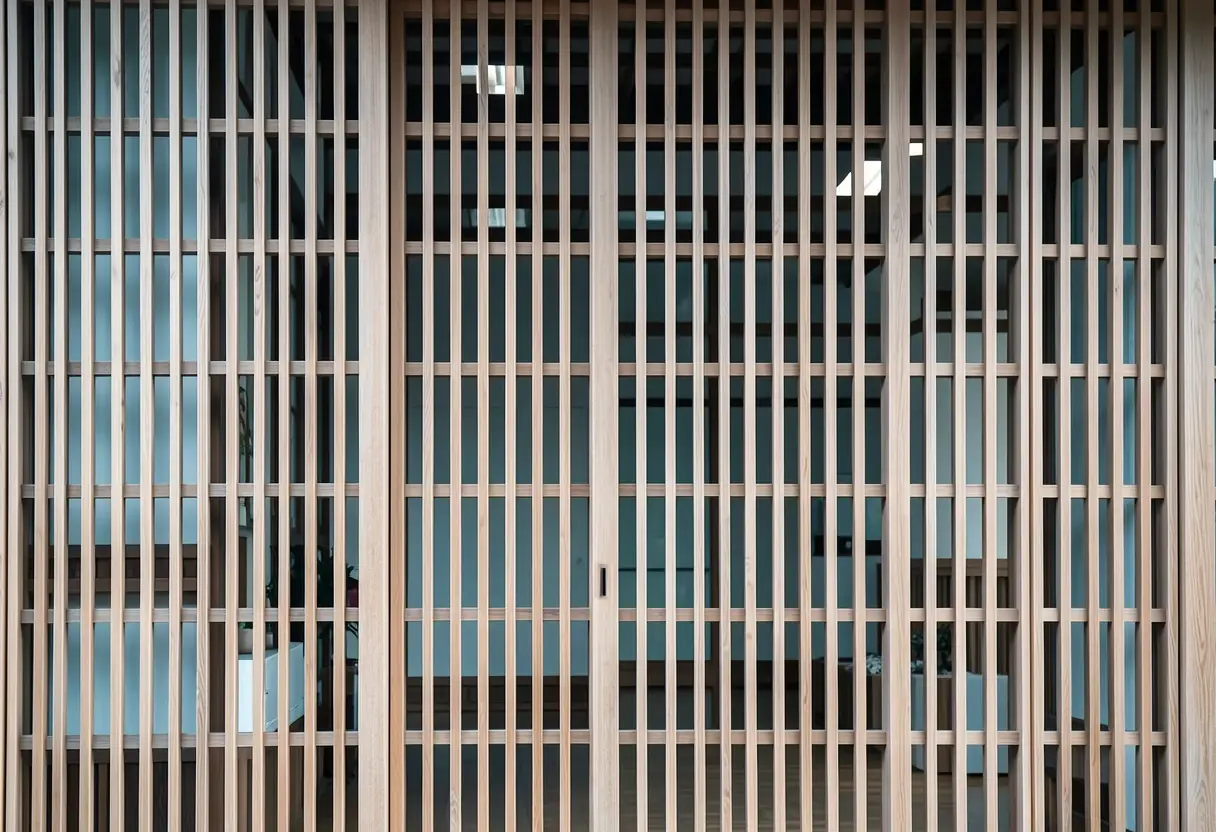
Craftsmanship carries the philosophy at detail scale — lattices, slats, screens, joints — breaking architecture into small modular components. The GC Prostho Museum Research Center in Kasugai, Aichi (2010), inspired by a traditional interlocking wooden toy, built its intricate latticed façade from a three-dimensional grid requiring no nails or glue.
What is the studio delivering now?
Japan projects completed this year alone include Capella Kyoto, a luxury hotel inspired by the stillness of a traditional machiya townhouse; Kirishima Greenship icoia, an environmentally interactive community hub with café, shop and botanical garden in Miyazaki; and Kannabiyama Observatory, a spiral deck of vertical louvres harmonising with forests on Mount Kannabi in Kyoto Prefecture.
The studio, based in Tokyo, Paris, Shanghai, Beijing and Seoul, also designs interiors and products: rugs with Yamagata Dantsu and Jaipur Rugs; Kumashima textiles with designer Noriko Tsuiki, rooted in a centuries-old southern Japanese weaving tradition; and 'Akane' chairs made from insect-eaten wood from Wakayama Prefecture.
With countless further projects in the pipeline, two new books landed in 2026 — the monograph Substance, published by Images Publishing, and Kengo Kuma: New Works, published by Thames & Hudson in September — confirming that 'losing architecture' continues to win.
Original: google.com
More from Marcus Bennett
Show full bio
Correspondent covering money, funding and market shifts around construction industry, architecture, interior design at Built Current.
328 articles