Kelp Council Gives Seaweed a Voice — and a Body — in London
Julia Lohmann's Kelp Council, shown at London's Design Museum through October 5, 2025, turns seaweed into alien-like sculptures that put marine ecosystems at the center of design.
- Section
- Materials & Products
- Author
- By Grace Kim
- Filed
- Length
- 3 min read
Key takeaways
- Julia Lohmann's Kelp Council installation ran at London's Design Museum from July 11 to October 5, 2025, as part of More than Human.
- Lohmann began exploring seaweed as a material in 2007 and founded the Department of Seaweed in 2013.
- Her earlier Oki Naganode, installed at the Victoria and Albert Museum in 2013, used Japanese Naga seaweed on a cane and aluminum framework.
- The installation includes a tidal soundscape by Ville Aslak Raasakka and Lohmann, plus seaweed species from Europe and East Asia.
- The Department of Seaweed argues seaweed alternatives only make sense when marine ecosystems and wild algae stocks come first.
Julia Lohmann's seaweed sculptures look like creatures that wandered out of a science fiction movie and agreed to pose for a museum photograph. Their skins curl around exposed ribs, with open mouths and looping bodies that suggest organisms nobody has named yet. That strangeness is deliberate, and it's the point.
The work is Kelp Council, an installation made for More than Human at London's Design Museum, which ran from July 11 through October 5, 2025. It takes on a design problem that swapping one material for another can't solve: how to use nature without treating it as an endless supply closet. Lohmann gives seaweed a presence beyond its usefulness to humans, inviting visitors to consider the organisms behind a potential design material.
What does the installation actually look like?
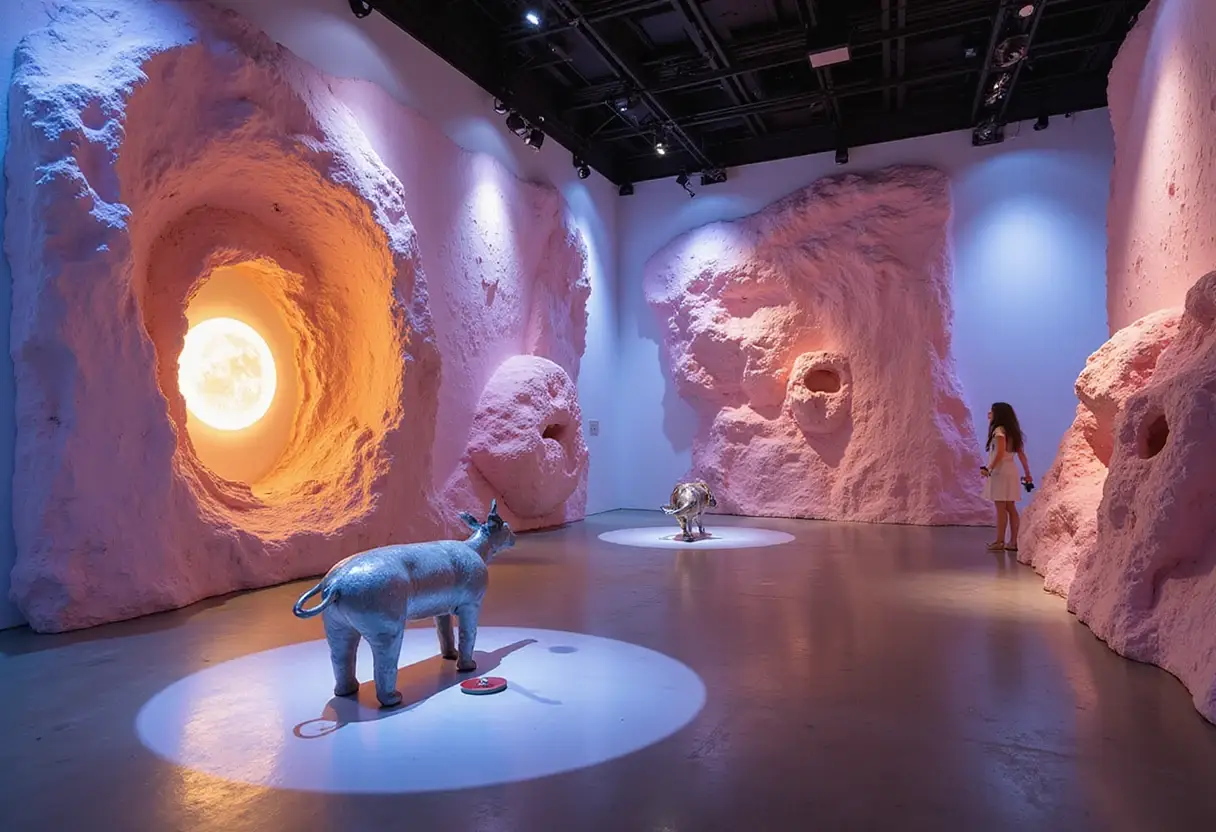
The surfaces range from olive green to warm amber and deep reddish brown. Light catches the thin skins while the curved framework stays visible underneath. One form folds around a large opening; another flares outward like an oversized sea creature's collar.
The exposed construction matters. You can read the relationship between skin and support rather than seeing a smooth shell that conceals how the object was assembled.
A material practice years in the making
Lohmann began exploring seaweed in 2007 and founded the Department of Seaweed in 2013, bringing together research, experimentation and making. The group's stated position is serious, despite the enjoyably bureaucratic name: seaweed-based alternatives only make sense when marine ecosystems and wild algae stocks come first. A renewable material still requires decisions about where it comes from and how it is grown.
That thinking has a track record. Lohmann's earlier Oki Naganode, installed at the Victoria and Albert Museum in 2013, used Japanese Naga seaweed treated to remain flexible, then stretched across a modular cane and aluminum framework. Seaweed can behave like a translucent covering with enough visual character to become the reason for an object's form. It doesn't need to impersonate injection-molded plastic to earn attention.
Sound, species and a warning about sourcing
Kelp Council adds a soundscape of rising and falling tides by Ville Aslak Raasakka and Lohmann, alongside seaweed species collected in Europe and East Asia. The sound connects the gallery objects to a setting beyond the gallery. The word "council" gives the gathering a theatrical premise: humans join a conversation whose other participants usually have no representation.
The strongest element of the project may be its caution. In a Wallpaper* interview, Lohmann warned against responding to seaweed's potential by simply harvesting more wild stock, which would create further problems for those habitats. Sourcing remains part of the design even after the sculpture is finished.
Can seaweed actually replace conventional materials?
Not yet, and the installation doesn't claim to. A compelling sculpture can't tell you what a mass-produced version would cost, how long it would last in a home, or what its full environmental footprint would be. Those answers need to exist before anyone calls seaweed a practical replacement.
As an exhibition piece, Kelp Council does a different job: making those questions feel worth asking. Its visible ribs and uneven colors suggest a design process willing to work with what makes seaweed distinctive — an approach that leaves the material's identity, and its origins, showing in the finished form.
Source: Yanko Design
More from Grace Kim
Show full bio
Staff writer covering money, funding and market shifts around construction industry, architecture, interior design at Built Current.
324 articles