Jialiang Guo's Ripple Light Screen Divides Rooms With Water-Current Shadows
Jialiang Guo's Ripple Light Screen suspends three illuminated panels above home workspaces, using CNC-routed wooden ribs and taut fabric to turn water-current patterns into shifting waves of light.
- Section
- Interiors
- Author
- By Priya Raman
- Filed
- Length
- 3 min read
Key takeaways
- The Ripple Light Screen is a three-panel suspended, illuminated spatial divider for residential workspaces
- Its pattern derives from fluid dynamics: water diverting around stones in a stream
- CNC-routed or steam-bent wooden contours sit proud of a taut fabric substrate
- Integrated warm, low-voltage light sources cast shadow gradients that shift with ambient daylight
- The prototype was submitted via designboom's DIY submissions feature
Designer Jialiang Guo has built a room divider that partitions space and lights it at the same time. The Ripple Light Screen is a suspended, three-panel prototype designed for residential workspaces, where the boundary between professional tasks and domestic routines is increasingly blurry.
Guo's concept is simple and physical: a divider that works as a luminaire. Each panel integrates low-voltage illumination with layered materials, so the screen does two jobs in one footprint. For home offices carved out of living rooms, that dual function is the pitch.
How does the screen produce its wave pattern?
The graphic language comes from fluid dynamics. Specifically, it references water diverting around stones in a stream. Across the three panels, concentric curves radiate from circular voids and resolve into continuous, undulating horizontal lines.
The construction gives those lines real depth. CNC-routed or steam-bent wooden contours (machine-cut or heat-shaped timber elements) sit mounted proud of a taut fabric substrate, producing a relief surface rather than a flat print.
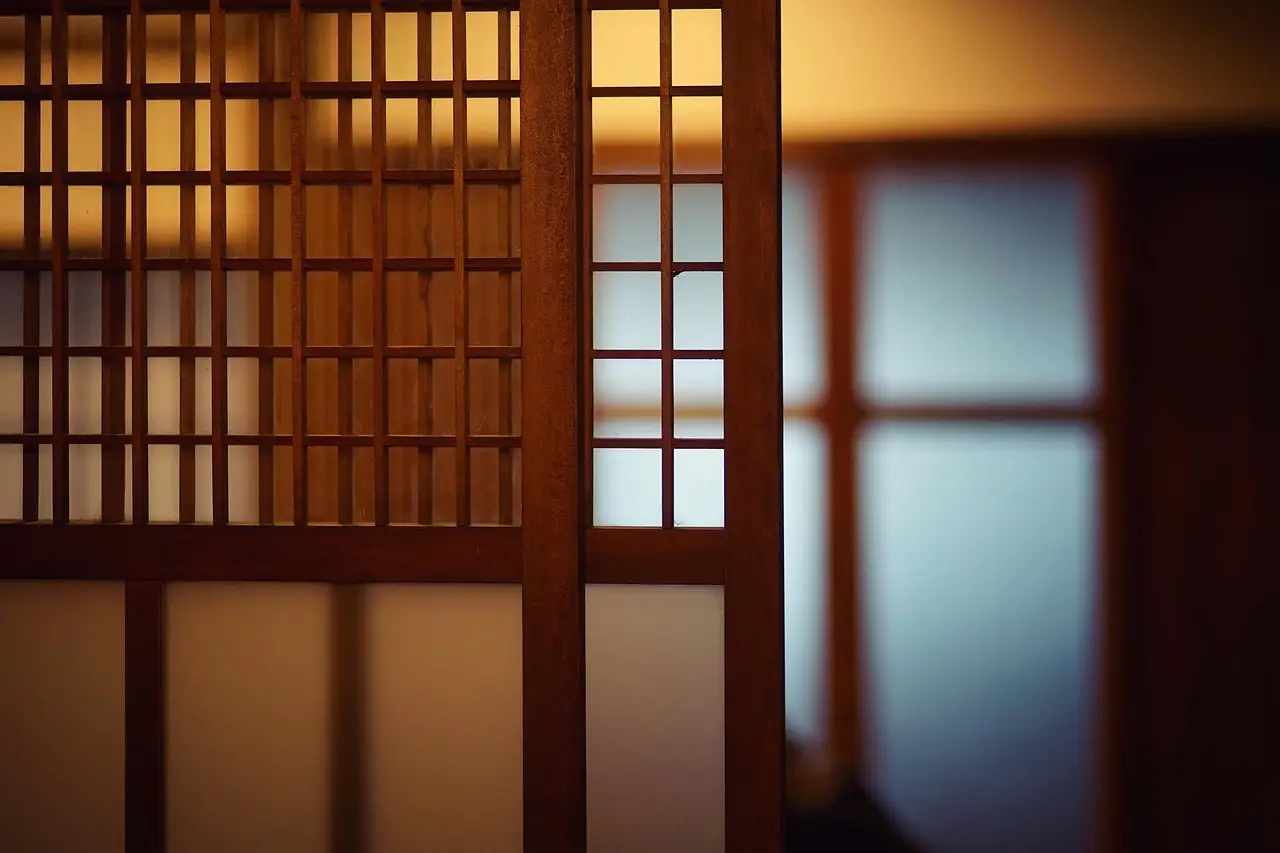
Light does the rest. Integrated warm sources cast grazing light across the wooden relief, projecting soft, overlapping shadow gradients onto the textile backing. Those shadows shift in intensity and contrast as ambient daylight changes through the day, meaning the screen's appearance is never static — morning sun reads differently from an overcast afternoon or an evening with the warm sources alone.
What does this change for the home workspace?
The prototype addresses a real spatial problem: how to separate a work zone from domestic life without building a wall and without losing light. Guo's answer is a permeable, luminous membrane. The circular voids keep sightlines partially open. The suspended format leaves the floor clear. And because the panels emit light themselves, the partition doubles as task-adjacent ambient lighting rather than casting the work zone into shadow.
The material logic is deliberately low-tech and legible:
- Structure: CNC-routed or steam-bent wooden ribs
- Backing: taut fabric substrate carrying the shadow gradients
- Lighting: integrated warm, low-voltage sources set to graze the relief
- Format: three suspended panels forming a tripartite assembly
Photography of the prototype shows the range of its effects. One detail image isolates the wooden edges and the shadows they throw across the fabric. Another shows the assembly in a brighter interior, revealing the wood grain and the full wave pattern. A wider shot places the screen above seating with a standing figure for scale, while an angled view documents the layered edge condition — wood, fabric and illuminated lower edge — that gives the screen its depth.
Guo presented the project through designboom's DIY submissions feature, where readers submit their own work for publication; more of Guo's work appears at jialiangguodesign.com and on Instagram as @jialiang_guo_design.
As a prototype, the Ripple Light Screen suggests a direction rather than a product: partitions that earn their footprint by lighting, texturing and softening the spaces they divide. Whether the CNC-routed and steam-bent ribs scale to production at an accessible price is the open question — but the core idea, a divider whose shadows change with the daylight, is already fully worked out.
Original: google.com
More from Priya Raman
Show full bio
News editor covering people, launches and day-to-day practice in construction industry, architecture, interior design at Built Current.
307 articles