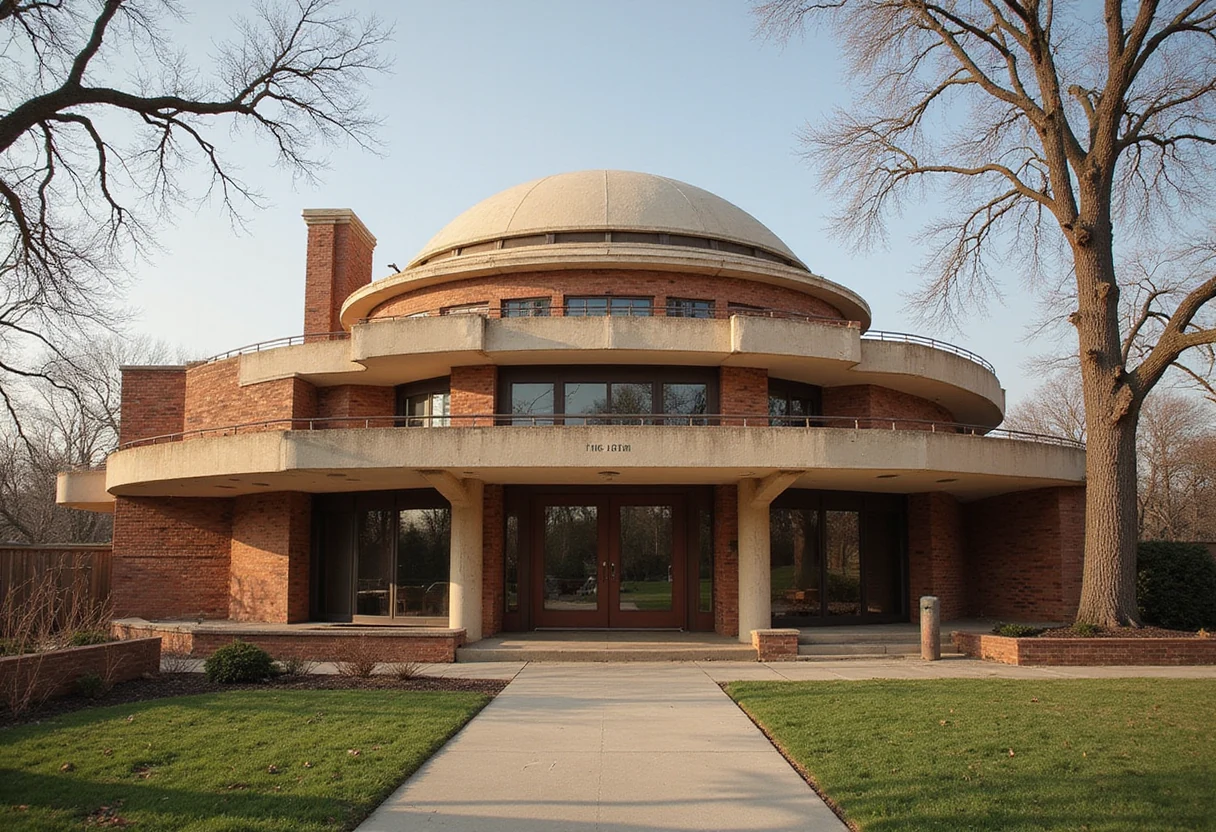
Florida Southern Restores Wright's Only Planetarium, Closed Since 2004
After a 21-year closure that began in 2004, Frank Lloyd Wright's only built planetarium has reopened at Florida Southern College. Crews replaced 280 hand-cast tiles and reinstated the original circular seating.
- Section
- Renovation & Retrofit
- Author
- By Amara Osei
- Filed
- Length
- 3 min read
Key takeaways
- Frank Lloyd Wright's only built planetarium reopened at Florida Southern College after a closure that started in 2004.
- Crews replaced 280 hand-cast 'textile' tiles during exterior work that began in 2021; interior work followed in 2023.
- FSC holds 13 Wright buildings constructed between 1938 and 1958, the world's largest single-site Wright collection.
- FSC has restored Wright buildings since 2007 under a Campus Heritage Plan backed by the J. Paul Getty Foundation.
- Wright's original circular plywood-and-vinyl seating was reinstated after removal of a 1980s computer closet.
By Amara Osei
Frank Lloyd Wright's only built planetarium has reopened at Florida Southern College, ending a stretch of darkness that began when the projection system failed in 2004. The structure, known simply as the Planetarium, anchors one end of the Polk County Science Building on the school's West Campus in Lakeland.
Twenty years dark. Then five years of work, and the room breathes again.
What did the restoration actually touch?
The team replaced the roof, flashings, failed stucco on upper façade portions, and 280 hand-cast "textile" tiles that ring the building's perimeter. Exterior work started in 2021. Interior work followed in 2023.
Inside, the crew stripped decades of additions. They pulled a 1980s computer closet that had eaten into Wright's original geometry. They repainted walls from deep blue back to a matched finish. They restored the floor in Cherokee Red.
The seating — Wright-designed plywood with colored vinyl upholstery — returned to its original circular orientation.
"The removal of the old computer closet retrieved the space as it was designed," said Jeff Baker, resident campus architect and a principal at MCWB Architects. "This removal allowed us to restore and reinstate all the seating in its original circular form, which we learned is a very rare survival in planetariums throughout the country."
Who led the work?
Baker has shepherded Wright's FSC buildings for twenty years. The Planetarium caps a longer campaign.
FSC holds the largest single-site collection of Frank Lloyd Wright architecture in the world. Thirteen Wright buildings rose on campus between 1938 and 1958. The college has been restoring them since 2007, following a Campus Heritage Plan prepared with J. Paul Getty Foundation support that year.
Prior rounds covered the Waterdome — Wright's largest built fountain — the Esplanades (monolithic covered walkways), and the towering Annie Pfieffer Chapel.
"Since the outset of these overall restoration efforts, the college was always looking for an opportunity to restore the Planetarium," Baker told Dezeen, "knowing full well its potential to excite and inspire audiences of all ages as they get a glimpse into the heavens and the great genius of Frank Lloyd Wright."
What made the building so hard to fix?
Wright's architecture, Baker explained, leaves nowhere to hide modern systems. "Frank Lloyd Wright spent his life conceiving architecture as a synthesis of art and structure. At Florida Southern College, this is manifested in buildings that are elemental – the concrete floors are the ceilings for the rooms below, the concrete ceiling is also the roof above."
Crews routed contemporary HVAC, audio, and projection into a building with "no 'poche' spaces." Audio and projection got full modern systems. The room keeps its bones.
Where does this sit in the Wright canon?
FSC is the only college Wright master-planned. FSC president Ludd Spivey commissioned the architect in 1938. The collection earned National Historic Landmark status in 2012. The Planetarium was dark from 2004 until this restoration. The rest of the campus has been getting steadily sharper since the 2007 plan laid the path.
The room now hosts campus tours and public screenings. If the rhythm holds, Baker's next twenty years probably mean a few more "original" interventions quietly erased.
Original: mcwb-arch.com
More from Amara Osei
Show full bio
Market editor covering companies, deals and strategy in construction industry, architecture, interior design at Built Current.
135 articles