ETH Zurich Teaches Robotic Hand to Walk on Its Fingertips
ETH Zurich's Soft Robotics Lab built an 818-gram autonomous hand that walks on its fingertips, recovers from falls and manipulates objects with no arm attached.
- Section
- Construction Tech
- Author
- By Marcus Bennett
- Filed
- Length
- 2 min read
Key takeaways
- ETH Zurich's Soft Robotics Lab built an autonomous five-fingered hand weighing 818 grams with 20 actuated joints that walks on its fingertips without any arm or legs.
- The hand moved untethered across 14 indoor and outdoor surfaces and righted itself in 21 of 25 trials after being placed on its side.
- Researchers trained locomotion policies with reinforcement learning in simulation before transferring them to the physical hand, which also pressed keyboard arrow keys with 29 of 32 correct hits.
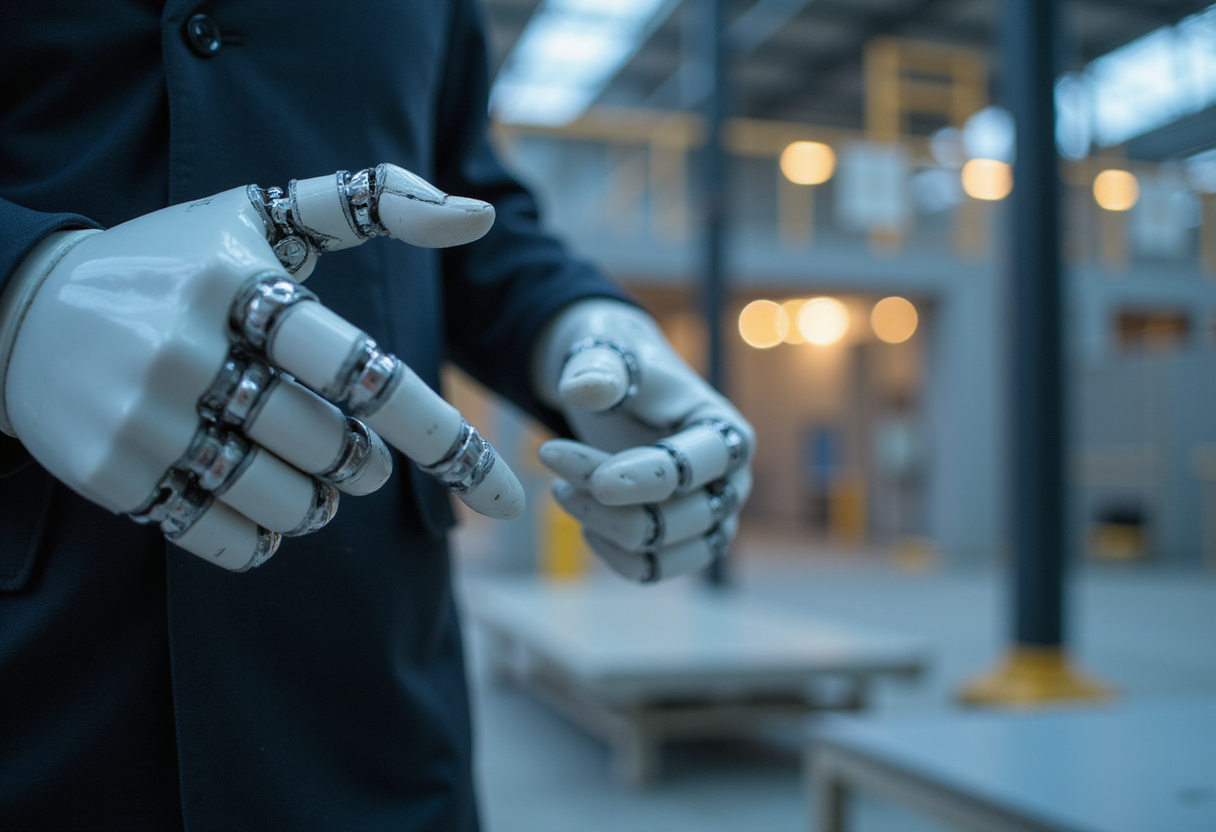
An autonomous robotic hand developed at ETH Zurich's Soft Robotics Lab walks on its own fingertips, steers itself, recovers from falls and manipulates objects — with no arm, wheels or legs attached. Researchers Amirhossein Kazemipour, Hehui Zheng and Robert K. Katzschmann turned the hand itself into a mobile robot, letting its fingers alternate between supporting, moving and manipulating its body.
The project, titled "Fingers as legs, Anthropomorphic hand," builds on a commercially available anthropomorphic hand with five fingers and 20 actuated joints — four per finger. The team added a compact onboard system containing a battery, sensors and computing hardware. The complete untethered robot weighs 818 grams.
The design brief sounds simple: use the fingers for locomotion instead of grasping alone. The execution is not. The five fingers have different geometries and ranges of motion, unlike a quadruped's legs, and the palm naturally sits at an angle. When one finger lifts off the ground to take a step or interact with an object, the remaining fingers must balance the robot's entire weight. The researchers addressed this asymmetry through reinforcement learning, training locomotion policies in simulation before transferring them to the physical hand.
From tabletop demo to gravel and asphalt
The results go well beyond a laboratory demonstration. ETH Zurich's hand moved untethered across 14 indoor and outdoor surfaces, including carpet, tile, metal grating, asphalt, grass, gravel and weathered stone. When researchers deliberately placed it on its side, the robot pushed itself back upright in 21 of 25 trials.
The fingers also switch between locomotion and manipulation on demand. In one experiment, the hand supported itself on some fingers while using others to press keyboard arrow keys, correctly hitting 29 of 32 targets. It then used those inputs to complete moves in the puzzle game Sokoban. In a further test, the hand approached and pushed a small object toward a target, demonstrating that walking and handling can run as part of one system.
The hand as its own end effector
This dual role is the point of the research. Conventional robotic hands arrive at a task attached to an arm, which in turn may need a larger mobile platform to move through space. Giving the end effector its own means of locomotion removes some of that hardware. The researchers envision a robot placing the hand near a narrow opening or confined workspace, letting it crawl independently toward a control or object, perform the required task and return to be collected.
Further development will require better onboard perception and a broader range of movement, according to the team. But the experiment already reframes a familiar piece of robotic anatomy: instead of designing another mechanism to carry the hand where it needs to go, ETH Zurich taught the fingers to take it there themselves.
Original: usys.ethz.ch