Dutch Traffic Barriers Recast as Benches at Dutch Design Week
Studio Martins Mezulis and 13_0663_tsx convert Dutch red-and-white aluminum traffic barriers into 'stop!', a bench and stool collection debuting at Dutch Design Week in Eindhoven.
- Section
- Urbanism & Planning
- Author
- By Marcus Bennett
- Filed
- Length
- 2 min read
Key takeaways
- The 'stop!' collection by Studio Martins Mezulis and 13_0663_tsx debuts at Dutch Design Week in Eindhoven, at Strijp-S Ketelhuisplein and Design Perron
- Each piece measures 450mm high, 1,250mm long and 500mm wide, built from road safety barriers and steel
- The design reinterprets the Dutch schrikhek, a standardized red-and-white aluminum traffic barrier used at construction zones
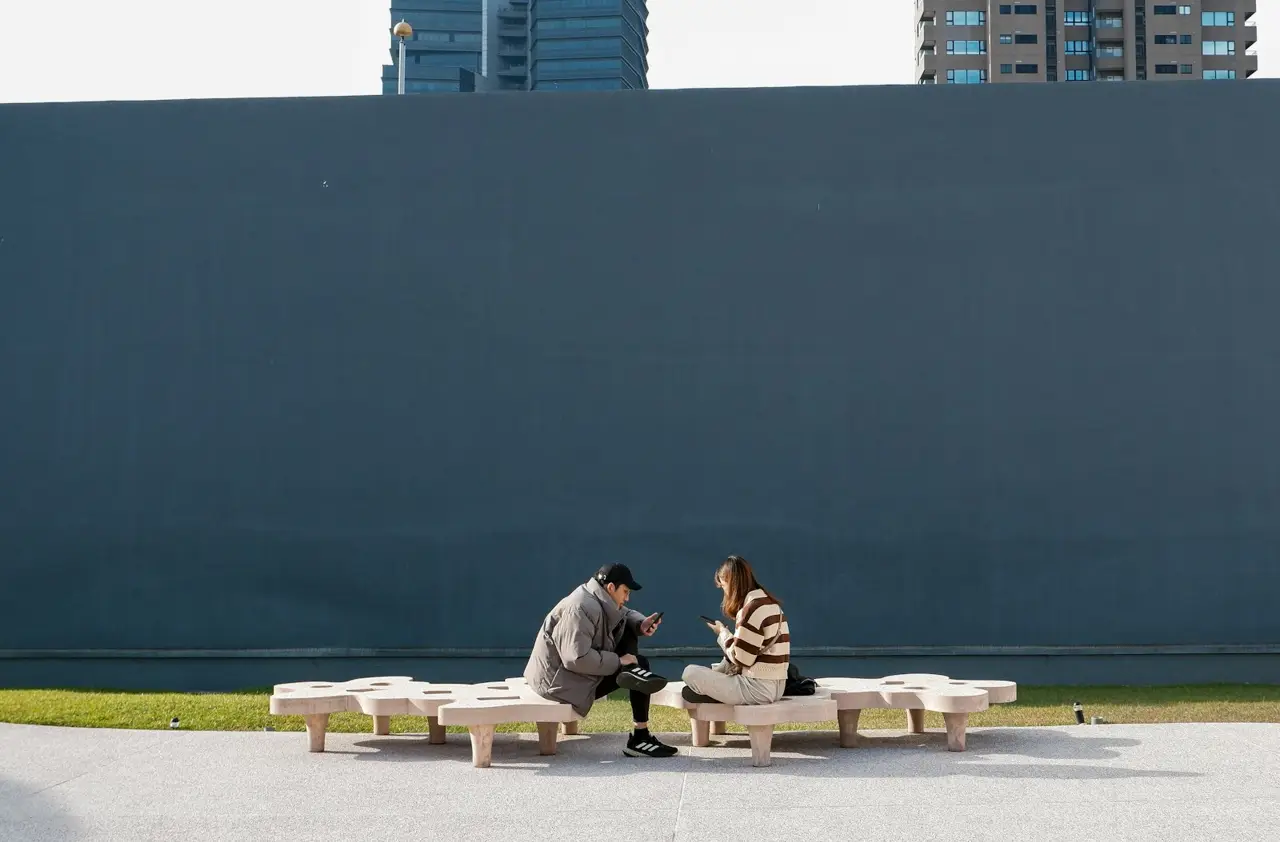
A red-and-white aluminum traffic barrier, the ubiquitous Dutch schrikhek that fences off construction zones, has been rebuilt as a bench. Studio Martins Mezulis and creative 13_0663_tsx present the 'stop!' collection of outdoor benches and stools at Dutch Design Week in Eindhoven, with installations at Strijp-S Ketelhuisplein and Design Perron.
The designers took the standardized barrier as their sole design reference. Across the Netherlands, these red-and-white aluminum structures signal construction sites and redirect pedestrians and cyclists. The collection inverts that job. Instead of diverting movement, the modified forms invite users to pause, sit, and gather.
What changes when a barrier becomes a bench?
The project reinterprets both the visual language and the material composition of traditional safety infrastructure. High-visibility striped aluminum panels, which normally read as prohibition, now read as invitation. The shift is functional, not just graphic: the reconfigured barriers serve a social rather than restrictive function in public space.
Each piece in the 'stop!' collection measures 450 millimeters in height, 1,250 millimeters in length, and 500 millimeters in width. The materials list is short: road safety barriers and steel. Nothing else. That economy matters for practitioners — the collection demonstrates how off-the-shelf safety components can be reconfigured into street furniture with minimal additional material.
Where to see it
The collection makes its public debut during Dutch Design Week in Eindhoven, the Netherlands. Two sites host the installations:
- Strijp-S Ketelhuisplein
- Design Perron
All images of the project are credited to Studio Martins Mezulis and 13_0663_tsx.
Why reuse utilitarian infrastructure?
By recontextualizing familiar temporary construction-zone barriers into seating, the project explores how utilitarian safety elements can support community interaction. The barrier carries decades of accumulated public recognition — every Dutch pedestrian knows what the red-and-white fence means. The designers bank on that recognition. A form trained to command attention now holds a person instead of stopping one.
For urban designers and municipalities, the proposition is concrete: standardized, mass-produced safety infrastructure already sits in inventories nationwide, and the 'stop!' collection suggests those same components can anchor gathering spaces rather than close them. The bench does what the barrier does — occupies the street, demands notice — but inverts its social register.
The debut at Dutch Design Week positions the work within the Netherlands' active conversation about adaptive reuse of infrastructure components. Whether the format scales beyond Eindhoven depends on how cities weigh furniture-grade durability against barrier-grade ubiquity; the collection's reliance on two materials and one familiar archetype keeps that door open.
Original: google.com
More from Marcus Bennett
Show full bio
Correspondent covering money, funding and market shifts around construction industry, architecture, interior design at Built Current.
159 articles