Apple Opens 600-Seat Music Hall Inside Battersea Power Station
Apple Music Hall, the company's first dedicated live-music venue, opens September 28 inside London's Battersea Power Station with 600 seats and broadcast-grade production facilities.
- Section
- Interiors
- Author
- By Marcus Bennett
- Filed
- Length
- 2 min read
Key takeaways
- Apple Music Hall holds 600 people and opens to the public on September 28 inside London's Battersea Power Station, beneath Apple's UK headquarters.
- The venue features a 48-speaker spatial audio system and 16 hardwired cameras — more than any other venue of its size, according to Apple — plus two professional-grade recording and mix studios.
- Kristina Raspe, Apple's vice president of Apple Places, led the in-house design, which retains heritage brickwork and adds four illuminated streamline-style arches and bronze balconies.
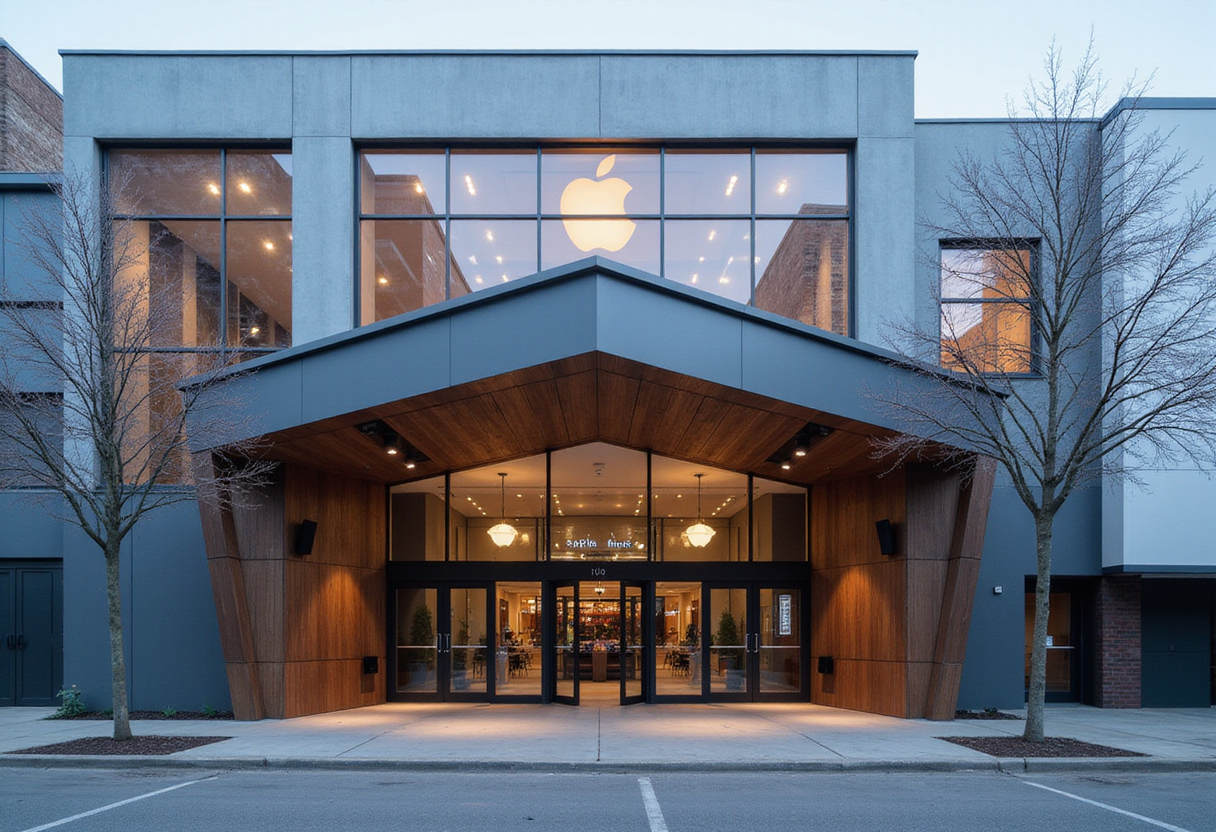
Apple has built its first dedicated live-music venue, and it holds only 600 people. Apple Music Hall sits inside Battersea Power Station in London, directly beneath the company's UK headquarters.
The venue opens to the public on September 28.
Apple designed the space in-house. Kristina Raspe, Apple's vice president of Apple Places, led the project — a signal that the company treated the venue as a product in its own right rather than handing it off to an outside design firm.
The capacity is deliberate. Apple built the hall for one-off, special shows where artists perform for a limited number of fans in an intimate setting. The room is fully reconfigurable: a show can be staged all-seated, all-standing, or a hybrid of the two, depending on what the artist wants that night.
Heritage fabric, left exposed
The design leans into the host building's industrial history rather than covering it up. Battersea Power Station is a decommissioned coal-fired plant from the 1930s, known for its dramatic Art Deco architecture and status as one of London's most beloved landmarks.
The venue's interior retains heritage brickwork and exposes structural steel joists that reference the building's industrial roots. Four illuminated, streamline-style arches sweep across the space, a nod to the power station's original Art Deco detailing. Bronze balconies sit between those arches like box seats, echoing the look of the building's historic oriel windows.
The foyer carries the same balance of old and new. It includes a seating area, a large screen, glass walls overlooking the Thames, and a staircase that ties the space together.
Built to broadcast
The venue's reach extends far beyond its four walls. Apple Music Hall comes equipped with a 48-speaker spatial audio sound system and 16 hardwired cameras — which Apple says is more than any other venue of its size anywhere in the world.
A full production facility is attached to the venue, including two professional-grade recording and mix studios. The setup allows an artist to perform a live show, record it in Spatial Audio, have it mixed to broadcast quality, and release it worldwide without leaving the building or bringing in outside equipment.
That combination — a 600-person room with arena-scale broadcast infrastructure — positions the hall as both a live venue and a content engine for Apple Music. Artists get an intimate room; the streaming audience gets a produced, spatial-audio version of the same night. Apple Music Hall won't replace the arena show, and it isn't trying to. But when the doors open on September 28, it will test whether a deliberately small room, wired for global broadcast, can become a new format for live music release.
Source: Yanko Design