Alexandre Arrechea's Orange Functional Turns a Park Sculpture Into a Basketball Court
A twenty-foot steel tree by Alexandre Arrechea, installed at Toronto's Biidaasige Park on the new Lassonde Art Trail, doubles as a functioning basketball court open to any visitor with a ball.
- Section
- Landscape & Public Space
- Author
- By Marcus Bennett
- Filed
- Length
- 3 min read
Key takeaways
- Orange Functional is a twenty-foot steel tree with working basketball hoops, installed this year at Biidaasige Park on Toronto's new Lassonde Art Trail.
- Arrechea first conceived the hoop-covered tree in 2010 as pure sculpture; a 2022 commission from Art Omi in upstate New York led him to reengineer the branches so real basketballs could drop through the nets.
- Art Omi describes the falling ball as evoking oranges dropping from a branch, which gives the work its title.
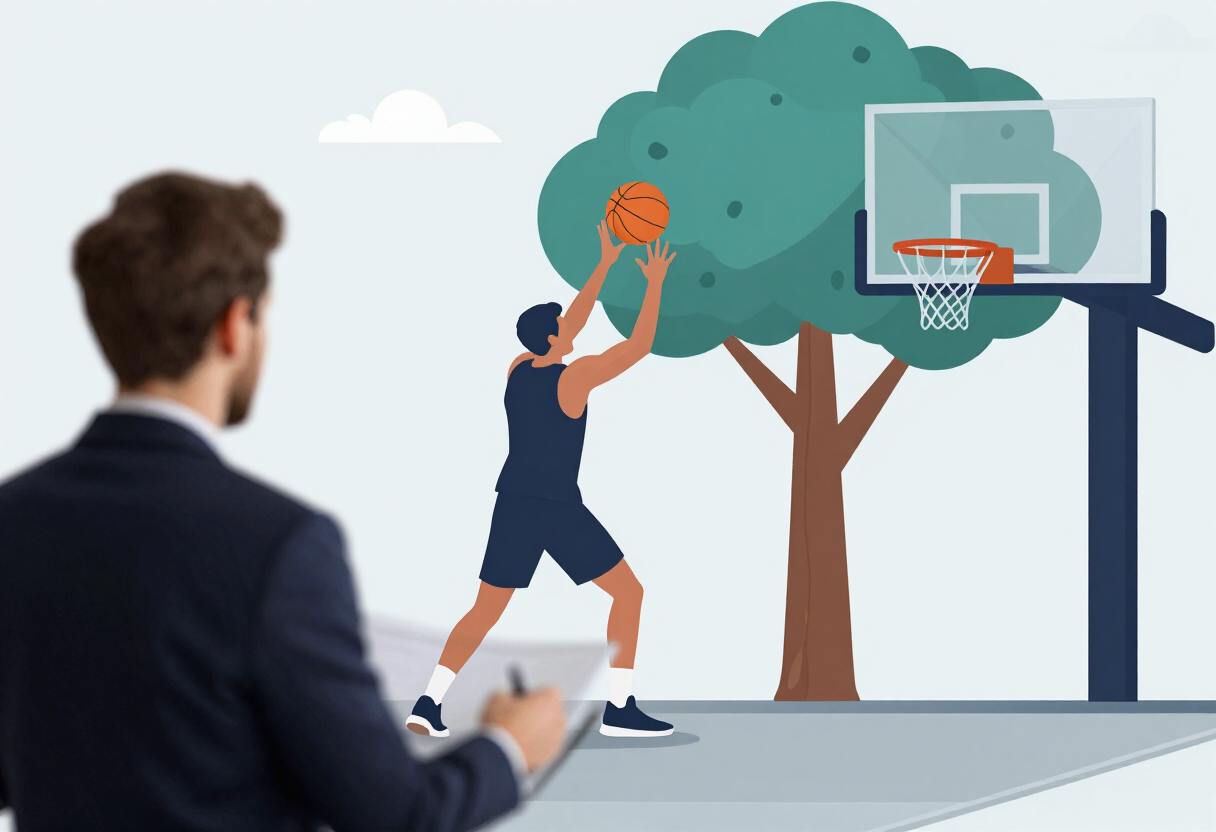
A twenty-foot steel tree with basketball hoops growing from its branches now stands at the entrance to Biidaasige Park in Toronto, and visitors are invited to bring a ball and start shooting. The sculpture, Alexandre Arrechea's Orange Functional, was installed this year as part of the city's new Lassonde Art Trail. It comes with no velvet rope and no "please do not touch" energy. Just a big red tree daring you to play.
The piece inverts the usual contract between public sculpture and its audience. Most public art asks you to look and keep walking: admire the bronze figure, read the plaque, snap a photo, move along. The art stays over there, behind an invisible line. According to the source, that gap between viewer and object is the quiet problem many city parks have never solved — they install expensive, meaningful work, then wonder why nobody lingers. Arrechea's answer is to remove the line entirely.
The concept took more than a decade to reach this form. Arrechea's archive traces the hoop-covered tree back to 2010, when it existed purely as sculpture — something to circle and photograph but never actually use. The turning point came with a 2022 commission from Art Omi in upstate New York, where he reengineered the branches so real basketballs could drop through the nets.
That reengineering marks a meaningful shift for an artist. Turning a static object into a functional one means giving up control. Once people can touch the work, they can also misuse it, argue about it, get bored of it. Arrechea made that trade anyway, and the piece is better for it.
What sells the design is how little it explains itself. A basketball hoop is one of the most recognizable objects in American and Canadian public life, sitting outside driveways, gyms, and rec centers everywhere. Arrechea doesn't reinvent it. He multiplies it until it stops reading as sports equipment and starts reading as something closer to a fruit tree. Art Omi's own description leans into that reading: as people throw the ball and it falls from hoop to grass, it evokes oranges dropping from a branch. The title does double duty, pairing the color with the idea of something actually working the way it looks like it shouldn't.
The curatorial placement may be the smartest decision in the whole project. The sculpture sits at the park entrance, next to newly planted real trees, not tucked into a sculpture garden where only people already looking for art will find it. It is the first thing visitors see walking in, competing for attention with the skyline behind it. A parent walking past with a kid carrying a basketball doesn't need to understand Arrechea's twenty-year interest in public gathering spaces to want to stop and shoot a few hoops. The concept sells itself in about four seconds.
There is a version of this idea that could have felt gimmicky — a photo-op sculpture built mainly for Instagram. Arrechea avoids that trap by making the interaction the entire point rather than an afterthought bolted onto a finished artwork. He has spent over two decades returning to the basketball court as a symbol, and this piece is where that research finally gets to be useful instead of just visible. You don't need the artist statement to enjoy it. You need a ball and about ninety seconds of patience while you figure out which branch to aim for.
Public art has a reputation problem in many cities: expensive, confusing, occasionally resented by the people who live near it. Orange Functional sidesteps all of that by refusing to be precious. It asks for nothing more than a basketball and a little curiosity, and it gives back an actual reason to stop walking — a rarer trade in public space than it should be. Whether the Lassonde Art Trail commissions more work in this participatory register will determine if Orange Functional stays a one-off or becomes a model.
Original: alexandrearrechea.com