KURA: Straw Walls and a 200-sqm Meadow Shape a Living Amphitheater
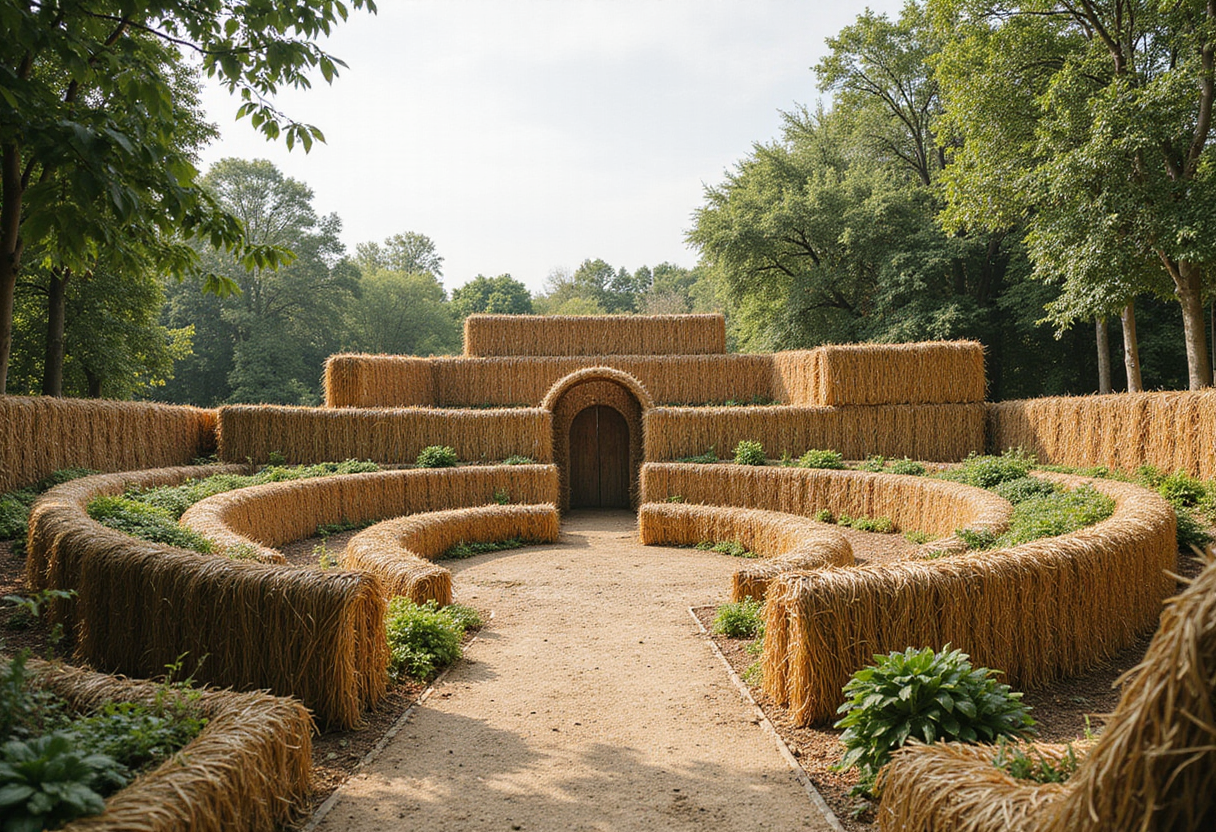
At La Nave Va in Berrocalejo, Studio Paisajeencontrado's KURA sets two curved straw walls around a 200-sqm meadow. The walls were seeded with native wildflowers at the spring equinox and feed seeds to a national germplasm bank.
- Section
- Landscape & Public Space
- Author
- By Elena Vasquez
- Filed
- Length
- 3 min read
Key takeaways
- Project KURA, designed by Studio Paisajeencontrado, sits at La Nave Va in Berrocalejo, Cáceres, Extremadura, Spain, with Andrey Brito as curator.
- Two curved straw walls frame a roughly 200-sqm meadow at the center of the installation.
- Native species — Centaurea cyanus, Papaver rhoeas, and Plantago lanceolata — were sown into the second wall at the spring equinox inauguration.
- Design team: Andrey Brito, Ismael Pizarro (landscape architect), Kmilo Morales, and Kika Goldstein (visual artists).
- Collected seeds are stored at the Plant Germplasm Bank 'César Gómez Campo' at the Polytechnic University of Madrid (BGV-UPM).
By Elena Vasquez
At La Nave Va in Berrocalejo, Cáceres, a roughly 200-square-meter meadow now anchors KURA, a new land art installation built from straw, earth, stones, and native seeds. Studio Paisajeencontrado designed the work; Andrey Brito curated it. The project is the latest commission at an open-air sculpture park in rural Extremadura.
Two curved straw walls run through the landscape, shaping an amphitheater, an experimental Mediterranean garden, and a walking path. The design team pairs landscape architect Ismael Pizarro with visual artists Kika Goldstein and Kmilo Morales.
Together, they route visitors along a narrow passage that opens onto a centuries-old olive tree and an old holm oak. The walls soften sound and keep temperatures more stable, the studio says, so the route reads as much through the body as the eye. The narrow passage alters how visitors register the surrounding landscape before the walls fan out into the meadow.
How do the straw walls work as living structures?
The second wall is a planted surface, not just a partition. At the spring equinox inauguration, participants sowed native wildflowers and grassland species — Centaurea cyanus, Papaver rhoeas, and Plantago lanceolata — directly into the straw. The equinox timing put the seeding at the start of the Mediterranean growing cycle, when native annuals germinate most reliably.
The surrounding meadow stays unmowed, so vegetation will gradually complete the amphitheater's semicircular form. In practice, the wall changes with the season. The straw holds moisture and seed; the meadow behind it fills in the geometry over a single growing season.
What happens on the 200-square-meter research plot?
At the center, the 200-sqm block is a working lab, not a showpiece. An ongoing program tracks germination, flowering, and fruiting of Mediterranean grassland species throughout the year. It tests different mowing methods, collects native seeds, and propagates them off-site.
Paisajeencontrado and its partners ship collected material to the Plant Germplasm Bank 'César Gómez Campo' at the Polytechnic University of Madrid (BGV-UPM). The bank supports wild plant genetic resource conservation and Mediterranean flora research, giving the local plot a national repository as its backup.
At 200 sqm, the field covers roughly the floor area of two typical suburban homes. That's small enough to cross in ten minutes and large enough to log meaningful germination data.
Why pair an artwork with a botanical program?
The studio frames KURA as both a piece and a working field, bringing artists, landscape practitioners, researchers, and local participants into the same site. The grounds host performances, photography sessions, and collective botanical activities, while materials and vegetation shift with the seasons. Through its spatial arrangement and ongoing ecological program, the installation connects visitors with the landscape's biodiversity, agricultural cycles, and rural knowledge, the studio says.
That dual function is the point. A straw wall is cheap to build, fast to seed, and disposable in a way concrete is not. If the project runs through several seed cycles, it could quietly become one of the more rigorous living-landscape experiments on display in rural Spain this year.
Original: paisajeencontrado.com
More from Elena Vasquez
Show full bio
Senior reporter covering money, funding and market shifts around construction industry, architecture, interior design at Built Current.
126 articles