Inaugural Pan-African Biennale Puts Africa's Own Voices on Display
Curator Omar Degan gathered all 54 African nations at Nairobi's Kenyatta International Conference Center for a biennale organized by climate, not colonial borders.
- Section
- Architecture
- Author
- By Elena Vasquez
- Filed
- Length
- 5 min read
Key takeaways
- The inaugural Pan-African Biennale ran September 7–11 at the Kenyatta International Conference Center, a 1973 Nairobi building by David Mutiso and Karl Henrik Nøstvik.
- Curator Omar Degan grouped the 54 national contributions by climatic region rather than colonial borders, challenging boundaries drawn during the Scramble for Africa (1880–1914).
- The Van Alen Institute reactivated its Paris Prize as the Re:Paris Prize; inaugural Africa-based winners are Arafa C. Hamadi and Bled el Abar Collective, with U.S. applicants to be selected in December.
"The rest of the world has long narrated African stories," said Omar Degan, curator of the inaugural Pan-African Biennale, which ran September 7–11 in Nairobi, Kenya. "To have this space on the continent allows us to own the narrative of what's happening, and no longer be the recipient of someone else's words. A lot of things get lost in translation. Things can be manipulated. This [the biennale] allows architects to say what they want and own their own work."
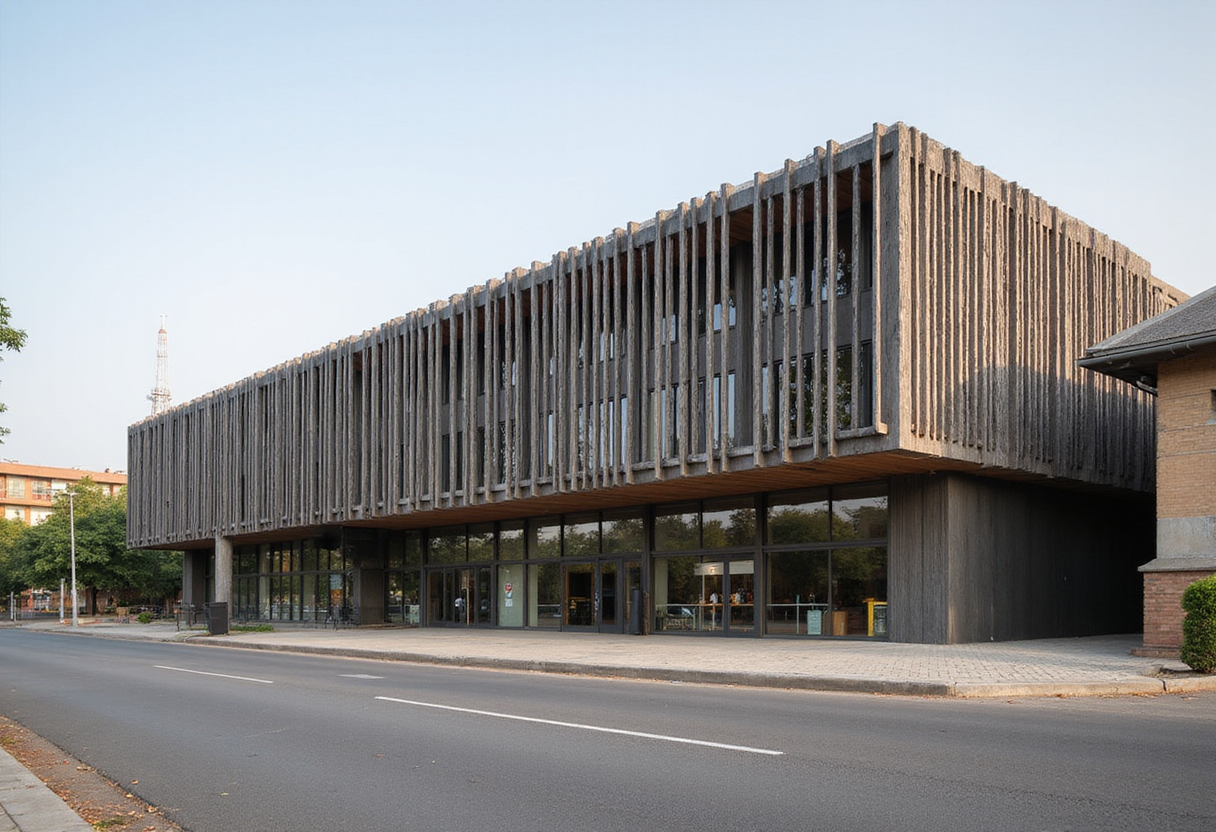
Degan, a Somali architect based in Milan, staged the biennale at the Kenyatta International Conference Center, a 1973 building in the heart of Nairobi designed by architects David Mutiso and Karl Henrik Nøstvik. The exhibition, titled Shifting the Center: From Fragility to Resilience, presented contributions from all 54 African nations alongside voices from the diaspora. Students traveled from across the continent and from Colombia, Singapore, and the U.S.
Demand exceeded capacity. "The environment was so positive. The energy was great," Degan said. "The talks were packed. Workshops sold out in a day. Part of my regret is not having enough capacity. The opening was extraordinary, full of colors."
A Roster Spanning the Continent
Participants ranged from established firms to emerging collectives. Djamel Klouche represented Algeria; Banga Coletivo represented Angola; Larry Tchogninou, Olufemi Hinson Yovo, and Armel Sagbohan represented Benin; Moralo Designs represented Botswana; and Association La Voûte Nubienne represented Burkina Faso. Others included Hive Earth (Ghana), MASS Design Group (Rwanda), Worofila (Senegal), Lemon Pebble (South Africa), Daar Studio (Somalia), Studio Ola Hassanain (Sudan), NANA Collective Studio (Nigeria), Raas Architects (Ethiopia), Aboubakar Fofana (Mali), Joan Razafimaharo (Madagascar), and Craig Muyambo (Zimbabwe), among many more.
The event doubled as a long-overdue meeting ground. "So many people met that had been in touch [digitally] but never in person," Degan said. "The most amazing thing was that the exhibition gave people the opportunity to come together, meet, and discuss."
A comradely ethos defined the installation process. "The mutual support was amazing. After the Ethiopian team installed their space, they helped the Benian team finish theirs," Degan said. "I saw a lot of collaborative moments that demonstrate the spirit of the biennale."
An Anti-Colonial Hanging
Degan and his team rejected geographic proximity as an organizing principle. Instead, they grouped exhibitions by climatic region. Libya sat near Mali; Senegal, Somalia, and Nigeria shared proximity. The goal, Degan said, was to challenge borders violently imposed upon the continent by Europe during the Scramble for Africa (1880–1914). "We didn't consider borders," Degan said.
"There's an 'Africa in Africa' but also outside Africa in Brazil, New York, the U.K. In the geopolitical climate today where diversity is fought, I think what we have [at the biennale] might be utopian," Degan continued. "By unleashing what's happening on the continent, people have the opportunity to see one another, and what's possible."
The biennale also countered a persistent curatorial habit in the Global North, where exhibitions about African art and architecture cluster around colonization and post-colonization. Few, Degan noted, address the contemporary continent.
"Africa emits a low amount of carbon relative to the rest of the world, but houses a vast amount of the world's population," Degan said. "This makes it a ground to learn from. Within constraints, African architects create resilient strategies that can be deployed around the world. New practices here bridge old and futuristic techniques."
New York in Nairobi
Several U.S.-based architects and educators attended, including Hayley Eber and Andrew Brown of the Van Alen Institute; Jerome Haferd, a practicing architect and educator at CUNY Spitzer; Mark Gardner, AIA New York president who also teaches at The New School; and The Cooper Union's Nora Akawi.
Haferd described "an incredible youthful energy to the Biennale, paired with robust and rare intergenerational, international discourse."
"The Pan-African Biennale shows the world what African designers have known for a long time: that Africa is, and has always been, a thriving center of architectural and urbanist discourse," Brown said.
The Re:Paris Prize
The Van Alen Institute partnered with Degan to re-activate its lauded Paris Prize for the occasion. The award is now the Re:Paris Prize, reshaped to support design and research on the African continent. The inaugural Africa-based winners are Arafa C. Hamadi and Bled el Abar Collective.
Hamadi's project, Who Designs Knowledge?, will challenge western museal aesthetics and ask "how exhibition design can instead become a tool for building narrative spaces rooted in African aesthetic and material cultures." Bled el Abar Collective will map oases, tents, wells, and other "places of hospitality" in the North African Sahara as sites of "resistance against colonial legacies, the authority of nation-states, and extractive economic system," per a project statement.
Calls for U.S. applicants to the Re:Paris Prize are now open; the winner will be selected in December.
"Partnering with the Pan-African Biennale gave us incredible reach to a group of extraordinarily talented designers we'd never previously had access to or a connection with," Eber said. "Through this collaboration, we were able to reach a cohort across the continent doing critical, impactful work. We look forward to using Van Alen's platform and resources to help recenter that work and give it the visibility it deserves."
Brown framed the stakes for the institution itself: "Through both the Re:Paris Prize and our partnership with the Biennale, Van Alen hopes to promote designers and ideas that have too often been relegated to the periphery, while also coming to terms with our own history of bias and exclusion."
Source: The Architect's Newspaper